The short answer
Buy for your largest ornaments, not your most numerous. Every box on this page is built around a 3-inch cube, and a 3-inch cube is the wrong size for the pieces you actually care about — the finial, the hand-painted one, the one from your grandmother. Adjustable dividers solve that; a fixed grid does not. That is why the Simple Houseware box is first here despite holding the same nominal 128.
The 3-inch cube, and why it is the whole story
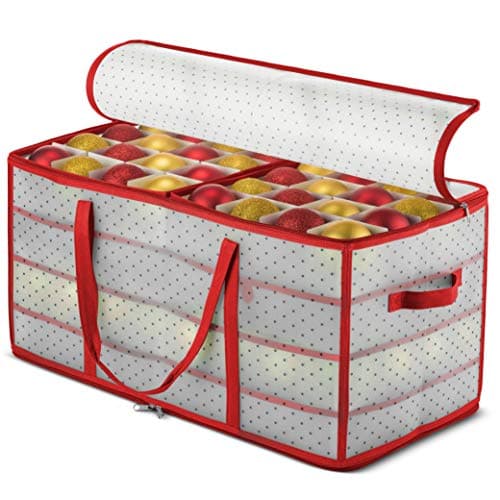
Ornament boxes are advertised by capacity: 64, 128, 200. That number is only meaningful alongside a second number the good listings publish and the poor ones do not — the compartment size. Every box in this ranking is built on a 3-inch cube. Three inches is a sensible default, because a standard glass ball is 2.5 to 3 inches across and there are a lot of them in most collections.
The problem is what happens at the edges of a collection. A 4-inch ball does not fit. A 6-inch finial does not fit. A ceramic house, a beaded icicle, anything the tree topper family belongs to — none of it fits. In a fixed-grid box those pieces have nowhere to go, so they end up loose in a carrier bag beside the box, which is where they break.
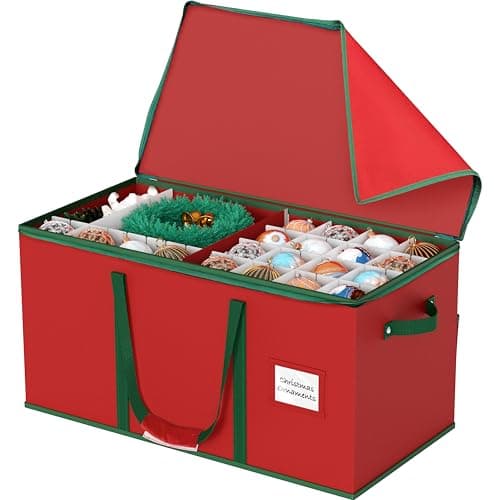
A box with interlocking dividers fixes this by construction rather than by luck. The Simple Houseware publishes 48 dividers with 7 slots each. Pull two out and four 3-inch bays become one 6 by 6 inch bay. You lose three slots of capacity and gain a home for the ornament you would actually miss. That trade is the single most useful thing a box in this category can offer, and it is why we rank an adjustable 128 above a fixed 128. The default 128 box is reviewed on its own specifications on the Zober 128 review, and the two TreeKeeper boxes that publish a 4-inch tray height are compared on telescoping versus Deluxe.
How many boxes you actually need
Count your collection by size class before you buy anything. Most people are surprised by the answer, because the oversized minority eats capacity out of proportion to its number. Here is the arithmetic on a fairly ordinary mixed collection, using published compartment sizes.
Slots consumed by ornament size in a 3-inch grid with adjustable dividers| Ornament size | Example | Slots consumed each |
|---|
| Under 3 in | Standard glass ball | 1 |
| 3-4 in | Large ball, small figurine | 2 |
| 4-6 in | Ceramic house, beaded drop | 4 |
| 6-9 in | Finial, small tree topper | 6-9 |
| Over 9 in | Large topper | Store separately |
Run your own count through that and a collection of 90 ornaments frequently needs 128 slots rather than 96. Twelve large pieces at four slots each is 48 slots gone before the balls are packed. The full working, including how the numbers change between a fixed and an adjustable box, is on ornament storage by capacity. The same arithmetic is why the biggest box is usually the cheapest per ornament, and what the bottom of the range leaves off the listing is on cheap ornament storage.
Three shapes, and the right one is decided by where the box lives rather than by what is in it.
The long box — roughly 26 by 13 by 13 inches — holds the most per container and needs 26 inches of clear shelf. It is the standard 128 format. None of these three shapes suits ornaments kept in their original boxes, which is a different problem with a different answer: storing Keepsake ornaments in their boxes.
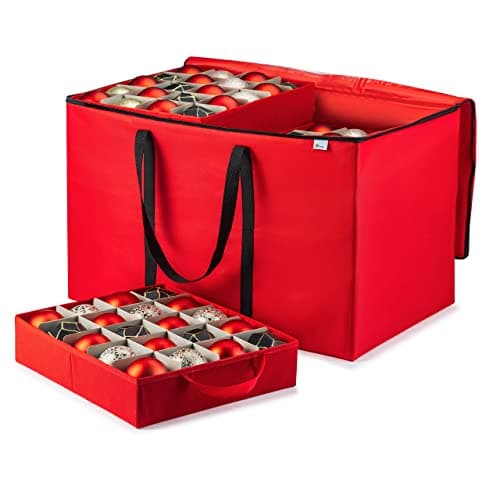
The cube — about 13 inches on each side — holds 64 and fits a normal closet shelf. Two cubes cost more than one long box for the same ornaments, and each one is half the weight. If the box goes up a ladder, that is worth paying for.
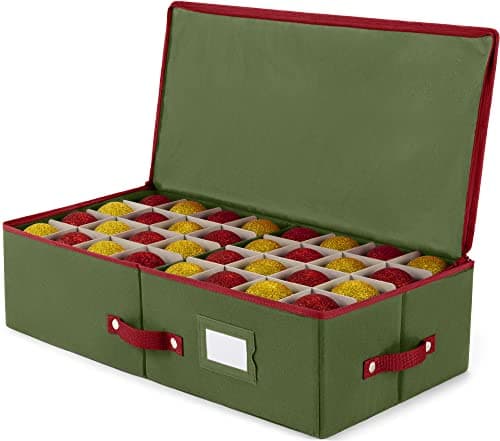
The under-bed box is the same 64 capacity flattened to 6.6 inches tall. It exists because apartments have no attic and no garage, and the space under a bed is the only unused volume left. One layer only, by definition, so tall ornaments are out of scope.
Which one suits your collection is worked through in dividers versus trays, and the awkward pieces get their own page at odd-shaped and oversized ornaments. If the only space you have is the gap under a bed, the clearance arithmetic is on under-bed ornament storage.
The parts that come off the tree with the ornaments — hooks, the topper, spare bulbs, batteries — are worth five minutes of their own, because they are what slows December down. That system is on storing ornament hooks, toppers and small parts.
What actually breaks ornaments in storage
Not the fall. Falls happen, but they are rare and dramatic and everyone already protects against them. Three quieter things cause most of the damage.
Contact. Two glass balls touching each other in a soft-sided container will chip. This is what a compartment prevents, and it is the reason a divided box beats a tote full of tissue paper even though the tissue feels more protective.
Compression. A fabric-lidded box on the bottom of a stack takes the weight of everything above it through the lid. Rigid-walled boxes and a stacking order that puts the ornaments on top solve this for free.
Ink and residue. Newspaper transfers onto painted and gilded surfaces over ten months. Unprinted tissue or plain paper towel does not. This one costs nothing to get right and is irreversible if you get it wrong. Over decades the box itself does the same thing more slowly, which is what an acid-free claim addresses — the boxes that publish one are ranked on cardboard and acid-free ornament storage. The full method is at storing fragile and glass ornaments and the general procedure at how to store Christmas ornaments.
Why a rigid outer bin is often the real answer
Most ornament boxes are fabric over cardboard inserts. That is fine on a shelf and vulnerable on a garage floor, where things get stacked and moisture rises. The cheapest upgrade is not a better ornament box, it is putting the ornament box inside a rigid latching bin.
The interior height figures matter here. A Sterilite 66 qt ClearView publishes 12 7/8 inches of interior height at the bottom, and a 12.9-inch Zober cube is just over that — which is exactly the kind of near-miss that published numbers let you catch before you buy. The 27-gallon Stacker publishes 18 7/8 inches inside and takes it comfortably. Full figures in storage bins and totes. Make that outer bin a wheeled one and you have the cheap version of a rolling ornament chest, compared on ornament storage on wheels.
The obvious alternative — buy a hard plastic box instead — turns out to be harder than it sounds, because in this category the word plastic usually describes the trays rather than the shell. Which listings actually state a rigid shell, and what rigidity costs in capacity, is on hard-plastic ornament storage.
How we ranked these
On published compartment size, published capacity, whether the dividers adjust, the material of the box and inserts, and whether one person can carry it loaded. We have not tested any of them and we do not own any of them. What we did instead is at how we pick.
Questions people ask
- How many ornaments does a 128-compartment box actually hold?
- 128, if every ornament is 3 inches across or smaller. That is the catch in the number. The published compartment size on both 128-slot boxes here is a 3-inch cube, so a 3.5-inch ball does not go in at all, and a large finial or a figurine occupies several bays. Count your ornaments by size, not in total: our capacity page does the arithmetic for a realistic mixed collection.
- Are adjustable dividers worth it over a fixed grid?
- Yes, if any part of your collection is not a uniform 3-inch ball, which is almost every collection. The Simple Houseware box publishes 48 interlocking dividers with 7 slots each, so you pull two dividers and turn four 3-inch bays into one 6 by 6 inch bay for the tree topper. A fixed grid gives you no way to do that, and the oversized pieces end up loose in a shopping bag, which is how they break.
- What is the safest way to store glass ornaments?
- One ornament per compartment, hooks removed, in a rigid-walled box that is never the bottom of a stack. The compartment is doing the work: it stops ornaments touching each other, which is the only way glass breaks in storage that is not a drop. Wrap only the ones with painted or gilded surfaces, and use unprinted tissue rather than newspaper, because newsprint ink transfers onto paint. Full method on our fragile and glass ornaments guide.
- Can ornament boxes go in an attic?
- Physically yes, and it is where most people put them. The risk is not the box, it is the temperature swing: an unconditioned attic can cycle through a very wide range across a year, and repeated expansion and contraction is what loosens glued joints and crazes old paint. If you have a conditioned space, heirloom ornaments belong there and the tinsel garland can take the attic. We compare the three locations honestly in attic versus garage versus basement.
- Should I keep the ornaments in their original boxes?
- If they came in fitted boxes, yes, and then put those boxes inside a divided container. A fitted manufacturer box is better protection than any general-purpose compartment because it was molded around that specific shape. What you should not do is stack loose original boxes in a tote, because cardboard corners collapse under weight and then the ornament inside is unsupported.
- How do I stop the hooks scratching everything?
- Take them off and store them separately. Hooks left in ornaments end up loose in the bottom of the box, and a loose wire hook against a painted glass surface for ten months will find the paint. The Simple Houseware box publishes two rear pockets, which is exactly the right place for a bag of hooks. A small zip bag in the corner of any box does the same job.
Top pick on this page: Simple Houseware Heavy-Duty Ornament Storage Box (128). Capacity: 128 x 3 in.