The short answer
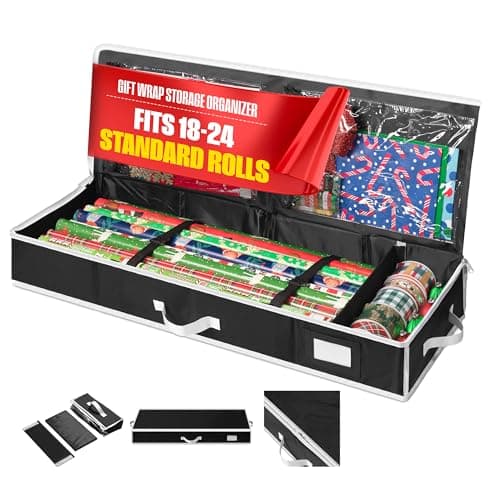
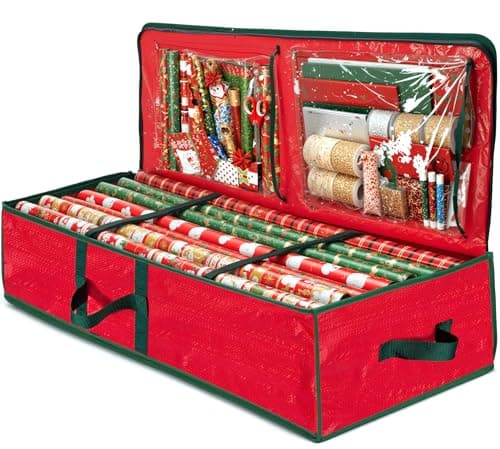
Measure your longest roll before you buy anything. Christmas rolls are commonly 40 inches; everyday rolls are commonly 30. A container has to publish an interior length greater than your longest roll, and most of them do not publish an interior length at all. The two picks at the top of this page publish 40.5 and 40.25 inches, which is why they are at the top.
The 40-inch problem
Wrapping paper is not sold in one length. The rolls the big-box stores stack up in November are frequently 40 inches. The rolls sold year-round for birthdays are frequently 30. Almost every storage container in this category is sized for the 30, and almost every buyer discovers this after the container arrives.
Two and a half inches decides it. A rigid under-bed box like the Sterilite 66 qt Ultra publishes 39 1/2 inches outside and 37 3/8 inches inside — a good box, and 2 5/8 inches short of a 40-inch roll. The lid will not go on. A fabric bag publishing 40.5 inches takes it with half an inch to spare.
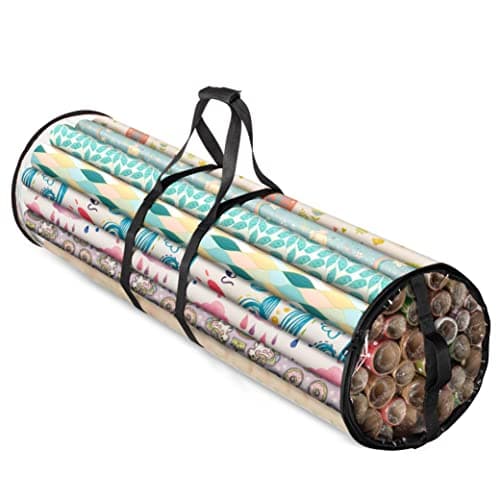
That half inch is not much either. A roll that has been leaned in a corner develops a slight bow, and a bowed 40-inch roll needs more than 40.5 inches of straight run. If your rolls are genuinely at the maximum, buy the longest container you can find rather than the closest fit. The full comparison, including what to do when nothing fits, is on storage for long wrapping paper rolls.
Roll length to container length
What each common roll length needs from a container's published interior dimension| Roll length | Where it comes from | Minimum interior length |
|---|
| 30 in | Standard year-round roll | 32 in |
| 32-36 in | Larger everyday rolls | 38 in |
| 40 in | Common Christmas roll | 41 in |
| Over 40 in | Jumbo and craft rolls | Upright storage only |
The right-hand column adds working slack, the same way the tree-bag table does. A container whose published interior exactly equals your roll is a container you will fight with every year.
Flat, upright, or on a cart
Flat under a bed is the default and the most space-efficient, because it uses volume nothing else wants. The trade is the crease: a roll lying on its side for ten months rests along a single line, and paper takes a set. Rotating the rolls a quarter-turn when you put them away is a free mitigation nobody does.
Upright is better for the paper and worse for your space. The roll rests on its end, so no crease forms. You need 40 inches of clear height in a closet, and the rolls become impossible to identify because you are looking at forty circular ends.
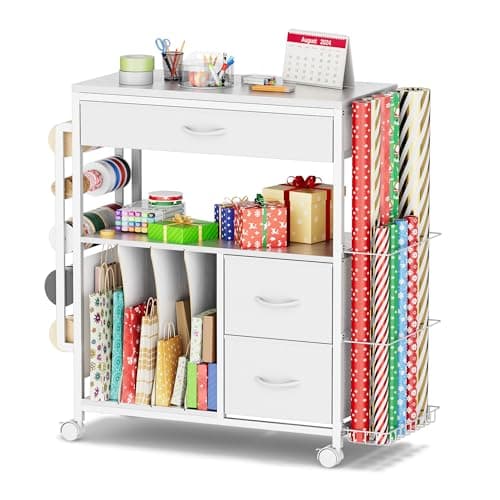
A cart is upright storage with wheels and access. It is the right answer for someone who wraps constantly and the wrong answer for someone who wraps in the third week of December. We compare the formats in detail on wrap cart versus under-bed bag, and the one rigid plastic organizer in a category of fabric is reviewed on the Rubbermaid Wrap N' Craft review, and once that is settled the carts themselves are ranked on published roll capacity and frame height on the best wrapping paper storage carts. If what you actually want is the whole workstation rather than a cart — a surface, the roll storage, somewhere for the ribbon and a tool pocket — the four formats are compared on how to set up a gift wrapping station.
Capacity, stated honestly
“Holds 20 rolls” is not a specification, because it does not say how thick those rolls are. A cheap thin roll and a heavyweight foil roll differ by an inch in diameter, and across twenty rolls that is nearly two feet of width.
Zober is the only maker in this set that publishes capacity against thickness: up to 18 rolls at 2.5 inches, or up to 25 at 1.5. That is a number you can check against the rolls in your own closet. Everyone else states a single figure and leaves you to find out.
If you are working out how much you need, count your rolls by diameter rather than by number, exactly the way we count ornaments by size rather than by total on the ornament storage page. The same principle keeps coming up: the advertised capacity is real, and it applies to a shape of load you may not have. At the bottom of the range the figure that goes missing is the roll length itself, and the budget organizers that still state one are on cheap wrapping paper storage.
Ribbon, bows, tape and the bags
Wrapping paper is the bulky part of the problem and not the annoying part. The annoying part is everything else: ribbon spools that unwind, bows that crush flat and never recover, tape that has migrated to another room, gift tags in three places.
Interior pockets are what separate an organizer from a bag, and they are worth more than an extra two rolls of capacity. The Zober and the Handy Laundry both publish interior pocket storage; that is where the tape and the scissors live, which is the difference between finding them next December and buying more. Bows go in last and on top, never underneath, because a crushed bow does not come back. The whole mixed load is worked through on storing ribbon, bows and gift bags.
When there is no space at all
Under a bed, behind a door, on the back of a closet door, flat on top of a wardrobe. Wrap storage is unusually good at fitting into leftover space because the load is long and thin, which is a shape most storage does not want. The trade-offs for each are on wrap storage for small spaces, and the general packing method is at how to store wrapping paper rolls. If the leftover space you have is vertical rather than horizontal — the back of a door, the corner of a closet — hanging and upright wrap storage compares those formats on published roll capacity.
How we ranked these
Published interior length first, because it is the number that decides the purchase. Then published capacity against roll thickness, stated material, whether it fits the space it is designed for, and whether the construction survives being dragged out from under a bed repeatedly. No testing, no ownership, no handling. The method is at how we pick.
Questions people ask
- What fits a 40-inch roll of wrapping paper?
- A container with at least 40.25 inches of published interior length, and there are far fewer of them than the category suggests. The Zober under-bed organizer publishes 40.5 inches and the Handy Laundry publishes 40.25 inches. Rigid under-bed boxes generally do not: the Sterilite 66 qt Ultra, which is one of the longest, publishes 37 3/8 inches inside, which is two and five-eighths inches short.
- Is it better to store wrapping paper flat or upright?
- Upright, if you have somewhere to stand it. A roll stored on its side rests on one line of contact for ten months and that line becomes a crease down the middle of the sheet. Upright storage puts the weight on the roll's end. Flat storage wins on space, because upright storage needs 40 inches of height in a closet, which most people do not have to spare.
- How many rolls fit in an under-bed wrap organizer?
- Between 18 and 25 depending on roll thickness, and Zober is the only maker here that publishes it that way: up to 18 rolls at 2.5 inches thick, or up to 25 at 1.5 inches. That is the honest version of the number. A capacity stated as a single figure assumes a roll thickness the maker has not told you.
- Where should I store gift bags and tissue paper?
- Flat, in the same container as the rolls if it has interior pockets, or in a shallow rigid box if it does not. Gift bags are the item most likely to be crushed, because they are the last thing packed and the first thing to be squashed against the lid. Flattening them and laying them under the rolls rather than on top solves it. We cover the whole mixed load on our ribbon, bows and gift bags page.
- Does wrapping paper go bad in storage?
- It does not spoil, but it fades and it curls. Sunlight is what fades it, so a clear container in a sunny room is the wrong choice for paper even though it is the right choice for finding things. Humidity is what makes it curl and makes the edges soften. A closet interior is better than a garage for both reasons.
- Are the rolling wrap carts worth it?
- Only if you wrap year-round. A cart holds a fraction of what a 40-inch bag takes and occupies floor space in January through October for a job most people do in one week of December. If you run a small shop, or wrap birthdays constantly, the accessibility is genuinely worth the footprint. If Christmas is the whole use case, it is not.
Top pick on this page: Zober Underbed Gift Wrap Organizer (40 in). Organizer dimensions: 40.5 x 14 x 6 in.