The short answer
Count your strands, then count your reels. Tangling happens when two strands share a space, so the number that matters is not total capacity, it is how many separate reels a container gives you and how many feet each one takes. Three reels at 80 feet suits a house with three long runs. Four at 60 feet suits a house with four short ones. Buy the shape of your lighting, not the biggest number.
One strand per reel, and the rest is detail
A single strand of lights, on its own, cannot tangle. It can coil, it can kink, it can knot loosely, but the two-hour January morning with a ball of wire on the living room floor requires at least two strands sharing a container.
Everything in this category is a way of enforcing one-strand-per-space. Reels do it best because the strand is physically wound and cannot migrate. Cord wraps — flat cards with notches — do it adequately for short strands. Winding a strand around your arm and dropping it in a tote does not do it at all, which is why that method produces the ball of wire.
Before you buy: walk the house and write down each run and its length. Tree, mantel, two windows, porch rail, eaves. That list, with a length beside each entry, tells you exactly how many reels you need and how long each has to be. It takes five minutes and it is the only sizing work this category requires. The full method is on light storage by strand count.
Reel capacity against real runs
Typical run lengths and the published per-reel capacity that covers them| Run | Typical length | Reel needed |
|---|
| Indoor tree, 7.5 ft | 50-100 ft | One 60 ft reel per strand |
| Mantel or bannister | 20-35 ft | One 60 ft reel, shared with a second short run |
| Single window | 15-20 ft | One cord wrap is enough |
| Porch rail | 35-50 ft | One 60 ft reel |
| Roofline, single story | 100-200 ft | Two or three 80 ft reels |
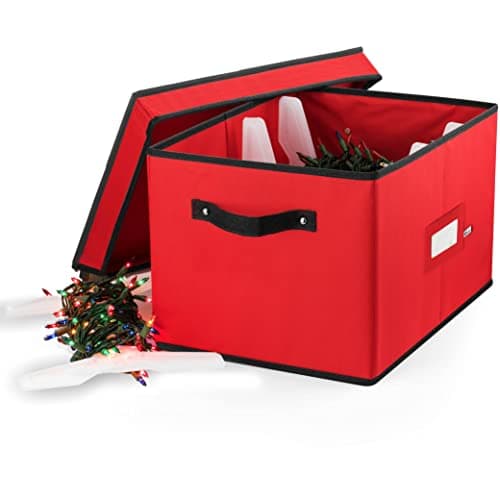
Read that against the picks. The Zober three-reel bag publishes 240 feet across three reels, which is 80 feet each — the right shape for a house with long outdoor runs. The four-reel version publishes 60 feet per reel, which is the right shape for an interior with several short ones. Same total capacity, entirely different use. That distinction is why we list both, and it is compared directly on reel versus bag.
How to wind a strand so it comes off cleanly
Start at the plug end, not the far end. Tape the plug to the reel or tuck it into the notch, then wind towards the tail. Next December you unwind from the tail and the plug is the last thing off, which puts it exactly where you need it — nearest the socket.
Wind under light, even tension. A strand wound loose slips off the reel flange and becomes the thing you were trying to avoid; a strand wound hard stresses the wire at every bulb socket, which is where these strands fail. The feel you want is the tension of winding a garden hose, not a fishing reel.
Test before you store, not after. A dead strand discovered in January costs you thirty seconds and a note on the reel. The same dead strand discovered in December costs you an evening. Full step-by-step on how to store Christmas lights tangle free.
Outdoor strands are a different load
Exterior sets are heavier, longer and dirtier. C9 bulbs on a 100-foot run weigh several times what an indoor mini-light strand weighs, and a plastic reel flange that is fine indoors flexes under that. It is the reason the three-reel Zober bag publishing metal reels ranks above the four-reel one publishing plastic.
Outdoor strands also come down wet. Storing a damp strand in a sealed container for ten months is how corrosion gets into the sockets. Let them dry indoors overnight before they go on the reel — it is a free step that most guides skip. More on outdoor and exterior light storage.
An exterior run is also more hardware than lights: extension cords, clips, stakes and a timer, all of which cost you an afternoon next December if they go away unlabeled. Where each one belongs, and the reel that publishes a cord capacity as well as a light capacity, is on storing light cords, clips and hardware. That reel set gets its own spec-based write-up on the Santa's Bags Install N' Store review.
When the free version is genuinely fine
A large part of what people search for in this category is not a product at all: cardboard rectangles, coat hangers, empty wrapping paper tubes. It would be easy for a site funded by commission to dismiss all of it. We are not going to, because for a short indoor strand the cardboard method works.
Cut a rectangle of stiff cardboard, notch both ends, wind the strand around it. That is a reel. It costs nothing, it enforces one strand per space, and for a 20-foot mini-light run that you handle once a year it is genuinely adequate. Where it stops being adequate is weight and repetition: heavy outdoor sets fold the cardboard, and notches tear after a few seasons of use.
The honest comparison, including the cases where the free version loses, is on DIY versus bought light storage.
How we ranked these
Published capacity per reel first, because it is the number that decides whether your strands fit. Then how many separate reels you get, whether the reels are metal or plastic, the container material, and whether the format hangs or stacks. We have not handled any of it. What we did instead is at how we pick.
Questions people ask
- How do you store Christmas lights so they do not tangle?
- One strand per reel, wound under light tension, with the plug end taped down before you start. Tangling is not caused by movement in the box, it is caused by two or more strands sharing a space and crossing over each other. A single strand wound on its own reel cannot tangle, because there is nothing for it to tangle with. Everything else is a refinement of that one rule.
- How many feet of lights fit on one reel?
- Between 60 and 80 feet on the reels here, and the makers publish it. The Zober four-reel bag states 60 feet per reel; the three-reel bag states 240 feet across three, which is 80 feet each. Sterilite rates its reels in bulbs instead, at up to 400 lights per reel. Match the figure to how your strands are sold: outdoor sets are usually described in feet, mini-light sets in bulb count.
- Is a cardboard reel as good as a bought one?
- For a short indoor strand, honestly, yes. A strip of stiff cardboard with notches cut in each end holds a 20-foot mini-light strand perfectly well and costs nothing. It stops being good enough at two points: heavier outdoor C7 and C9 strands, where the cardboard folds under the weight, and any strand you handle every year, where the notches tear. We say so plainly on our DIY page rather than pretending otherwise.
- Should indoor and outdoor lights be stored together?
- Separately, and the reason is practical rather than technical. Outdoor strands come in wet and dirty, and they are the ones you want to test before you go up a ladder. Keeping them in their own container means you can pull out and test only what is going outside. Two-container sets like the HOMZ pair exist for exactly this.
- Do LED and incandescent lights need different storage?
- The storage is the same. The difference is weight and bulk: LED strands are lighter and thinner, so more feet fit on the same reel than a published figure based on incandescent sets suggests. Where a maker publishes a bulb count rather than a length, that count generally assumes mini bulbs, so a C9 strand will fill the reel long before you reach it.
- Can Christmas lights be stored in a cold garage?
- Yes. Cold is not the problem for a light strand; moisture and crushing are. Wire insulation stiffens in cold and can crack if a strand is bent hard while it is cold, which is an argument for winding them indoors and carrying the reel out, not for storing them indoors. A sealed rigid container in a garage is a perfectly reasonable home for them.
Top pick on this page: Zober Christmas Light Storage Bag with 3 Metal Reels. Strand capacity: 240 ft.