The short answer
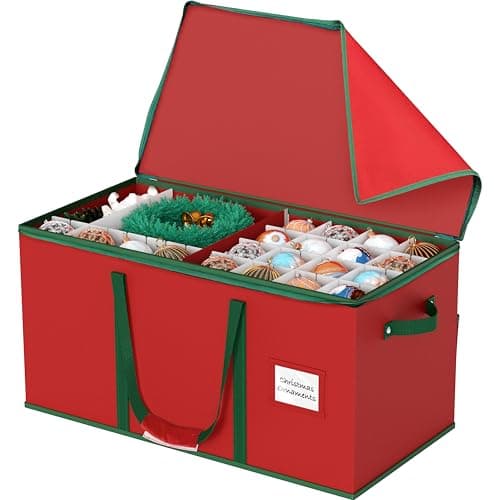
Work top-down and category by category: topper, ornaments, garland, lights, tree, room. One container per category, sized to its tallest item, labeled on the short end, stacked with the heaviest at the bottom and the ornaments on top. That sequence is the entire method, and the container choices follow from it rather than the other way round.
The order, and why it is that order
Every part of this sequence exists to stop you handling something twice or reaching over something fragile.
- 1
Topper first
The most fragile and least replaceable item in the house, and the one most often left on a table while everything else happens around it. Pack it before anything else moves.
- 2
Ornaments, top of the tree downward
Working downward means you never reach across a decorated section. Sort into four size piles on the floor as you go: under 3 inches, 3 to 4, 4 to 6, over 6. Hooks off and into a bag.
- 3
Garland and ribbon
Off the tree next, coiled loosely rather than folded. Wire-cored garland takes a permanent set at any hard bend.
- 4
Lights, one strand at a time
Test each one as it comes off, then wind it onto its own reel from the plug end. Complete each strand before starting the next; the pile of half-removed strands is the tangle.
- 5
The tree
Now that it is bare. Measure the longest section before you buy a bag, or fold the branches upward if you are storing it assembled.
- 6
The rest of the room
Wreaths flat in oversized containers, wrap flat under a bed, table linens and mantel pieces in a shared bin, plus the tree skirt, collar and stand hardware. This is the part everyone forgets to plan for and it is usually two bins' worth.
- 7
Label and stack
Short end of every container, three or four words. Heaviest bins at the bottom, ornaments and wreaths on top.
One container per category, sized to its tallest item
The arrangement that makes December fast is one container per category, and the sizing rule is that each one is bought for the tallest thing going in it. Here is what that means with the published numbers.
Category, tallest typical item, and the container that clears it| Category | Tallest item | Needs | Example |
|---|
| Ornaments | 128-slot box, 13-13.5 in | Over 13 in interior height | Sterilite 27 gal Stacker, 18 7/8 in |
| Lights | Reel bag, 10-12 in | Over 12 in interior height | Roughneck 25 gal, 16.25 in |
| Wreaths and garland | 7-10 in deep, 30-36 in across | Its own wreath container | One per wreath, sized up |
| Tree hardware and skirt | Stand, fluffing gloves, spare tips | Any medium bin | 66 qt ClearView |
| Table and mantel | Candles, runners, small figures | Any medium bin | 66 qt ClearView |
| Wrap | 40 in rolls | Over 40 in interior length | Fabric under-bed organizer |
| Outdoor | Inflatables, stakes, exterior lights | Rigid, off the floor | Roughneck 25 gal |
Full published interior figures for every bin are on storage containers by capacity. The one that catches people out is the ornament row: a 128-slot box does not stand up in a 66 qt ClearView, which publishes 12 7/8 inches inside.
Where each category should live
This decision matters more than any container choice and it costs nothing. The rule is about material, not value.
What belongs in conditioned space and what does not| Belongs inside | Fine in a garage or attic |
|---|
| Glass and heirloom ornaments | Plastic foliage and artificial trees |
| Painted or gilded pieces | Light strands, once dry |
| Ceramic villages | Tinsel, garland, plastic decorations |
| Wrapping paper and ribbon | Outdoor decorations, once dry |
| Anything with real pine cones or berries | Stands, poles, hardware |
| Photographs, cards, paper crafts | Inflatables, once thoroughly dry |
The reasoning behind each, and what each location actually does over ten months, is on attic versus garage versus basement.
The detail, category by category
The tree. Buy for the longest section, not the tree height. A 7.5 ft tree typically needs 50 inches of published bag length; a 9 ft tree needs 60. Full table at tree height to bag size.
Ornaments. One per compartment, hooks off, unprinted tissue on painted finishes only. Count by size class rather than total, because a dozen large pieces eat 48 slots. Method at how to store ornaments.
Lights. One strand per reel, wound from the plug end, tested before it goes away. Count your runs, not your feet. Method at tangle-free light storage.
Wreaths and garland. Size the container five or six inches above the wreath diameter, take the bow off, coil garland rather than folding it. Sizing at wreath sizes.
Wrap. Secure the loose end of every roll, load flat and parallel, bags underneath and bows on top. Method at how to store wrapping paper rolls.
Everything else. Table linens, mantel pieces, candles, stockings, the nativity set, cards. This is the category nobody plans for and it is usually two bins. Group by room rather than by type — everything that goes on the mantel in one place — because that is how you will look for it. The tree's own orphans, the skirt, the collar and the stand bolts, have their own rules at storing the tree skirt, collar and stand.
When to do all of this. The indoor work can happen on any weekend after New Year; the outdoor run needs a dry, still day above freezing, whenever that arrives. The dates, traditional and practical, are on when to take Christmas decorations down.
Stacking order
Heaviest at the bottom. Ornaments and wreaths on top, always, because they are the two things a stack crushes and both are fabric-lidded. Anything you might need before next December — birthday wrap, spare bulbs — goes where you can reach it without unstacking.
If you are buying bins new, matching lid sizes is worth more than it sounds: Sterilite publishes that its 10, 19 and 27 gallon bins share a lid size and stack in one footprint, which is what turns a pile into a stack.
Then label it
The whole afternoon is wasted if next December you open four bins looking for the stockings. Three or four words on the short end of each container, readable from the aisle. The system that survives contact with a real attic is on labeling so you find it next year.
If you would rather work from a printable order of operations than a reference page, the pack-down checklist is the same method as a sequence you can follow start to finish.