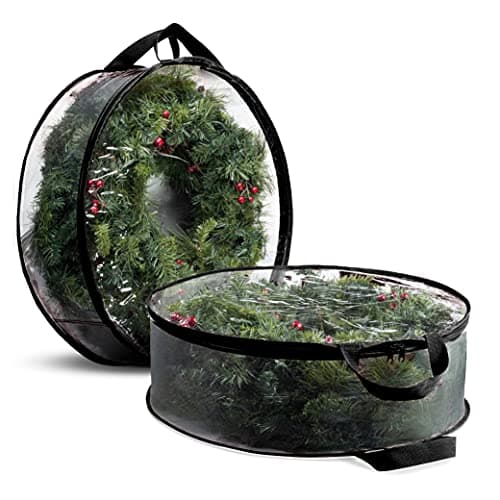
The short answer
Size up. A wreath container carrying the same number as your wreath will hold it, and it will hold it compressed. Measure across the outer tips, add five or six inches, and buy the next size class. A 24-inch wreath belongs in a 30-inch container; a 30-inch wreath belongs in a 36.
Why the sizes do not mean what they say
A wreath container labeled 24 inches publishes 24 inches of exterior dimension. Subtract the seam allowance, the zip, and the wall, and the usable circle inside is smaller than that. Put a genuinely 24-inch wreath in it and the outer tips are pressed against the wall for ten months, which is precisely how a wreath comes out of storage flat on one side.
The fix costs nothing except buying one size up. It is the single most common mistake in this category and the easiest to avoid, and the reason our top pick is a 30-inch container rather than a 24: the wreath most American front doors carry is 22 to 26 inches across.
Wreath diameter to container size
Measured wreath diameter and the container size that holds it without compression| Measured wreath diameter | Typical use | Container to buy |
|---|
| 12-16 in | Window, cabinet, interior door | 24 in |
| 18-20 in | Small front door, apartment door | 24 in |
| 22-26 in | Standard 36 in entry door | 30 in |
| 28-32 in | Wide or double entry, large porch | 36 in |
| 34-44 in | Commercial, gate, oversized porch | 48 in |
Depth matters as well and gets less attention. A flat, sparse wreath needs three inches. A deep wreath with pine cones, ribbon and a bow needs seven or more, and the published depth figures here run from 7 inches on the Zober 24 to 10 inches on the Elf Stor 36. If your wreath has a bow, the bow is what sets the depth requirement. Measuring guidance and the full table are on wreath sizes and how to measure.
Soft bag or hard container
The category is split between fabric bags that hold a shape and rigid plastic shells that enforce one, and the choice is about what else is in the room.
A fabric container in 600 denier Oxford, like the Zober two-pack, is lighter, hangs on a hook, and forgives an awkward wreath shape. It gives no protection against something being stacked on it.
A rigid shell resists exactly that. If the wreath goes on a garage floor or the bottom of a stack, rigid wins and it is not close. We work through the trade on wreath bag versus hard container— and because most boxes sold as “hard shell” are stiffened fabric rather than molded plastic, the two kinds are ranked separately on hard wreath storage boxes.
Either way, the figure that decides the container is depth rather than diameter, and a wreath that keeps its bow and picks needs roughly twice what a plain one does. How to measure it, and what should come off first, is on storing a decorated wreath. At the cheap end of the range, depth is also the first figure to disappear from the listing; the budget bags that still publish one are on cheap wreath storage bags.
Garland is a different problem
Garland is not a wreath. It is nine feet of wire-cored foliage that takes a permanent set wherever you bend it, and the failure mode is not crushing, it is kinking.
Coil it, do not fold it. A loose circle roughly the diameter of the container, laid flat, keeps every bend gentle. Folding garland in half to fit a box puts a hard crease in the wire core and that crease never comes out — unless the bag is long enough to take the fold gently, which is the case for the dedicated garland sleeves ranked on best garland storage bags. Several containers here publish an interior compartment or a pocket sized for exactly this, which is why the Elf Stor 36 with its interior compartment is second on our list rather than fourth.
Pre-lit garland is two problems at once, because now you also have a light strand that will tangle. Coil the garland with the lights still attached and do not attempt to remove them — a pre-lit garland is a single object. The full method is at how to store garland after Christmas, and if you have loose strands as well, the reels on Christmas light storage are the answer to those.
How much container a coil actually needs depends on the length of the run, and depth runs out before diameter does. The conversion from garland length to coil size to container is on garland storage by length.
Natural elements change the rules
A fully artificial wreath is plastic and wire and can go almost anywhere sealed. A wreath with real pine cones, dried berries, raffia, cinnamon sticks or eucalyptus is food and nesting material, and an unheated garage or attic is where that becomes a problem.
If your wreath has natural elements, store it inside the conditioned part of the house, in a sealed rigid container, and check it when you unpack rather than assuming. That is not a product recommendation, it is just what the material is. Where each storage location actually helps or hurts is set out on attic versus garage versus basement and for outdoor decorations specifically on outdoor and garage wreath storage.
How we ranked these
Published diameter and depth first, then whether the maker states depth per wreath as distinct from container height, then material weight, whether garland has somewhere to live, and how the container behaves in a stack. We have handled none of these. The method and its limits are at how we pick.
Questions people ask
- What is a standard wreath size?
- There is no single standard, but the range is narrow. Most front-door wreaths sold in the United States are 20 to 24 inches in diameter, a standard 36-inch-wide entry door suits 22 to 26 inches, and a double door or a large porch takes 30 to 36 inches. Interior wreaths for windows and cabinets are commonly 12 to 18 inches. Measure across the widest point including the outer tips, not the frame.
- How do you measure a wreath for storage?
- Lay it flat and measure across the widest point from outer tip to outer tip, then measure its depth from the back of the frame to the highest point of the decoration. Those two numbers are what you compare against a container's published diameter and depth. Do not measure the metal or foam ring, because the tips are what get crushed.
- What size container do I need for a 24-inch wreath?
- A 30-inch container. The rule is to go one size class up from your measured diameter, because a container the same nominal size as the wreath compresses the outer tips against the wall and they stay flattened. A 24-inch container is the right buy for an 18 to 20 inch wreath, not for a 24-inch one, despite the name.
- What is the best way to store garland?
- Loosely coiled in a large circle, not folded, and not tightly wound. Garland takes a set wherever it is bent, so a tight fold becomes a permanent kink. Coil it the way you would a garden hose, into a circle roughly the diameter of the container, and lay it flat. Several wreath containers here publish an interior compartment or pocket that exists for exactly this.
- Can wreaths be stored in a garage?
- Yes, if the container is genuinely sealed and the wreath is artificial. The two risks in a garage are moisture, which is what a waterproof polyethylene shell is for, and pests, which are attracted to natural materials like pine cones, berries and raffia far more than to plastic foliage. A wreath with natural elements is better off inside the house.
- Should I hang wreaths for storage instead of boxing them?
- Hanging works well and costs nothing, and it is what many people do with a spare closet rod or a garage hook. The catch is dust: an unbagged wreath collects ten months of it and artificial foliage is difficult to clean without shedding. A hook plus a large bag over the top is the cheap version of a wreath container and does most of the same job.
Top pick on this page: Zober Christmas Wreath Storage Container (30 in). Container dimensions: 30 x 30 x 7.4 in.