The short answer
Buy for the longest piece your tree breaks into, not for the height printed on the box. A 7.5 ft tree usually splits into sections of 34 to 40 inches, so a bag with 50 inches of published length swallows it. A 9 ft tree with a one-piece center pole can need 60 inches or more. Every bag below is listed with the manufacturer's own dimensions so you can check yours before you buy.
The one measurement that decides this
Tree storage bags are sold by tree height. That is the wrong unit, and it is why so many of them arrive and do not fit. A tree's advertised height is the height it stands at with every section joined. What has to fit in the bag is the longest single piece left over once you have pulled it apart, and that varies enormously between trees that are nominally the same size.
Two 7.5-foot trees can differ by a foot and a half in their longest section. A three-section tree splits into roughly equal thirds, so the longest piece is around 34 inches. A two-section tree with a one-piece pole can leave you holding something 46 inches long. Same tree height on the box, completely different bag. The problem gets sharper the taller the tree: which bags actually reach the size a 12 ft tree needs is on storage bags for 10 and 12 ft trees. If the tree is a real one on its way out rather than an artificial one going away, the bags for that job are on Christmas tree disposal and removal bags.
So before you buy anything: lay the tree out on the floor as it will be stored, and measure the longest piece end to end. Add the stand if the stand goes in the bag too, and add three or four inches of slack, because a bag packed to its exact interior length will not zip once the branches spring outwards. That figure — not the tree's height — is what you compare against the published dimensions in the table above.
Tree height to bag length
This is the arithmetic. The middle column is the typical longest section for a tree of that height, taken from how these trees are hinged; the right-hand column is that figure plus working slack, which is the minimum published bag length we would buy. Measure your own tree before you rely on the middle column — it is a starting point, not a promise about your specific tree.
Longest section by tree height, and the minimum bag length that clears it| Tree height | Typical longest section | Minimum bag length to buy |
|---|
| 6 ft | 28-32 in | 40 in |
| 6.5 ft | 30-34 in | 44 in |
| 7 ft | 32-38 in | 48 in |
| 7.5 ft | 34-40 in | 50 in |
| 8 ft | 36-44 in | 54 in |
| 9 ft | 40-50 in | 60 in |
| 10 ft | 46-56 in | 65 in |
| 12 ft | 52-64 in | 67 in |
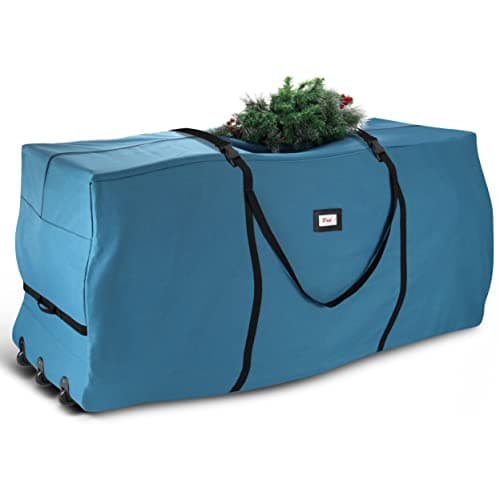
Read that against the picks above and the shape of the market becomes obvious. The Zober publishes 65 inches, which covers everything up to a 10-foot tree. The Hearth & Harbor publishes 59.84 inches, which covers a 9-footer only if its sections are at the short end. The Elf Stor rolling duffle publishes 67 inches, which is the reason it is the only pick here we would put a 12-foot tree in. The full working is on our tree height to bag size table, which adds width and height and the stand.
Bag, box, or upright
There are three real formats and they answer three different storage problems.
A flat bag is the default. The tree comes apart, the sections lie down beside each other, and the bag compresses around them. It is the most space-efficient option by a wide margin and the easiest to shelve. The cost is that you dismantle the tree every year, which on a pre-lit tree means unclipping the connectors.
A rigid box trades that efficiency for crush resistance. If your tree lives on a garage floor with bins stacked on top of it, a box is the honest answer. We walk through the trade in detail on bag versus box.
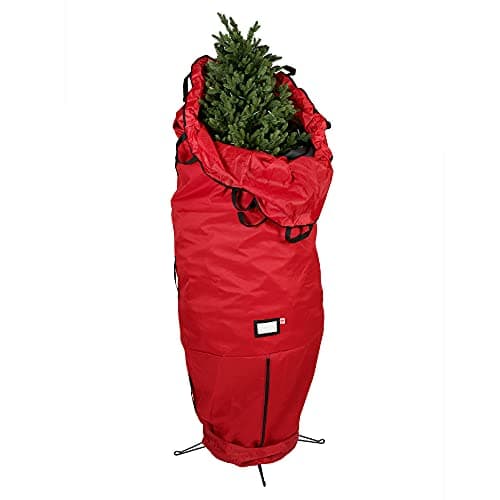
An upright bag exists for one reason: some people will not take the tree apart, and they are not wrong to feel that way about a pre-lit tree with forty connectors. An upright bag takes the whole tree standing, branches folded up, and rolls it away on a dolly. It uses far more floor space and it needs ceiling height — the Santa's Bags upright is 96 inches tall, which does not stand under an eight-foot basement ceiling. See upright versus flat for which one your space can actually take, and how to store a tree without taking it apart if you have already decided. Going one step further and leaving the ornaments on is a floor space decision rather than a container one, and the arithmetic is on storing a Christmas tree with the ornaments on. Once the format is settled, the upright bags themselves — for 7.5, 9 and 12 ft trees, with and without wheels — are ranked on the best upright Christmas tree storage bags.
Three questions that arrive before any of that: whether to buy a bag at all is answered on are Christmas tree storage bags worth it; the least you can spend and still get a published length is on cheap Christmas tree storage; and why the rigid box people search for mostly does not exist is on a storage box for a 9 ft tree.
What the fabric numbers mean
Two published figures are worth caring about, and both appear on some listings and not others.
Denier is a yarn weight. 600D Oxford, which the Zober and the Elf Stor rolling duffle both publish, is a mid-weight woven polyester — the same class of fabric used for luggage exteriors. The 300D poly-blend on the Santa's Bags upright is lighter. Neither figure is a durability test, but a published denier is at least a number you can compare between two bags, and “heavy duty” is not.
Mil is a thickness in thousandths of an inch, and it appears on polyethylene sacks rather than woven bags. The Elf Stor storage-or-disposal bag at the bottom of our table is 3 mil, roughly a heavy contractor bag. That material is genuinely good at getting a shedding real tree out of the house through a carpeted hallway. It is not a container, and we have listed it as a skip for exactly that reason.
A third figure — load capacity — is published by Zober at 50 lb and by almost nobody else. It matters more than it sounds: a bag rated for 50 lb is telling you something about its seams and handles, which is where these bags fail.
If durability is the whole reason you are replacing a bag, those figures deserve their own ranking, and they get one on the best heavy-duty Christmas tree storage bags — the same category sorted by fabric weight, load rating, frame and warranty rather than by fit.
Two brands account for most of what is published in this category at all, and they publish opposite halves of it: one states dimensions, denier and a load rating, the other states a warranty. Which one you want, category by category, is on Zober versus Santa's Bags.
One tree makes all of this secondary. A flocked tree loses its coating to compression and rubbing rather than to anything the fabric figures describe, which inverts the ranking: the bag to buy is the one publishing the most generous diameter, not the heaviest cloth. That case is set out on storing a flocked Christmas tree.
Whether you need wheels
Wheels are the difference between a carry and a push, and once a 9 ft tree bag is loaded that difference is substantial. But wheels only help on a hard floor. If the bag's home is a shelf in a closet or a spot in a loft you reach by ladder, wheels add bulk and nothing else, and you would rather have the extra six inches of length the Zober gives you. Decide where the bag lives first, then pick.
If wheels are the deciding factor, the rolling options are compared side by side on rolling and wheeled tree bags. For a tree that never comes apart at all, the wheels belong under the tree rather than under the bag — rolling tree stands and dollies compares those on published trunk range and wheel count.
And three things belonging to the tree fit in none of its containers: the skirt, the collar and the stand hardware. Where each one goes is on storing the tree skirt, collar and stand.
If there is no attic and no garage
A tree bag needs its length somewhere. In an apartment that usually means the top of a closet, the space under a bed, or nothing at all. Under a bed is the interesting one: clearance is typically about seven inches, which rules out every bag on this page and puts you into shallow rigid boxes instead. That is a different product and we have written it up separately in storing a Christmas tree in a small apartment and in under-bed holiday storage.
The premium end
One maker publishes materials the rest of this category does not — a fabric weight, a frame material and an acid-free lining on the same listing — and charges several times the going rate for them. What that line commits to, and where the specification runs thin, is on Balsam Hill Christmas storage.
How we ranked these
Five things, all of them published rather than tested: how completely the maker publishes its dimensions, how much clearance those dimensions give against the stated tree height, whether the material is stated as a real number, whether the bag can be moved by one person, and whether the construction is built to survive being pulled off a shelf ten times. We have not handled any of these bags. The whole method, and what it cannot tell you, is at how we pick.
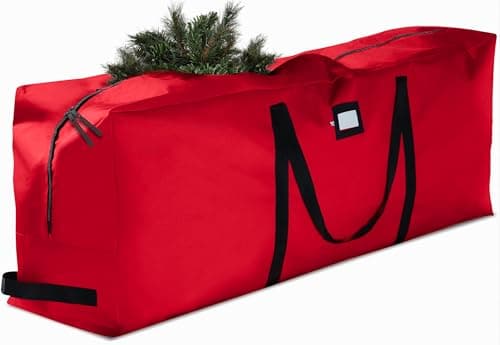
Top pick on this page: Zober 600D Oxford Large Christmas Tree Storage Bag (9 ft). Bag dimensions: 65 x 15 x 30 in.