The short answer
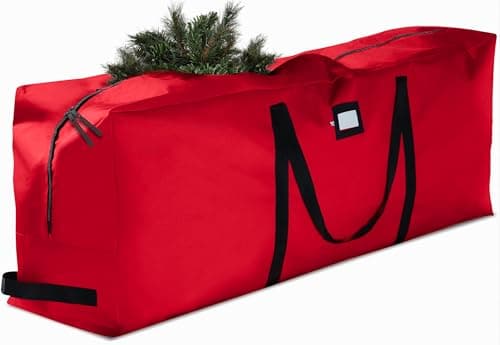
Buy a bag if the tree lives on a shelf, in a loft, or anywhere nothing gets stacked on it. Buy a rigid box if it lives on a garage or basement floor where bins go on top. The tree does not care; the storage location decides.
The comparison, on published numbers
Bag and box compared on the attributes their makers actually publish| Attribute | Fabric bag | Rigid box |
|---|
| Typical published length | 59-67 in | 20-30 in |
| Fits a full 7.5 ft tree's sections | Yes, in one container | Only if the tree splits short |
| Compresses around an irregular load | Yes | No |
| Crush resistance under a stack | None | High |
| Published load rating | Zober states 50 lb | Not usually stated |
| Moves on wheels | On some models | Rarely |
| Stacks | Poorly | By design |
| Shelf depth used | Less | More |
Why the length gap is so large
A tree bag is long because a disassembled tree is long. The longest single piece of a 7.5 ft tree is typically 34 to 40 inches, and of a 9 ft tree, 40 to 50 inches. Tree bags publish 59 to 67 inches of length to accommodate that with slack.
Household storage totes are not built to that shape. The Sterilite 27-gallon Stacker publishes 20 1/8 inches of interior length — a genuinely large bin, and roughly half of what a 7.5 ft tree's longest section needs. This is why “just use a tote” works for a 4 ft tabletop tree and fails for anything you stand on the floor.
If you want the numbers for your own tree, the tree height to bag length table lists the typical longest section at every common height.
What crushing actually damages
The honest answer is: less than people fear, on an unlit tree. Artificial branch tips are wire-cored and spring back after ten months of compression; the fluffing you do in December undoes most of it anyway.
On a pre-lit tree it is a different question. Those trees carry wiring bonded along the branches, and a hard, sustained bend at a wire junction is how a section goes dark. If your tree is pre-lit, that is the strongest single argument for the rigid box or for a bag that is not packed to its limit.
The arrangement most people end up with
There is a third option that neither product page will tell you about: a bag inside a bin, or a bag on top of a stack. The bag does the compressing and the containment; the stack order does the crush protection. If you already own bins for the rest of the decorations — and after packing down a whole house you will — putting the tree bag on top of that stack costs nothing and removes the entire crush question.
The same choice comes back for everything that is not the tree, and the answer is not always the same one: Christmas storage bags versus bins works through which decoration belongs in which format.
- 1
Measure the longest section
Lay the tree out as it will be stored and measure end to end. Add the stand if the stand goes in too.
- 2
Decide where it lives
Shelf or loft means a bag. Garage or basement floor with bins on top means a box, or a bag stored on top of the stack.
- 3
Add slack
Buy a container whose published interior beats your measurement by three or four inches. A container packed to its exact limit will not close once the branches spring outward.
Our verdict
For most households, a bag. It is the only format that holds a full-size tree's sections in one container, it takes less shelf depth, and the good ones publish a load rating you can check. The box wins in exactly one scenario — the bottom of a garage stack — and in that scenario it wins decisively, with one caveat: no household box publishes enough interior length for a 7.5 or 9 ft tree's sections, which is worked through on a storage box for a 9 ft tree. And if the question is whether to buy either, are tree storage bags worth it takes it against the carton, a tote and a sack.
If you would rather not disassemble the tree at all, neither of these is your answer and upright versus flat is. And if the bag you are replacing split rather than failed to fit, the format is not your problem: start with which heavy-duty claims are backed by a published number.