The short answer
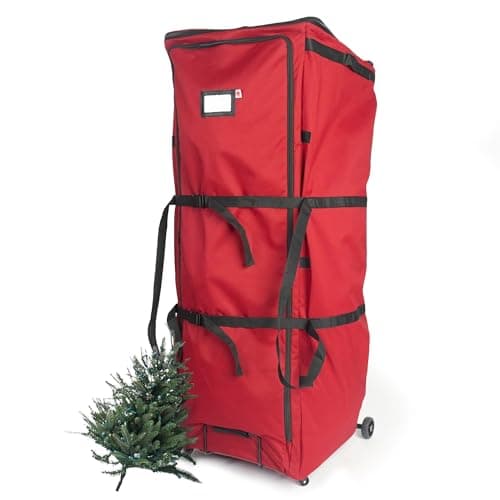
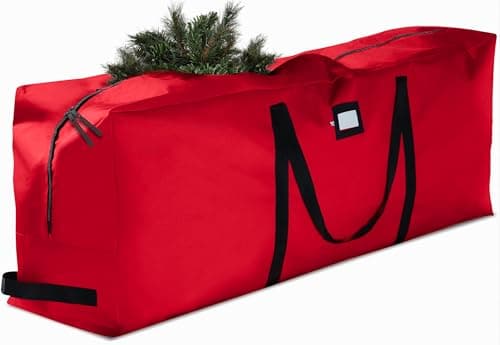
Buy the Zober if you want the only bag on this page that publishes both a fabric weight and a load rating — 600D Oxford and 50 lb, printed on the listing rather than implied by the word premium. Buy the Santa's Bags Expandable Tree Storage Dolly if your tree is 10 to 12 ft, because a steel frame under the fabric is the only durability claim here that does not depend on cloth. Everything else in this category that calls itself heavy duty is asking you to take its word for it.
What we counted as heavy duty, before looking at any product
“Heavy duty” is not a specification. No standard defines it, nobody certifies it, and it appears on the polyethylene sack at the bottom of this page as readily as on the steel-framed dolly near the top. So the ranking above was built the only way it can honestly be built: by deciding first which figures count, then reading what each maker publishes, then ranking on what survived.
Four things count here, and they count in this order.
A stated fabric weight. Denier is a published measure of yarn weight, so 600D and 300D are comparable numbers rather than adjectives. A maker who states one is telling you something you can check against a competitor. A maker who writes “durable, wipe-clean polyester” and stops has told you nothing at all.
A stated load rating. Exactly one product on this page publishes one: the Zober bag states 50 lb. Every other listing we read leaves it out. That is worth noticing, because load is the thing that actually breaks a bag, and a maker confident enough to print a number is a maker who has decided on one.
A load path that is not fabric. A steel frame, an axle, metal caster wheels. When a bag has one, the fabric stops being structural and becomes a cover, and the whole durability question changes shape. This is why the 300D dolly ranks above two bags with heavier cloth.
A stated warranty. Santa's Bags publishes a one-year limited warranty against manufacturer defects on every product of theirs we read. The Amazon-only bags publish no term at all. A warranty is not a durability test, but it is a maker putting a period of time in writing, and in a category this vague that is meaningful.
Deliberately excluded: the words tear-proof, waterproof, premium, industrial and reinforced, in every case where no test standard, no material and no measurement appears beside them. Those words are on nearly every listing in this category. If we scored them, the ranking would be a ranking of copywriters.
The four figures, side by side
What each pick publishes against the four criteria above| Pick | Fabric stated | Load rating | Load path | Warranty |
|---|
| Zober 600D Oxford (9 ft) | 600D Oxford | 50 lb | Fabric | None published |
| Santa's Bags Expandable Dolly (12 ft) | 300D poly-blend | Not published | Full-length steel frame, 4 wheels | 1 year |
| Santa's Bags Pro Upright (9 ft) | 300D poly-blend | Not published | Fabric | 1 year |
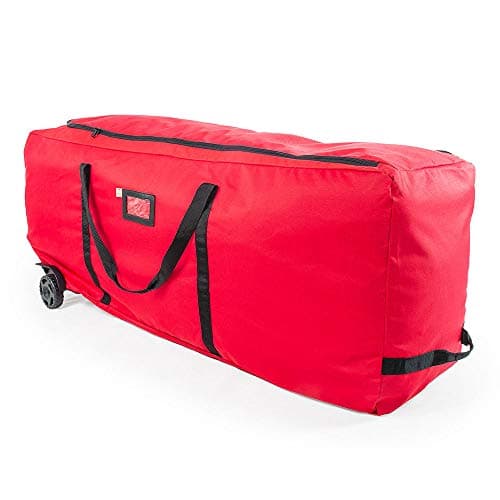
| Santa's Bags EZ Roller (9 ft) | 300D poly-blend | Not published | Fabric on an axle | 1 year |
| Elf Stor storage or disposal bag | 3-mil polyethylene | Not published | Fabric | None published |
Read that table and the shape of the category appears immediately. Nobody publishes all four. One product publishes a load rating. Three publish a warranty. One publishes a frame. The heavy-duty decision is not a matter of finding the best bag, it is a matter of deciding which of the four missing numbers you are willing to do without.
Denier, and why 600D is not automatically the answer
Denier is a weight measure for the yarn a fabric is woven from, so a higher number means heavier thread. It is the closest thing this category has to a spec sheet, and it is genuinely useful: 600D Oxford is a real, heavier cloth than a 300D poly-blend, and the 3-mil polyethylene at the bottom of the table is not in the same conversation as either.
What denier does not describe is everything that is not the fabric panel. It says nothing about the stitch density at the handle anchors, nothing about the gauge of the zipper, nothing about whether the base has a second layer where it meets the floor, and nothing about whether there is a frame taking the weight. Those are the parts that give out. A 600D bag with a light zipper and single-stitched handles is a heavy cloth wrapped around the same three weak points as everything else.
That is the honest reason the ranking above is not simply sorted by denier. The Zober leads because it publishes the most, not because 600D wins an argument by itself. The 300D dolly sits second because a steel frame changes what the fabric is being asked to do. If you want the fabric-first reading of the same category, the main tree storage bag ranking orders the same products by fit rather than by durability, and the two rankings disagree in useful ways. The opposite end of the range — what disappears from the listing when you spend as little as possible — is on cheap Christmas tree storage.
Where tree bags actually fail
A tree bag has a strange duty cycle. It is loaded once a year, moved twice, then left alone for ten months. Almost nothing wears it out through use, which is why the failures are so consistent and so predictable.
The base goes first, from dragging. A loaded 9 ft tree bag is heavy and shapeless, and almost everybody drags it the last few feet across a garage or basement floor. Concrete is an abrasive, the base is the contact patch, and three or four seasons of that is enough to open a seam. This is the whole argument for wheels, and it is the reason the EZ Roller's angled edge behind the wheels — a small detail, the maker publishes it — is more valuable than another 300 denier of cloth.
The zipper goes second, from overstuffing. Branch sections spring outward when you let go of them, so a bag packed to its published limit is under constant outward pressure for ten months. That pressure concentrates at the corner where the zipper turns, and that is where it parts. Compression straps exist for exactly this reason: the EZ Roller publishes three of them inside, and the Pro Upright zips fully shut rather than gathering on a drawstring.
The handles go third, from the lift. Handle stitching sees its worst moment once a year, when two people hoist a loaded bag through a loft hatch. Three reinforced handles, which both Santa's Bags uprights publish, spread that load across three anchor points instead of two.
The fabric goes last, and usually from the inside. When a panel does fail, it is normally a branch tip that has been pressing outward all year rather than abrasion from outside. Which is another way of saying that buying a bag one size up does more for longevity than buying a heavier cloth in the size you would otherwise pick.
The heavy-duty bags we left off, and why
Two absences are worth explaining, because both would have fitted the brief on paper.
Hold N' Storage publishes a 600D Oxford tree bag with a PVC inner layer, an end-to-end zipper and reinforced handles, at 59 by 27 by 24 inches for a 9 ft tree. On specification it belongs in the table. On the day we checked, the maker's own store listed both it and the rolling XXL version as out of stock, so it is not something you can currently buy from the people who make it, and a roundup that recommends an unavailable product is wasting your afternoon.
The other absence is broader: a number of 600D bags exist as marketplace listings only, with no maker's page behind them. We could not read a manufacturer's specification for those, only a seller's title, and a seller's title is the least reliable document in this category. They may well be fine. We are not in a position to say so.
What a one-year warranty is actually worth
Less than it sounds, and still more than nothing. A one-year limited warranty against manufacturer defects covers a seam that was sewn wrong or a zipper that was fitted badly. It does not cover a base worn through by dragging, which is the failure you are most likely to have, and it expires long before the third season when problems normally show up.
What it does tell you is that there is a company behind the product with a stated position on defects, and a defect is exactly what you discover in the first ten minutes of the first use — a zipper that binds, a handle that pulls at the stitch. That is worth having in writing, and it is a real point of difference against the listings that publish no term at all.
The one line that publishes a material set rather than an adjective — a fabric weight, a frame material and an acid-free lining on the same listing — sits at several times these prices, and is examined on Balsam Hill Christmas storage.
Fit still overrides durability
The strongest bag in the world is the wrong bag if it is four inches too short. Length is decided by the longest single piece your tree breaks down into, not by the height printed on the tree's box — a 9 ft tree that splits into four sections needs a shorter bag than a 7.5 ft tree with a one-piece pole. Measure before you shop, and check the measurement against the tree height to bag length table.
The same rule cuts against the wheeled picks. Wheels and an axle eat interior length, so the EZ Roller publishes 56 inches where the Zober publishes 65. If your tree's longest section is 54 inches, that difference decides your purchase before any durability argument gets a hearing. The full trade-off is in rolling and wheeled tree bags, and if you have not settled the format question at all, bag versus box is the place to start.
Where the bag lives decides more than the bag does
An attic in July is the harshest environment any of these products will see, and no denier figure protects against heat cycling; it degrades adhesives and hardens plastics regardless of what the outer fabric weighs. A garage adds damp and, in most of the country, mice, and no fabric bag on this page is a pest barrier — the makers who mention pests do not cite a standard, so we do not repeat the claim.
If your only option is an attic or an uninsulated garage, the durability upgrade that actually pays is a rigid latching bin around the fragile items and a bag for the tree itself, stored off the floor. The trade-offs by location are set out in attic versus garage versus basement.
How to buy one in five minutes
- 1
Measure the longest piece
Break the tree down as it will be stored and measure the longest single section, including the stand if the stand goes in the bag. This number, not the tree's advertised height, decides the bag.
- 2
Decide how the bag will move
Carried up a ladder, rolled across a floor, or never moved at all. Carried means handles and a light load; rolled means wheels and an angled base; never moved means buy on fabric and forget the rest.
- 3
Check the four published figures
Fabric weight, load rating, load path and warranty. Count only what the maker actually prints. If a listing states none of the four, you are buying an adjective.
- 4
Add three or four inches
Buy a bag whose published interior beats your measurement by three or four inches. A bag packed to its exact limit is a bag under constant outward pressure, and that pressure is what opens zippers.
What we cannot tell you
We have not put any of these bags through an abrasion cycle, loaded them to failure, or left one in an attic for a summer. Every figure on this page is the maker's own, read on the page linked in the sources below, and the ranking is our reading of those figures rather than a test result. Where a maker publishes nothing, the product card says so in words instead of carrying an estimate.
That is a real limit and it is why the criteria come first: you can check every input we used in about ten minutes, and disagree with the weighting if you want to. The full method, including what would get a product removed from a ranking, is at how we pick.
It is also worth knowing which figures each brand is willing to print before you weigh them. Across this whole category two makers publish most of the specifications that exist, and they publish different ones — dimensions, denier and a load rating against a one-year warranty. The comparison is on Zober versus Santa's Bags.