The short answer
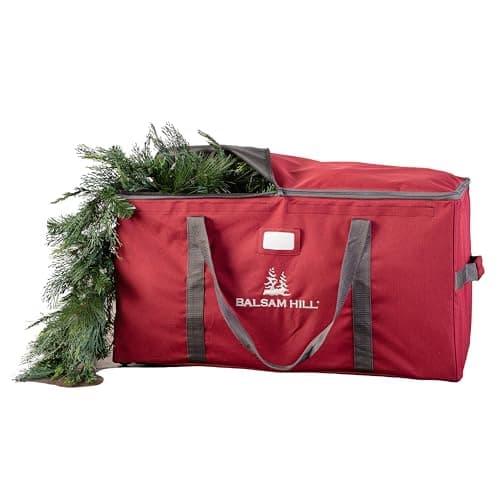
Balsam Hill publishes better materials than anything else in holiday storage — 600D polyester over padded canvas, steel frames, acid-free fabric-lined dividers — and charges accordingly. The Deluxe Rolling Ornament Chest is the one worth the money if your ornaments are heirloom glass. The Rolling Multipurpose box is the value pick and is really a garland box. The Greenery Bag is the only tree-sized product, and it is the one place where the line's specifications get thin.
Why one brand gets its own page
The same reason Sterilite does: this maker publishes something almost nobody else in holiday storage publishes. With Sterilite it is interior dimensions on nearly every line. With Balsam Hill it is materials — a fabric weight, a frame material and an archival lining claim, stated together on the same listing.
That is worth a page because the rest of this category sells adjectives. “Premium”, “heavy duty” and “luxury” appear on hundreds of listings with no number attached. When a maker writes 600D and acid-free, you can check it against a rival. Our Sterilite equivalent is on Sterilite for Christmas storage.
The line, on what each product publishes
Balsam Hill storage sold here, on published figures| Product | Published size | Capacity | Materials published | Wheels |
|---|
| Deluxe Rolling Chest (100) | 23.5 x 18.5 x 24" | 100 ornaments | 600D polyester, padded canvas, steel frame, acid-free dividers | Integrated, size not stated |
| Deluxe Rolling Chest (120) | 26.5 x 16.5 x 39" | 120 ornaments | Same as the 100 | Integrated, size not stated |
| Rolling Multipurpose Box | 31 x 15.5 x 15.8" | Not published | 600D polyester, padded canvas | Stated, size not published |
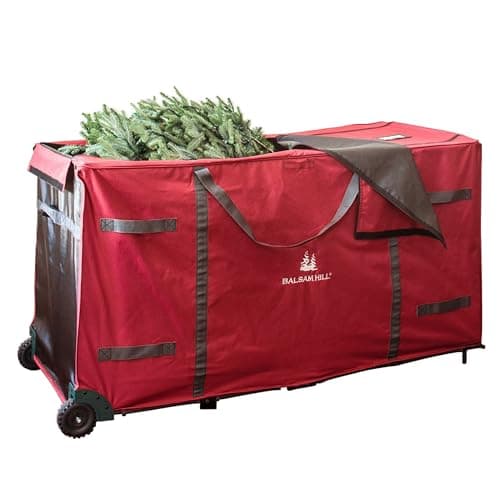
| Rolling Greenery Bag | 60 x 25 x 31" | Trees to 12 ft, or tree plus greenery | 100% polyester, polypropylene parts; no denier | Two, size not stated |
Read the materials column and the pattern is clear: the ornament chests are the best-specified products in the line and the greenery bag is the least. That is the opposite of what the prices imply, and it is the most useful thing on this page.
Best of the line: the Deluxe Rolling Chest (100)
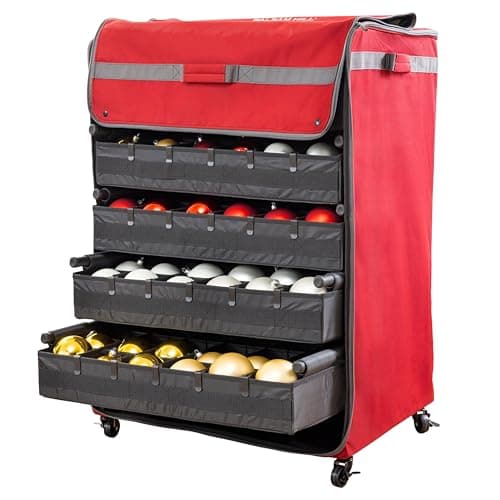
Twenty-three and a half by eighteen and a half by twenty-four inches, 100 ornaments, in 600D polyester with padded canvas construction over a steel frame, with acid-free fabric-lined dividers and a front storage pocket. That combination — a stated fabric weight, a real frame and an archival lining — is not published together by anything else we have read in ornament storage.
The steel frame is what separates it from a fabric box with ambitions: the walls do not lean in when the chest is half empty, and the wheels have something to be mounted to. For a collection of blown glass that is staying in the family, that is the specification to want.
The honest cost is arithmetic. At roughly two and a half dollars per ornament of capacity, against about a quarter for a divided box inside a wheeled tote, you are paying ten times over for materials and trays. If your ornaments are replaceable, that is a bad trade, and the cheaper route is set out on ornament storage on wheels. One more gap: the tray count is never published for this size.
Best value here: the Rolling Multipurpose Box
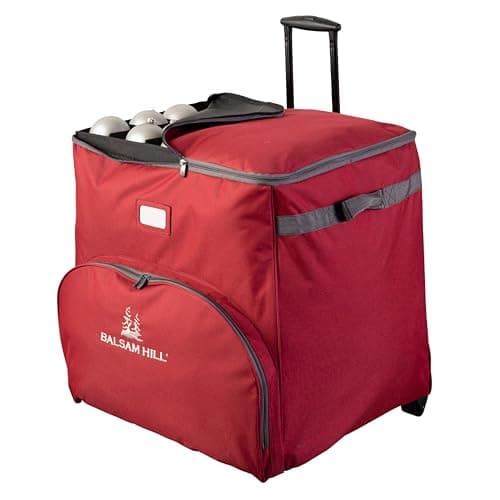
Thirty-one by fifteen and a half by fifteen point eight inches, one removable top drawer over an open main compartment, same published 600D polyester and padded canvas, on wheels, at about half the price of the chests.
Thirty-one inches of length is the point. It takes garland and artificial greenery that no ornament chest will, and the removable top drawer keeps small fragile things off whatever is underneath. As a garland and greenery box it is the sensible buy in this line.
What it is not is ornament storage, whatever the search results suggest: no ornament count, no cells, no dividers described. Put divided boxes inside it and it works; buy it expecting compartments and it does not. No steel frame is published for this model either, which is the main thing separating it from the chests.
The only tree-sized bag: the Rolling Greenery Bag
Sixty inches long by twenty-five wide by thirty-one high, stated for artificial trees up to 12 feet or a smaller tree stored alongside its wreaths and garland, with an integrated inner compression system and two wheels.
Twenty-five inches of width is genuinely generous, and width is exactly where bags sold for tall trees fail — we measured that across the category on storage bags for 10 and 12 ft trees, where most 12-foot bags come up three inches narrow. An inner compression system is also the right idea: it holds the sections rather than squeezing the bag from outside.
Then the specification stops. No denier, no load rating, no wheel size, no warranty term — on the most expensive tree bag on this site by a wide margin. A 600D bag that publishes its denier, its dimensions and a one-year warranty costs a fraction of it and tells you more. Buy this if you own the matching tree and want the brand's system; buy on published specs and you will buy something else.
Best vertical footprint: the Deluxe Chest (120)
The same chest built upward: 26.5 by 16.5 inches on the floor and 39 inches tall, holding 120 ornaments with removable drawer-style trays. Twenty more ornaments than the 100 on a footprint only three inches longer, which is the argument for it in a crowded closet.
Thirty-nine inches is a chest you load standing up and store where nothing sits on top. It also costs more than the 100 for twenty extra ornaments, which is a poor marginal rate. A 150-piece version is listed as well, at a higher price again.
Who should buy into this line, and who should not
Buy it if the collection is heirloom glass, the storage space is conditioned, and you want the one product set that publishes an archival lining alongside a fabric weight. The chests genuinely are the best-specified ornament storage we have read.
Do not buy it for shatterproof ornaments, for a damp garage, or for the tree bag on specifications. Padded canvas is not a seal; no product in this line publishes a gasket or a waterproof rating, and for a damp space a rigid gasket bin protects better for a fraction of the money. The acid-free question in general — including the cheaper cardboard boxes that publish 100% acid-free rather than an acid-free lining — is on cardboard and acid-free ornament storage.
What we cannot tell you
These are published-specification comparisons, not tests. Nobody here loaded a chest with glass and towed it across a garage floor for ten seasons. Where the line does not publish a figure — tray counts on the chests, wheel sizes anywhere, denier on the greenery bag — this page reports the gap rather than guessing.
Prices in this line move a long way across the season, and the figures on this page are today's live ones rather than a stable guide. The pattern worth remembering is the ratio, not the number: this is roughly ten times the cost per ornament of the divided-box-in-a-tote arrangement, and whether that is worth paying depends entirely on what is inside.