The short answer
For most collections, skip the rolling chest. A 128-cell divided box published at 26.8 by 13.6 by 13.4 inches drops inside a 40-gallon wheeled tote published at 30.5 by 16 by 17.1 inches of interior, with clearance on every axis — more ornaments, a rigid shell and a latching lid, for a fraction of the price. If you want a purpose-built chest, the TreeKeeper telescoping box is the one that publishes an ornament size (120 ornaments up to 4 inches tall, five trays of 24), and the Balsam Hill Deluxe chests are the ones that publish real materials: 600D polyester over padded canvas on a steel frame, with acid-free dividers.
What we looked for
Wheels are easy to advertise and hard to specify, so this ranking runs on what the listings commit to in writing, in this order.
- A published capacity, and ideally an ornament size. A count alone cannot tell you whether your ornaments fit, because almost all divided storage is built around 3-inch cells and a lot of collections are not.
- The tray system. Removable trays are what make a deep chest usable: one tray goes to the tree, instead of the whole box being unpacked onto the floor.
- Materials, stated rather than praised. A fabric weight, a frame material, acid-free lining. “Premium” and “luxury” are not specifications.
- Published dimensions. Both so you know where it lives and so you can compare it against the cheaper route below.
- What the wheels actually are. Count, size, bearing, load rating. This is where the whole category goes quiet, as the table shows.
Everything below is read off the listing each product links to on the date this page was published, with the same method as how we pick. Where a figure is not published, the table says so instead of carrying a guess.
The rolling options compared
Rolling ornament storage compared on published figures| Product | Ornament capacity | Ornament size | Trays | Wheels published as |
|---|
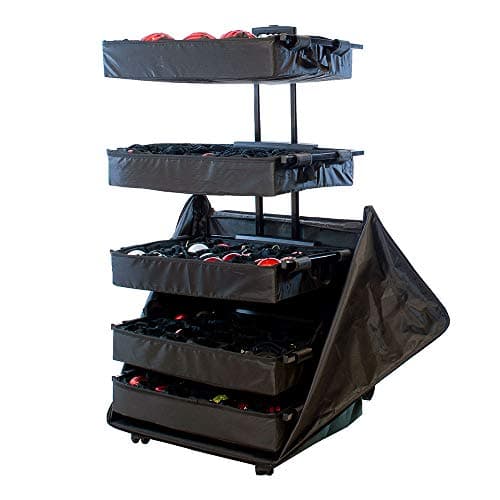
| TreeKeeper telescoping | 120 | Up to 4" tall, any width | 5 removable, 24 each | Rolls; no size stated |
| Balsam Hill Deluxe (100) | 100 | Not published | Dividers; tray count not stated | Integrated; no size stated |
| Balsam Hill Deluxe (120) | 120 | Not published | Removable; count not stated | Integrated; no size stated |
| Lukeline rolling box | 60 at 3.5" | 3.5" | 3 removable | Rollers plus a tow rope |
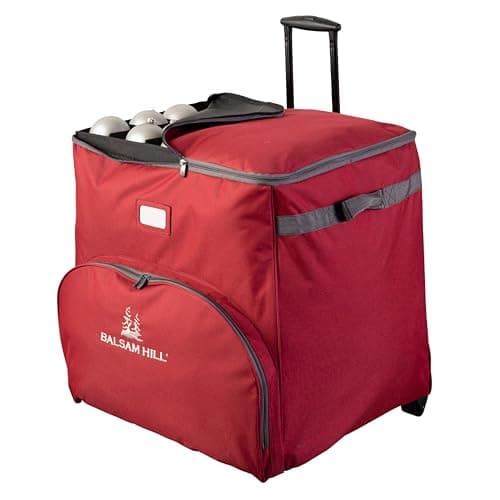
| Balsam Hill multipurpose | Not published | Not published | 1 removable top drawer | Rolling; no size stated |
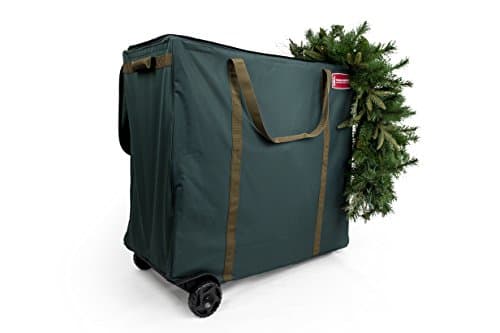
| TreeKeeper rolling bag (skip) | Not published | Not published | None; zip-on net | Oversized; no size stated |
Read the last column. Not one listing in this category publishes a wheel diameter, a bearing type or a load rating, on a product whose entire premium is the wheels. Read the third column and the problem repeats: one product out of six tells you how big an ornament it takes.
The cheaper route, with the arithmetic
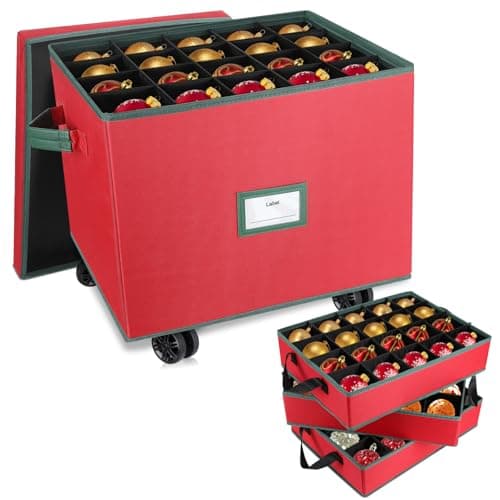
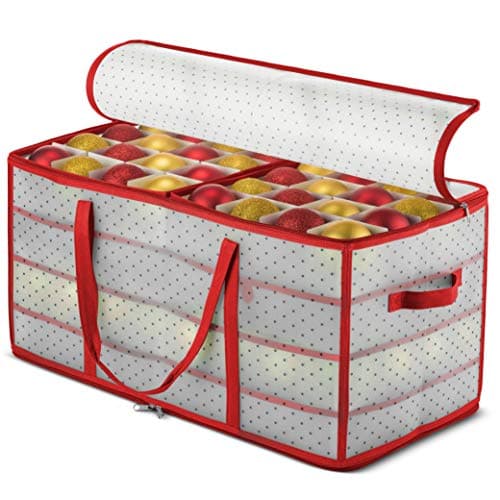
Before spending two hundred dollars on wheels, do this sum. A Zober 128-cell divided box publishes 26.8 by 13.6 by 13.4 inches. A 40-gallon wheeled tote publishes an interior of 30.5 by 16 by 17.1 inches. The box goes inside with about 3.7 inches to spare along its length, 2.4 across and 3.7 above — room for a second shallow box, or for the tree topper.
One caution, because it cuts against the convenience: our wheeled-tote page warns against putting fragile categories in a bin that gets shoved across concrete, and that warning stands. Cells protect against ornaments knocking together, not against a loaded tote dropping off an expansion joint. Smooth floor, walk it; rough floor, carry it.
What that buys you over a fabric chest: a rigid shell rather than padded canvas, a latching drip-resistant lid, wheels the maker states for rough surfaces, and 128 cells against 100 or 120. What it costs you: no acid-free lining, no removable trays to carry to the tree, and a tote that looks like a tote. The capacity comparison in detail is on ornament storage by capacity, and the wheeled totes themselves are compared on wheeled holiday storage totes.
The honest case for buying a chest anyway is the trays and the lining. If your ornaments are heirloom glass, acid-free fabric-lined cells and a tray you can carry around the tree are worth real money — that is the argument made on storing glass ornaments. If they are shatterproof balls from a big-box store, they are not.
Best overall: the TreeKeeper telescoping box
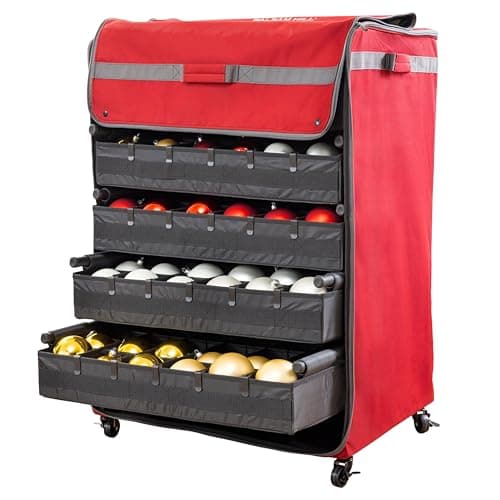
This is the only product here that answers the question buyers actually have. It states 120 ornaments up to 4 inches tall across five removable trays of 24, with movable separators for width and length, velour tray lining hung from rods, and acid-free fabric to prevent discoloration. The frame telescopes upward so you can see into a tray without bending over the box, then compacts for storage.
Four inches of tray height is the specification that matters. Almost every divided box on this site is built on 3-inch cells, which is why oversized ornaments end up in tissue and shoeboxes — the problem covered on storage for odd-shaped and oversized ornaments. One extra inch per cell sounds small and is the difference between a collection fitting and not.
The caveats are price and vagueness. This is among the most expensive ornament storage on the site, for 120 ornaments. “Nearly any width or length” is a phrase rather than a measurement — only the height is specified. And at 46 inches extended, the telescoping frame needs headroom where the box is opened, which an attic eave may not have.
Best for fragile glass: the Balsam Hill Deluxe chest
The Deluxe chests are the only products in this comparison that publish a material set rather than an adjective: 600D polyester with padded canvas construction over a steel frame, acid-free fabric-lined dividers, and a front storage pocket. For glass that is staying in the family, that combination is the specification to want, and nothing else here states it.
The 100-piece model publishes 23.5 by 18.5 by 24 inches in its bullets, while the listing's own dimension field says 24 by 19 by 24 — a rounding difference worth knowing if you are fitting it to a shelf. The 120 stands 39 inches tall on a 26.5 by 16.5 inch footprint, which is the one to buy if floor space rather than money is the binding constraint; a 150-piece model is also listed, at a higher price again.
What you are paying is roughly two and a half dollars per ornament of capacity, against about a quarter for a divided box in a tote. That is the trade, stated plainly: materials and trays against cells per dollar. The tray count for the 100 is never published, which for a chest sold on its organization is a gap.
Best under $50: the Lukeline rolling box
Three removable trays that stack into a wheeled outer box, stated at 60 ornaments of 3.5 inches, 17 by 13 by 13 inches overall, with handles on both the inner and outer boxes and a long tow rope. It publishes both a count and an ornament size, which puts it ahead of every chest here except the TreeKeeper, at a tenth of the price.
The tow rope is a better idea than it sounds: a fabric box on rollers is awkward to push and easy to tow, and the trays lift out to carry around the tree. Reinforced top and sides are stated, which matters for a soft-sided box that will have something stacked on it.
Sixty ornaments is the limit of the argument. That is half of what the chests take and less than half a 128-cell divided box, so a collection of any size needs several, and several of these cost more than the tote route. There is no steel frame and no load rating, and it is a recent listing from a seller with no track record in this category, so treat its longevity as unproven.
Best for mixed decorations: the Balsam Hill multipurpose box
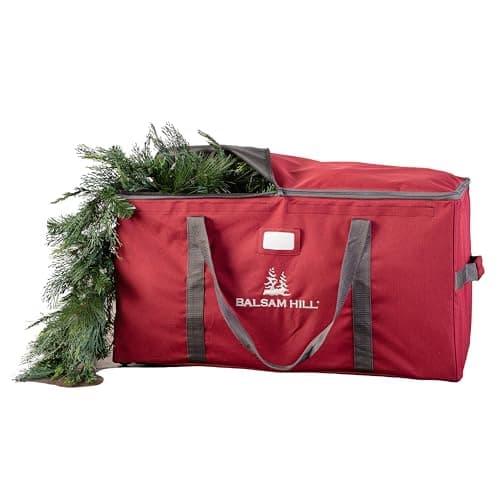
Same published fabric and padding as the Deluxe chests, in a long low box: 31 by 15.5 by 15.8 inches, one removable top drawer over an open main compartment, on wheels. At 31 inches it takes garland and artificial greenery that no ornament chest will, for about half the price of the chests.
It is in this comparison because it is sold into ornament searches, and it is ranked below the chests because it is not really an ornament product: no ornament count, no cells, no dividers described. Put divided boxes inside it and it works; buy it expecting cells and it does not. Garland has its own constraints, covered on how to store garland.
Skip: the TreeKeeper rolling decoration bag
A self-standing wheeled bag on a steel frame, with a zip-on net above the main compartment and padded handles. For wreaths and garland it is a sensible product. For the query that brings people to this page it is the wrong answer, and the listing is candid about it: the stated contents are wreaths, garlands and miscellaneous decorations, and there is no ornament capacity, no cells and no trays.
What earns the skip rather than a low rank is the absence of any published dimensions at all. You cannot check what fits before buying, at a price more than three times a divided box that states 128 cells and its exact outside size. Buy it for garland if you want the frame and the wheels; do not buy it for ornaments.
Before you buy any of them
- 1
Measure your largest ornament, not your average one
Height first, then width. If anything is over 3 inches, most divided storage is out and the published tray height is the number that decides your purchase.
- 2
Count what you actually hang
Not what is in the attic. Collections shrink when you sort out the broken and the never-used, and the count decides whether a 60-ornament box is enough.
- 3
Walk the route the box travels
Wheels only pay on flat runs. If the journey includes a loft ladder or a staircase, weight and handles matter more than wheels, because you are carrying it anyway.
- 4
Measure the storage spot, including headroom
A 39-inch chest and a 46-inch telescoping frame both need clearance to open where they live, not just floor space to stand on.
Limits of this page
These are published-specification comparisons, not hands-on tests. Nobody here loaded a chest with glass and towed it across a garage floor. Where a listing does not publish a figure the page says so, which in this category is most of what there is to say about the wheels themselves.
One maker accounts for three of the six products here. That is not a preference, it is what the category looks like: Balsam Hill publishes the most detailed material set and also sets the highest prices, and the cheaper end is recent listings from sellers with no history. Prices in this category move a long way between September and December, so treat the live figures on this page as today's, not the season's.