The short answer
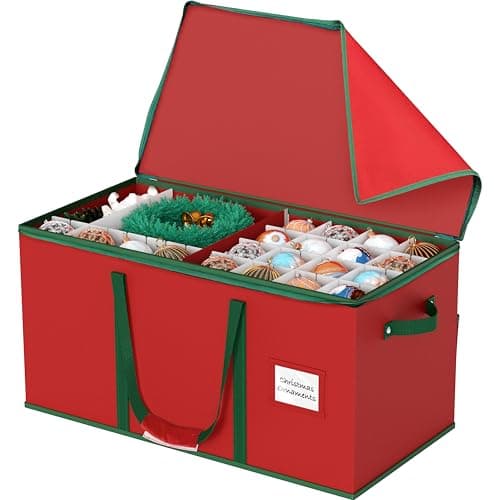
Hooks off, one ornament per compartment, unprinted tissue only on painted and gilded pieces, and the box goes near the top of the stack rather than the bottom. Those four steps address every common failure that is not a drop.
The three failures
Contact. Two glass ornaments touching in a soft container will chip each other over a season of small movements. This is the failure a compartment exists to prevent, and it is why a divided box beats a tote full of tissue paper even though the tissue feels more protective. Tissue cushions a blow; a compartment prevents the blow.
Compression. Ornament boxes are typically fabric over cardboard inserts, which means the lid is not structural. A bin stacked on top puts its full weight through that lid onto the top row. The fix is free and takes no equipment: ornaments go on top of the stack, heavy bins at the bottom.
Residue. Newsprint transfers onto paint and gilding over ten months of contact. So does the oil from a hand on an unlacquered metal cap. Neither is reversible on most finishes, and both are prevented by using unprinted tissue and handling by the cap rather than the body.
The method
- 1
Take every hook off
Collect them in a small zip bag. A wire hook loose in the bottom of a box will find a painted surface eventually.
- 2
Wrap only what needs it
Painted, gilded, matte and hand-decorated pieces get a loose wrap of unprinted tissue. A plain glass ball in its own compartment does not need wrapping at all, and a tight wrap on a fragile piece is worse than none.
- 3
One per compartment
This is the whole design. Two ornaments sharing a bay is the same as no compartments at all.
- 4
Fill part-empty bays
A small ornament rattling in a merged 6-inch bay travels further than it would in a tight one. Half a sheet of crumpled tissue stops the movement without pressing on the piece.
- 5
Photograph the layout
One photo on your phone before you close the lid. Next December you will not remember which bay the angel came out of, and repacking is when things get forced.
- 6
Store the box near the top
Not the bottom of a stack, and not under anything heavy. If the box is going in a rigid bin, the bin needs more than 13 inches of interior height.
Heirlooms and old glass
Old blown glass, mercury glass and pieces with original paint are more fragile than modern reproductions and less tolerant of temperature swings. Two things are worth doing for them specifically. (If those pieces are collectible ornaments still in their original boxes, the container question changes completely — see storing Keepsake ornaments in their boxes.)
If the collection is valuable enough to justify it, the rolling chests are the only ornament storage on this site that publish acid-free fabric-lined dividers as a specification rather than a selling line — ranked, with their price per ornament, on ornament storage on wheels.
The box can be acid-free too, not just the tissue: which ornament boxes publish that claim, and the humidity limit that rules cardboard out, are on cardboard and acid-free ornament storage.
Use acid-free tissue rather than ordinary tissue — ordinary tissue is mildly acidic and over decades that matters on old paint. And store them in the conditioned part of the house rather than an attic. The difference between a conditioned closet and an unconditioned attic is a much larger factor for old glass than any container choice, and it costs nothing. We compare the locations honestly on attic versus garage versus basement.
This is also the group that comes off a tree you intend to store still decorated. The unbreakable ornaments can stay on the branches for ten months; blown glass on an open hook cannot, whatever the container claims. The rest of that method is on storing a tree with the ornaments on.
The rigid outer bin
A fabric ornament box on a shelf is fine. On a garage floor, it is one spill and one stacked bin away from a bad outcome. Putting it inside a latching rigid bin costs less than a better ornament box and solves both problems at once.
Interior height is the number to check. A 128 box is 13 to 13.5 inches; the 66 qt ClearView publishes 12 7/8 inches inside, which is a near miss, and the 27-gallon Stacker publishes 18 7/8, which is not. Full figures on bins and totes.
The alternative is a rigid box rather than a rigid bin around a fabric one. It is a real option for a small number of irreplaceable pieces and a poor one for a whole collection, for reasons of arithmetic set out on hard-plastic ornament storage.
The pieces that do not fit any of this
Tree toppers, large ceramic figures, anything with a projecting arm or a long spike. These do not belong in a compartment system and forcing them in is how they break. They get their own treatment on odd-shaped and oversized ornaments.