The short answer
Merge bays for anything up to about 9 inches: four 3-inch slots make a 6-inch bay, nine make a 9-inch one. Above that, use the original box inside a rigid bin — the arithmetic for a whole collection kept that way is on storing Keepsake ornaments in their boxes. Do not force an oversized piece into a 3-inch bay, and do not leave it loose in a carrier bag, which is what most people end up doing.
What counts as odd-shaped
Awkward ornament types and what each needs| Type | Typical size | Slots if merged | Better option |
|---|
| Finial / spire | 6-12 in tall | 6-9 | Original box, or a merged bay lying down |
| Tree topper | 9-18 in | Out of scope | Original box in a rigid bin |
| Ceramic house or figure | 4-6 in | 4 | Merged bay, padded |
| Beaded or wire drop | 5-8 in long | 2-4 | Merged bay, laid flat |
| Projecting arm or wing | 4-8 in | 4 | Merged bay, one per bay |
| Framed or flat ornament | 4-6 in | 2-4 | Laid flat in a shallow layer |
How merging bays actually works
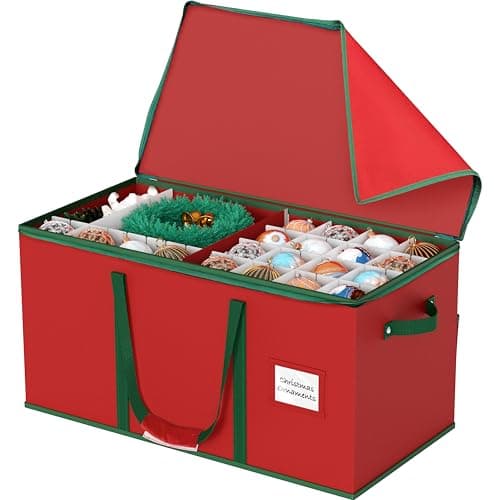
The 128-cell box most people start with is reviewed on its own published figures on the Zober 128 review. The Simple Houseware box publishes 48 interlocking dividers with 7 slots each. Each divider drops into slots in the ones running the other way, so pulling one divider out joins two bays and pulling two joins four.
Plan it before you pack rather than during. Decide how many merged bays you need, build them at one end of the box, and keep the standard 3-inch grid at the other. Rebuilding the layout with the box half full is how dividers get bent.
Finials specifically
A finial is long, thin, top-heavy and usually glass, which is close to the worst combination for storage. Two approaches work.
Lay it down in a merged bay running the length of the box, with tissue under and beside it but not compressed over it. Or keep it in the fitted tube it came in, and put that tube in the bin with the rest of the hardware. What does not work is standing it upright in a bay it barely fits, because the weight is at the top and any tilt puts the whole load on one edge of the glass.
Toppers are their own problem
A tree topper is typically 9 to 18 inches, often lit, often the single most sentimental object in the box. No ornament storage system on the market is designed for it, and the honest answer is that it should not be in one. The nearest thing that exists is figurine storage, where one box publishes a 16-inch figure capacity — those are compared on figurine and village storage boxes.
Put it in its original box if you have it. If you do not, wrap it loosely in unprinted tissue, sit it in a rigid bin with soft items packed around but not on it, and note on the outside of the bin that the topper is in there. A 27-gallon Stacker publishes 18 7/8 inches of interior height, which stands most toppers upright — and standing upright is what a topper wants, because that is the orientation it was designed to bear its own weight in.
Ceramic villages are a separate category
If the awkward pieces are lit ceramic houses, you do not have an ornament storage problem, you have a village storage problem: dozens of pieces of wildly different sizes, each with a cord and a bulb. Divided containers still win, but the sizing is different and the cords change the packing order. See Christmas village storage.
Label the merged bays
Once a box has a non-uniform layout, it needs a note. A photograph taken before you close the lid is the fastest version; a strip of tape on the inside of the lid saying “finials, left end” is the durable one. Next December you will be unpacking in a hurry, and a forced repack is when the merged-bay pieces get damaged. General labeling method is on labeling so you find it next year.