The short answer
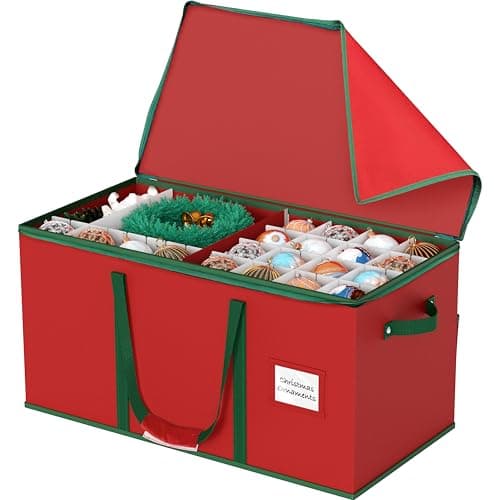
Take your ornament count, then add four slots for every piece between 4 and 6 inches and six or more for every finial. A 90-ornament collection with a dozen large pieces needs about 128 slots, not 96. Buy that capacity across two boxes rather than one if the box goes up a ladder.
The slot cost of each ornament size
Slots consumed per ornament in a 3-inch grid with adjustable dividers| Ornament size | Example | Slots each |
|---|
| Under 3 in | Standard glass or satin ball | 1 |
| 3-4 in | Large ball, small figurine | 2 |
| 4-6 in | Ceramic house, beaded drop, small angel | 4 |
| 6-9 in | Finial, small tree topper | 6-9 |
| Over 9 in | Large topper, oversized figure | Store separately |
Work an example. Seventy balls under 3 inches, ten pieces at 3 to 4 inches, eight at 4 to 6, and two finials. That is 70 + 20 + 32 + 14 = 136 slots for 90 ornaments. The 128 box is not quite enough and the 64 is nowhere near, which is not what a straight count would have told you.
The three capacities, on published dimensions
Published dimensions for each capacity| Capacity | Box | Published dimensions | Where it fits |
|---|
| 128 | Simple Houseware, adjustable | 25.5 x 13 x 13 in | A long shelf or a large bin |
| 64 | Zober cube | 12.9 x 12.9 x 13.5 in | A standard closet shelf |
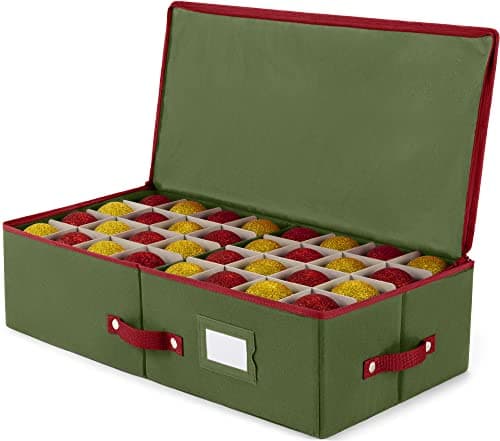
| 64 | Zober under-bed | 25.9 x 12.9 x 6.6 in | Under a bed frame |
| 200 | Zober | Not published | Unknown, which is the problem |
The box most of this arithmetic is run against — the standard 128 at 3-inch cells — is reviewed on its own specifications on the Zober 128 review.
The weight argument
A 128-slot box full of glass is not heavy in absolute terms. It is heavy in the specific context of carrying it one-handed down a loft ladder while holding the rail with the other, which is how most people move it. Once the journey is along a floor rather than down a ladder, wheels change the arithmetic again — the rolling chests, and the cheaper divided-box-in-a-wheeled-tote route, are compared on ornament storage on wheels.
None of this arithmetic applies if the ornaments stay in their own boxes, because a cell count stops being the unit — that case is worked out separately on storing Keepsake ornaments in their boxes.
Two 64s cost more than one 128 for the same ornaments. What you buy with the difference is a load one person can carry safely, a footprint that fits a normal closet shelf, and the fact that dropping one costs you half the collection instead of all of it. If the box only ever slides along a shelf, take the 128 and save the money. What the bottom of the range gives up in exchange for a lower price — usually the fabric weight and the acid-free trays, sometimes the published dimensions — is on cheap ornament storage.
The under-bed variant
The same 64 capacity, flattened to 6.6 inches. That figure exists because bed frames give about seven inches of clearance, and this is one of very few ornament products built to fit it.
One layer only, by definition, so anything taller than about 5 inches is out of scope regardless of what the divider layout allows. Under a bed is also the dustiest location in a house, so the published zipped lid matters more here than anywhere else. The clearance arithmetic, and what to do when a collection outgrows one flat box, is on under-bed ornament storage; what else competes for that space is on under-bed holiday storage.
Sizing the outer bin
If the ornament box is going inside a rigid bin — and on a garage floor it should — the constraint is interior height, and it is closer than people expect. A 128 box is 13 to 13.5 inches tall. The Sterilite 66 qt ClearView publishes 12 7/8 inches of interior height, which misses. The 27-gallon Stacker publishes 18 7/8 inches, which clears with room over the top.
That is exactly the sort of near-miss published numbers let you catch. Full interior figures are on holiday storage containers by capacity.
Counting method
- 1
Sort into four piles by size
Under 3 inches, 3 to 4, 4 to 6, and over 6. Do it on the floor as you take the tree down; it takes ten minutes and you only do it once.
- 2
Apply the slot cost
One, two, four, and six-plus respectively. Add them up.
- 3
Add 15 per cent
Collections grow. A box packed to exactly its capacity has no room for this year's additions.
- 4
Split the total across boxes you can carry
If the answer is over 128 slots, that is two boxes regardless, and two 64s or a 128 plus a 64 both work.