The short answer
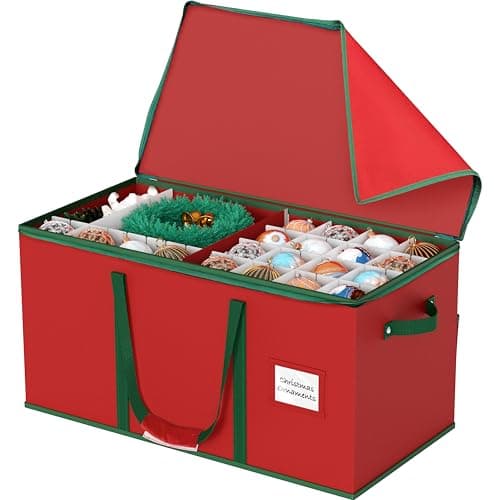
Dividers, unless every ornament you own is a uniform 3-inch ball. The adjustable box holds the same nominal 128 and gives you somewhere to put the finial, the ceramic house and the hand-painted one — which are the ornaments you would actually miss.
The two designs
Published figures for the two 128-slot boxes | Simple Houseware (dividers) | Zober (fixed grid) |
|---|
| Box dimensions | 25.5 x 13 x 13 in | 26.8 x 13.6 x 13.4 in |
| Nominal capacity | 128 x 3 in | 128 x 3 in |
| Compartment size | 3 x 3 x 3 in default | 3 in cube, fixed |
| Dividers | 48 interlocking, 7 slots each | Fixed |
| Reconfigurable | Yes | No |
| Extra storage | 2 rear pockets | Not published |
| Lid | Dual-zippered fabric | Two-sided zipper |
What adjustability actually buys you
Forty-eight dividers with seven slots each is a grid you build rather than a grid you receive. Pull two dividers and four 3-inch bays become one bay 6 inches square. Pull more and you get a 9-inch bay for a tree topper.
The cost is capacity: a 6-inch bay consumes four 3-inch slots, so a collection with a dozen large pieces effectively holds around 80 ornaments in a 128-slot box. That sounds like a loss until you consider the alternative, which is those twelve pieces sitting loose in a carrier bag beside the box. That is where breakage happens.
When the fixed grid is the better buy
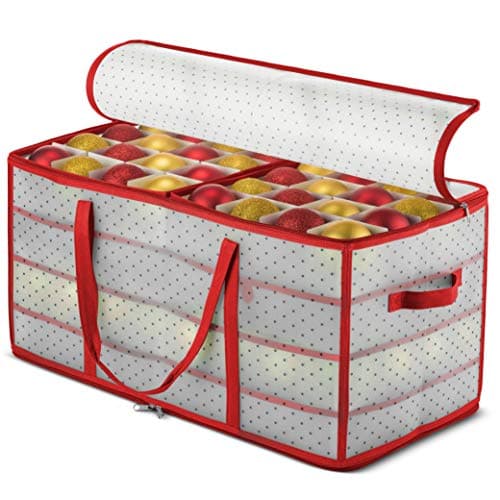
When the collection is uniform. Plenty of people own 90 identical satin or glass balls from a set, and for that collection a fixed grid is simpler, has no dividers to lose, and gives the full 128 slots.
The Zober also publishes a genuinely useful feature the other does not: a two-sided zipper, so the whole top folds back. Loading the far row without reaching over the near one is a small thing that matters when your hands are full of glass.
A fixed grid is also where the cheapest boxes live, and the trade at that end of the range — which figures the budget listings stop publishing — is on cheap ornament storage.
The third option: neither
If your ornaments came in fitted manufacturer boxes, those boxes are better protection than any general-purpose compartment, because they were molded around that exact shape. The right move then is to keep the original boxes and put them inside a rigid bin.
What does not work is stacking loose original boxes in a tote. Cardboard corners collapse under weight and then the ornament inside is unsupported and touching its neighbors, which is the failure mode a compartment exists to prevent. If that is your situation, go to bins and totes and buy on interior height instead.
A fourth option people reach for is a rigid plastic box rather than a fabric one. It exists, it is smaller than you expect, and most of the boxes advertised that way are fabric with plastic trays inside — hard-plastic ornament storage reads the listings against themselves.
Count before you buy
Whichever design you choose, count your collection by size class rather than by total. The arithmetic, with the slot cost of each size, is on ornament storage by capacity. And if the awkward pieces are the reason you are here, they have their own page at odd-shaped and oversized ornaments.