The short answer
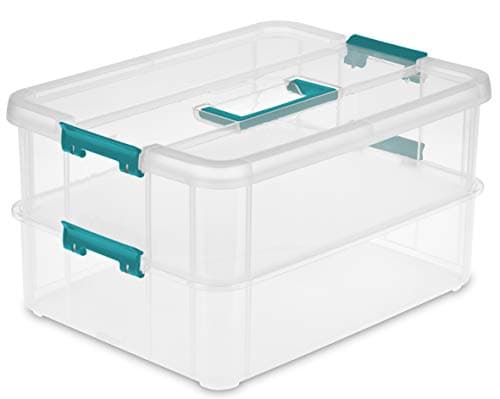
If you want a shell that genuinely cannot be crushed, buy the two-layer latched plastic box and accept 24 compartments. If you want one container for a whole collection, buy a fabric box and put a rigid bin around it, because no rigid box in this category holds 128 ornaments at a sensible price. And read the listing rather than the title: several boxes sold as hard plastic describe a foldable shell in their own bullet points.
What “plastic” means on these listings
This is the part worth reading before any product. Search hard plastic ornament storage and the results are full of boxes whose own descriptions contradict the word.
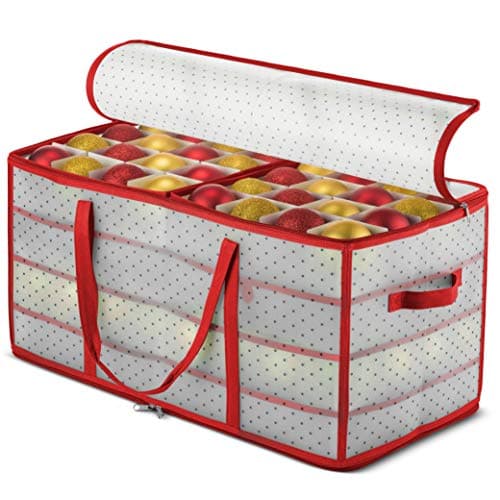
One 128-capacity box titled Hard Plastic Organizer describes, four bullets later, an “innovative foldable design with dual zippers” that “stores flat when not in use.” A box that folds flat is not a rigid shell. Another, titled Ornament Storage Box Plastic, describes “tear proof fabric” and a “design supported by trays instead of cardboard inserts” that “stores like Santa's bag.” Both are real products and neither is lying, exactly: the plastic is the trays and the dividers. The shell is fabric.
That matters because the reason people search for hard plastic is crush protection, and trays do not provide it. So the criterion this page ranks on is simple and checkable: does the listing state a rigid shell, in its own words? Everything else — capacity, cell size, dividers — is judged the same way we judge it everywhere on this site, on published figures.
The four boxes, on what they publish
Ornament boxes compared on shell construction as stated by the maker| Box | Shell, as stated | Capacity | Published size |
|---|
| Sterilite Stack & Carry 2-Layer | Rigid plastic, two latched layers | 24 adjustable compartments | 14 3/8" x 10 3/4" x 7 3/4" |
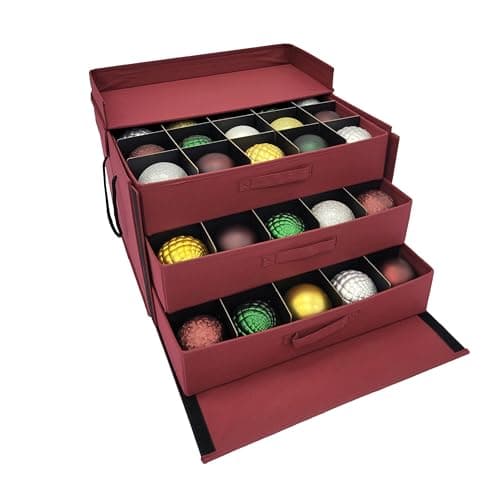
| 612 Vermont 60 x 4 in | Crush-resistant cardboard, fabric lined | 60 cells at 4" | 21.25" x 17.25" x 13" |
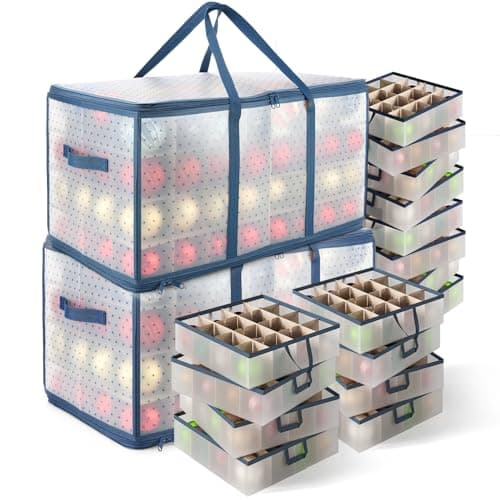
| Hearth & Harbor 128 | Called plastic; rigidity not stated | 128 ornaments | 25.5" x 13.5" x 12.9" |
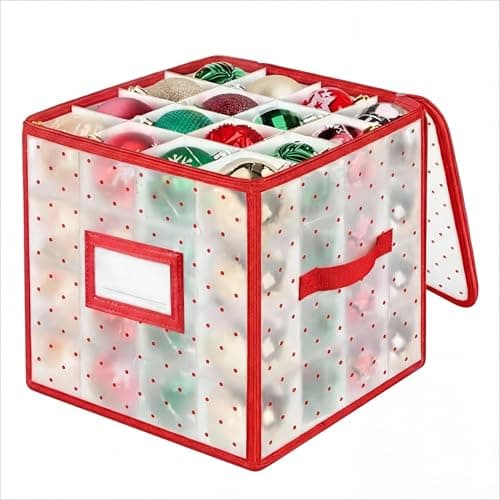
| Poxela 64 | Stated hard plastic, also stated to store flat | 64 x 3" or 36 x 4" | 11.8" x 11.8" x 11.8" |
| Zober 128 (fabric benchmark) | Fabric with plastic trays | 128 x 3" | 26.8" x 13.6" x 13.4" |
Read the first column downward and the category sorts itself. One box states a rigid shell. One states cardboard and is straightforward about it. One says plastic and stops. One says hard plastic and, two bullets later, says it folds.
What rigidity costs: 24 against 128
The rigid box holds 24 ornaments. The fabric box beside it holds 128 in a container barely twice as long. That is not a manufacturing failure, it is the arithmetic of a molded shell: rigid plastic has to hold its own shape, so the walls and the lip eat volume that a fabric box spends on cells.
For a hundred-ornament collection that means four or five rigid boxes against one fabric one, at several times the price and roughly twice the shelf. Almost nobody does this, and the people who should are the ones with a small number of genuinely irreplaceable pieces. Two dozen heirlooms in a latched box, and everything else in a fabric 128 — that is the arrangement we would actually use, and it costs less than going rigid for everything.
The counting method for the fabric side, including why a 90-ornament collection often needs 128 cells, is on ornament storage by capacity.
Crushing is not what breaks ornaments
Worth saying plainly, because it decides whether any of this matters to you. The common failure in ornament storage is not a box being crushed. It is two ornaments touching: a piece that shifts in an oversized cell, rubs against its neighbor through a season of the building moving, and arrives in December with a chip or a crack.
A divided cell fixes that, and the divider material barely matters. What rigidity fixes is the other failure — something heavy landing on the box — which is a stacking problem rather than a box problem. If the ornament box lives at the bottom of a garage stack, the honest fix is either a rigid box or a latching bin around the fabric one, and the bin is usually cheaper per ornament. The full handling rules for glass are on storing fragile and glass ornaments.
The 4-inch problem, which outranks all of this
Before shell material, check cell size. Essentially every box in this category is built around a 3-inch cell, and nothing larger than 3 inches goes into one — not by pressing, not by removing a divider on a fixed grid.
The 612 Vermont box is on this page because it is the one container here designed for the larger size: three trays of twenty 4-inch cells, sixty in total, behind a front panel that opens so the bottom tray is reachable without lifting the two above it. It also states acid-free materials, which is a genuine long-term claim for painted and gilded finishes and which almost nobody publishes.
It is cardboard. The listing says so in plain words, and we would rather feature a box that is honest about being crush-resistant cardboard than one that implies plastic and then describes a zipper. If your collection is mostly large baubles, cell size decides the purchase and the shell question is secondary — the oversized-piece options are on odd-shaped and oversized ornament storage.
One small thing the big box gets right
The Hearth & Harbor box includes a separate small box for ornament hooks. That sounds trivial and it is the only listing in this category we have read that solves a problem every household has: hooks end up loose in the bottom of a bin, tangled into one mass, scratching whatever they touch.
We still cannot call that box rigid, because its listing never says so. But if you are buying a large-capacity box anyway and the shell question is not your deciding factor, the hook box and the finger-slot dividers are real, published features rather than adjectives. The wider small-parts routine is on storing ornament hooks, toppers and small parts.
The arrangement that usually wins
A fabric divided box inside a rigid latching bin. The box does the dividing; the bin does the crush resistance, the damp resistance and the stacking. It costs less per ornament than rigid boxes, it scales to any collection size, and it is the only version of this that survives a garage floor.
The one figure to check before buying it is interior height: a 128-ornament fabric box is roughly 13 to 13.5 inches tall, which stands up inside a 27-gallon tote publishing 18 7/8 inches and does not stand up inside a 66-quart box publishing 12 7/8. Every bin interior we have measured is on holiday storage containers by capacity.
How to read a listing in this category
- 1
Ignore the title
Hard, plastic, premium and heavy-duty are title words in this category. The bullet points are where a maker commits to something.
- 2
Look for the word that contradicts
Foldable, stores flat, zippered, tear-proof fabric. Any of those means the shell is not rigid, whatever the title says.
- 3
Check the cell size, not the cell count
Three inches is the default and it is not stated as often as it should be. A 4-inch ornament needs a box built for one.
- 4
Check the outside dimensions against your bin
A box that does not stand up inside your tote will be stored lying down with something on top of it, which defeats the point of buying a divided box at all.
What we cannot tell you
How thick any of these shells is, because none of the makers publishes a wall thickness or a load figure, and we have not handled them. What we can do is quote each listing against itself, which is what the table above does. Where a maker states nothing about rigidity, the row says so rather than inferring it from the word plastic. Our method is at how we pick.