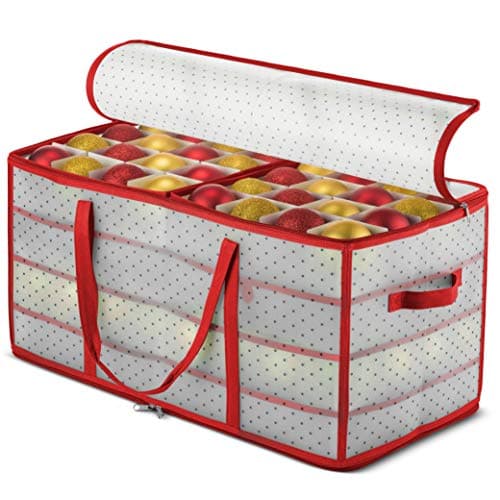
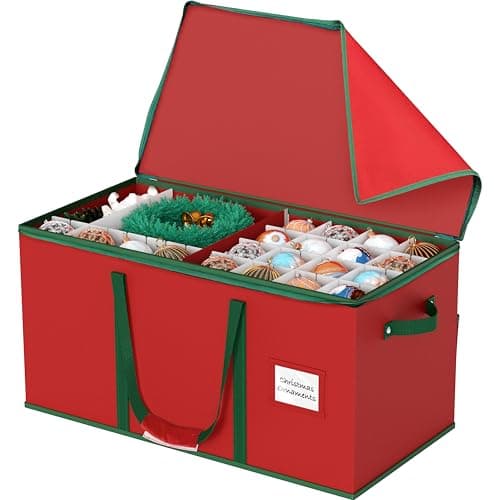
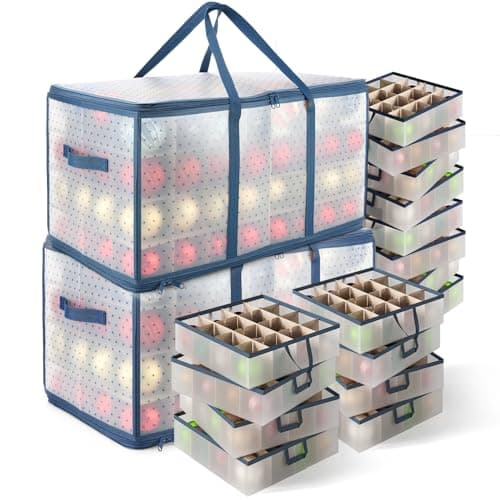
The short answer
Buy it if your ornaments are standard 3-inch balls and the box will live on a shelf. The Zober 128 publishes 128 three-inch cube compartments in a 26.8 by 13.6 by 13.4 inch shell, and its trays — rather than the cardboard inserts this format usually uses — are why it holds its shape. Buy the interlocking-divider box instead if any part of the collection is oversized, because a 3-inch cube has no answer for a finial.
What this review is, and is not
This is a reading of what the maker publishes, checked against the rest of the category. We have not bought this box, loaded it with glass and dropped it down a loft ladder, and nothing below should be read as a durability test. Where the listing does not state something, this page says so rather than filling the gap — the method is on how we pick.
What the maker publishes
Zober 128 ornament box, published figures| Specification | Published value |
|---|
| Compartments | 128 |
| Compartment size | 3 in cube |
| Box dimensions | 26.8 x 13.6 x 13.4 in |
| Structure | Trays rather than cardboard inserts; stated freestanding |
| Closure | Two-sided zipper |
| Material | Stated tear-proof fabric, water-resistant; titled flexible plastic |
| Identification | Card slot |
That is a fuller spec sheet than most of this category manages. The compartment size in particular is the figure that decides the purchase, and plenty of 128-cell listings never state it at all.
The trays are the actual product
The bullet worth reading twice is the one about structure: the box is supported by trays rather than by cardboard inserts, and the maker calls it freestanding. In a category where most soft boxes are a fabric sleeve around die-cut card, that is a meaningful difference.
Cardboard inserts are the component that fails first. They soften with humidity, they go soft at the folds after a few seasons of loading, and once they slump the compartments stop holding ornaments apart — which is the entire job. A tray-supported box keeps its geometry for longer, and it stands up on its own while you are loading it, which matters more than it sounds when you are packing with one hand.
The trade is height. Trays take vertical space, so a 13.4-inch box gives you less usable depth than the number suggests. That is the normal arithmetic for the format and it is why the tray-versus-divider question has its own page: adjustable dividers versus fixed trays.
The 3-inch ceiling, which decides everything
A 3-inch cube fits a standard glass ball with room for tissue. It does not fit a 3.5-inch ball at all, and every finial, figurine, ceramic house and beaded drop in your collection eats several cells or goes somewhere else entirely.
This is not a flaw in this particular box — it is the category default, and the Zober at least publishes it. But it does mean the 128 on the front is a ceiling for one size class rather than a capacity for your collection. The arithmetic for a realistic mixed collection, where 90 ornaments need about 136 slots, is on ornament storage by capacity.
The practical consequence: count your ornaments by size class before buying. If more than a handful are over 3 inches, the adjustable-divider box is worth the difference because it can build a bay to fit them.
What the listing cannot decide: plastic or fabric
The title calls this a flexible plastic ornament storage container. The bullets describe tear-proof fabric with water resistance. Those are different materials, and the listing does not reconcile them.
Our reading, based on the rest of the format: this is a coated-fabric shell with tray structure inside, which is what “flexible plastic” means in this corner of the market. It is not a rigid box, whatever the title implies. That distinction matters enough that we gave it a page of its own — hard plastic ornament storage — because several boxes sold as hard plastic describe a foldable shell in their own bullets.
Water-resistant is likewise worth reading precisely. It means the fabric sheds a splash. It does not mean the box survives a damp garage floor, and no rating is cited for it.
Against the two obvious alternatives
The 128-cell boxes compared on published figures| Box | Compartments | Divider system | Published shell |
|---|
| Zober 128 | 128 x 3 in cube | Adjustable slots within trays | Tear-proof fabric, water-resistant |
| Simple Houseware 128 | 128 x 3 in | 48 interlocking dividers, 7 slots each | Fabric with dividers |
| Hearth & Harbor 128 | 128 | Adjustable, finger slots for removal | Not stated as rigid |
The Simple Houseware is the one to buy if your collection is not uniform. Interlocking dividers with seven slots each let you pull two dividers and turn four 3-inch bays into one 6 by 6 inch bay, which is the only mechanism in this price range that houses a tree topper properly. The Zober's adjustable slots change how many compartments a tray has; they do not build a bay across tray rows in the same way.
The Hearth & Harbor is the one to buy for small-parts handling: it publishes a separate box for ornament hooks and finger slots that make the dividers easy to pull. Against both, the Zober's case is the tray structure and the two-sided zipper, which is a genuinely better opening than a single zip on a box this long.
The honest downsides
Three, in order of how much they should affect your decision.
The 3-inch ceiling. Shared with the category, and still the reason most buyers end up with an overflow bag of oversized pieces beside the box. If that describes your collection, the interlocking-divider box is worth more than the tray structure.
The material ambiguity. A listing that calls itself plastic in the title and fabric in the bullets has not told you what you are buying. It is very likely coated fabric, and we would treat it as such.
No acid-free claim. For ordinary ornaments this does not matter at all. For heirloom glass kept for decades it does, and the boxes that publish an archival claim are on cardboard and acid-free ornament storage.
Verdict
A sensible default. It publishes the figures that matter, the tray structure is a real advantage over cardboard inserts, and the two-sided zipper makes a 26-inch box usable. For a collection of standard glass balls stored on a conditioned shelf, it is a straightforward buy.
Two cases where something else wins. If your ornaments vary in size, buy the interlocking box and build bays. If the box has to live in a garage or attic, buy this one and put it inside a latching tote, because the shell is water-resistant and nothing more — the interior heights that make that combination work are on holiday storage containers by capacity.