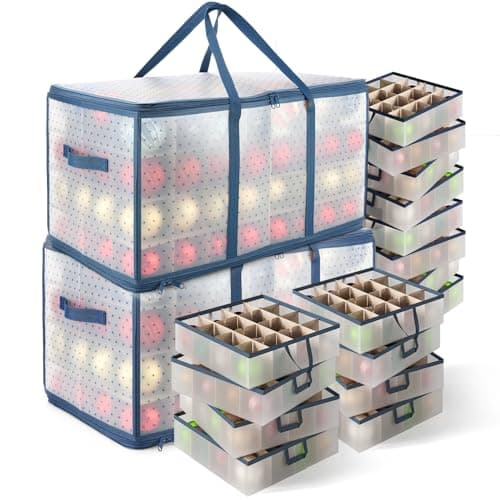
The short answer
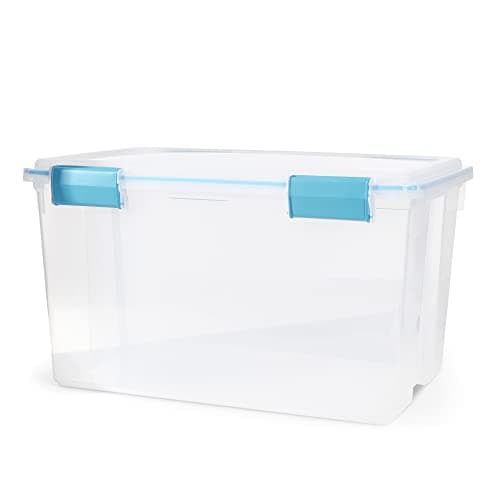
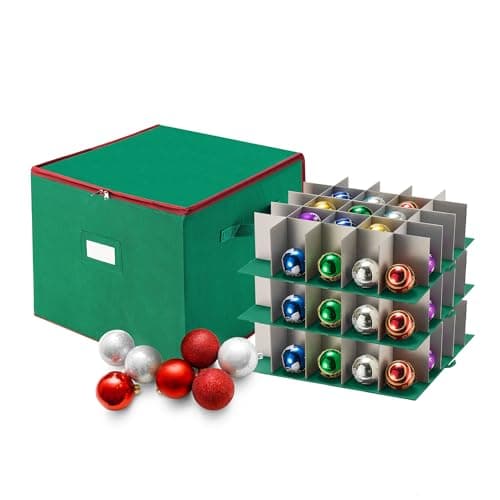
No divided ornament box fits a boxed Keepsake, because the cells are 3-inch cubes and the boxes are flat rectangles — published 2024 Keepsake boxes run from about 3.25 by 3.25 by 2.25 inches to 6.06 by 5.83 by 2.13. Store them flat instead: in a sealed gasket tote if they live in a garage, attic or basement, or in a divided box whose dividers actually come out if they live in a conditioned closet. A 54 qt gasket box takes roughly thirty boxes stacked flat; a 120 qt takes about fifty.
The mismatch, in published numbers
Every piece of ornament storage advice on this site starts from the 3-inch cube, because that is what the category is built around and what a standard glass ball needs. Collectors who keep the original packaging are storing something else entirely.
Published box dimensions for 2024 Hallmark Keepsake ornaments| Keepsake ornament | Published box size | Fits a 3 in cell? |
|---|
| Twelve Days of Christmas Papercraft | 6.06 x 5.83 x 2.13" | No, twice too long |
| Peanuts Super Lucy and Linus | 5.2 x 4.25 x 2.17" | No |
| Cute as a Button | 4.13 x 3.62 x 1.85" | No |
| Sweet Decade snowman | 3.25 x 3.25 x 2.25" | Barely, on the diagonal |
| Nostalgic Houses Rod's Barbershop | 2.6 x 4.3 x 2.6" | No |
Those are the dimensions each ornament's own listing publishes for the packaged product, which is the box you are storing. Read the right-hand column and the problem is plain: the boxes are longer and wider than a cell and shallower than one, so a divided grid wastes the depth and refuses the footprint at the same time. Buy 128 cells and you will fill maybe a dozen of them.
Stack flat, and count the layers
The arrangement that works is the one the ornaments arrived in: boxes lying flat, stacked in layers, in a rigid container. That is not a compromise. A Keepsake box is engineered to take a stacking load across its whole face, which is exactly what it did in a carton on its way to the store.
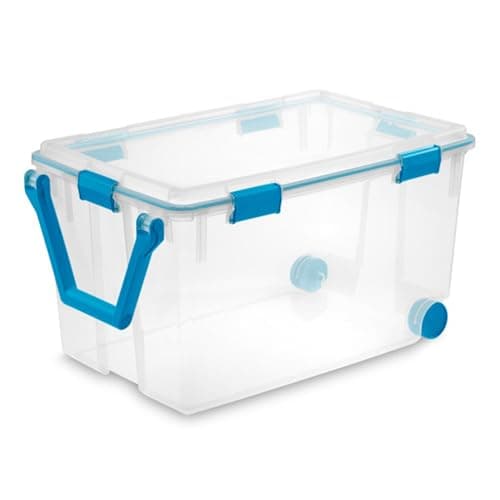
The arithmetic is worth doing before you buy a container. Take a 6 by 6 inch box, 2.2 inches deep, as the worst case. In the 54 qt gasket box, whose interior publishes about 18.9 by 12.6 by 11.8 inches, that is three across by two deep per layer and roughly five layers — about thirty boxes. In the 120 qt, at about 24.4 by 15.8 by 15.1, it is four across by two deep and six layers, or close to fifty. Smaller boxes do better; these are floor figures with no padding between layers.
One thing not to do: stand them on edge to fit more in. On edge, the ornament sits on one end of its own packaging for ten months and carries whatever is stacked above it through that single line. The same logic that governs glass in cells governs cardboard in totes, and the full method for the fragile pieces is on how to store glass ornaments.
Best for boxed ornaments: dividers that come out
If the collection lives in a conditioned closet, the useful format is a fabric chest whose dividers are loose rather than sewn in. The Tiny Tim Totes box publishes 16 by 16 by 13 inches with three stackable cardboard trays and twenty-four separate dividers, and states plainly that the inserts can be rearranged for larger items. That is the feature that matters: you build a bay the size of the box you own instead of accepting a grid.
Two honest limits. Thirteen inches across three trays is about four inches per level, so a deep boxed piece needs a bay that spans two levels — you lose a tray to make it work. And it is cardboard and non-woven polyester with no acid-free claim published anywhere, which for boxes you intend to keep for decades is the specification you would most like to see and do not get.
Best sealed tote: the gasket box
For a garage, attic or basement, the container question is really a humidity question. Cardboard is the fragile part of a boxed collection: it softens, swells at the corners and eventually delaminates, and a printed Keepsake sleeve shows every bit of that. A gasket lid with latches is the only thing in this comparison that seals against damp air rather than merely covering the contents.
The 54 qt version publishes a tight-seal gasket, latching lid and integrated handles, and is the size most collections start at. The 120 qt is the same idea with wheels and about fifty boxes of capacity, which suits a collection that has been growing since the nineteen-nineties. Neither publishes an acid-free anything, so use acid-free tissue between layers if the boxes matter to you. The wider case for gasket boxes over ordinary latching totes, including what a gasket does and does not buy you, is on waterproof holiday storage bins.
If you do not keep the boxes
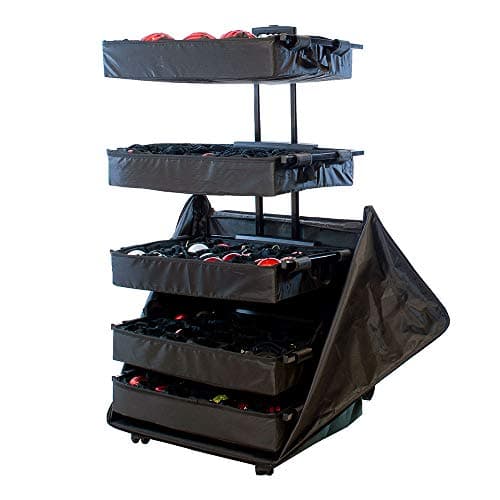
Plenty of collectors throw the packaging away, and for them the answer flips back to divided storage — with one adjustment. Keepsake ornaments are frequently larger and more irregular than a 3-inch ball, so the container to buy is one that publishes a tray height rather than only a cell count. The telescoping chest here states four inches of tray height with movable separators, which is the only published fit figure we have found in that format.
The general case for oversized and awkward pieces — finials, figurines, anything that eats four cells — is worked through on storage for odd shaped and oversized ornaments, and the slot arithmetic for mixed collections is on ornament storage by capacity.
The method, in order
- 1
Sort by box size, not by year
Collectors file by year and it wastes space. Group the boxes by footprint so each layer in the tote is flat and stable; keep the year order inside each group if you like.
- 2
Check each ornament is seated in its own insert
The plastic clamshell or cardboard cradle inside is what stops the piece moving. An ornament rattling loose in its box is worse off than one wrapped in tissue with no box at all.
- 3
Stack flat, heaviest at the bottom
Porcelain and metal pieces on the floor of the tote, papercraft and light resin on top. Acid-free tissue between layers if the boxes are part of what you are preserving.
- 4
Seal it and label the layer order
Write what is in each layer on a card taped inside the lid. It is the difference between finding one ornament and unpacking thirty boxes to get at it.
- 5
Store it off the floor, in the coolest dry place you have
Cardboard's enemies are humidity and temperature swings. A conditioned closet beats an attic by a wide margin, and a shelf beats a concrete floor everywhere.
Limits of this page
The Keepsake dimensions above are published figures for five 2024 ornaments, not a survey of the whole line, which runs to hundreds of pieces a year across four decades. They are representative of the range rather than a guarantee; measure your own largest box before buying a container, exactly as you would measure a tree before buying a bag.
The capacity numbers are arithmetic from published interiors, not counts from a packed tote. They assume flat stacking, no padding and boxes of one size, so treat them as a ceiling. And nothing here is a hands-on test: these are published specifications compared honestly, with the gaps — acid-free lining, above all — named as gaps.