The short answer
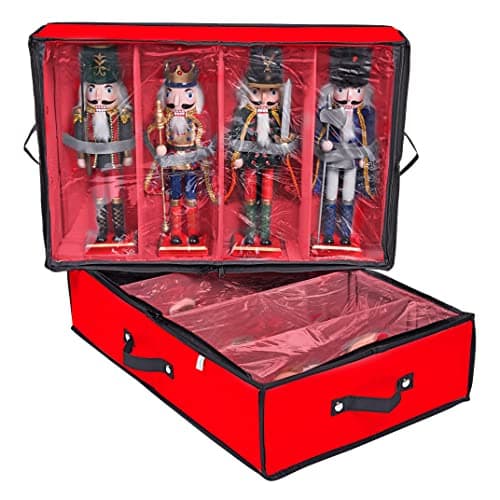
Buy on published height, not on cell count. A lit village house is 6 to 10 inches tall and a nutcracker is often 16; divided storage in this category is built on a 3-inch cube, and merging cells widens them without making them taller. The ProPik figures box is the only product we found that publishes a figure height — four figures up to 16 inches per box, with a loop in each section. For pieces up to 4 inches the boxes publishing a tray height work. For the small accessories, any 3-inch grid will do.
What we looked for
This page is only about the containers. How to pack a village — the original-box rule, the cords, the drying, where it should live — is the method guide on Christmas village storage, and nothing here repeats it. What follows is which box to buy, judged in this order.
- A published height. Cell height, tray height, or a stated figure height. This is the specification that decides whether your pieces go in, and almost nobody publishes it.
- What the dividers can actually do. Adjustable dividers merge cells sideways. None of them adds a millimeter of height, which is the limit buyers discover after the box arrives.
- Whether pieces are secured. A ceramic house sliding around a tray in an attic is the failure mode here, not crushing.
- Lining, stated. Acid-free matters on painted ceramic and resin kept for decades. Most listings never mention it.
- Whether the product is what the title implies. One box on this page ranks for village storage because a village is printed on the outside.
The boxes compared
Figurine and village storage on the figures each listing publishes| Box | Published height limit | Capacity | Pieces secured? | Lining stated |
|---|
| ProPik figures box (2-pack) | Figures to 16" | 4 figures per box | Loop in each section | Not published |
| TreeKeeper telescoping | Tray height 4" | 120 pieces, 5 trays | Movable separators | Acid-free velour |
| 612 Vermont 60-cell | Cells for 4" pieces | 60 cells, 3 trays | Fixed cells | Acid-free, non-woven |
| BROSYDA 128 | Stated 3" pieces | 128 cells, 8 trays | Adjustable dividers | Not published |
| pnyoin village scene (skip) | Stated 3" pieces | 64 cells, 4 layers | Paper dividers | Not published |
Read the second column and the category sorts itself. One product commits to a figure in the teens, two commit to four inches, and the rest are three-inch grids whatever the artwork on the lid suggests.
Height is the whole problem
A Department 56 or Lemax house is a boxy ceramic object with a chimney, a lit interior and a rubber grommet where the cord enters. Call it six to ten inches tall. A nutcracker is taller again and top-heavy, and a resin Santa is heavy for its size. None of those is an ornament, and the storage industry only really makes ornament boxes.
The trap is adjustable dividers. Every listing here advertises them, and they are genuinely useful — they merge four 3-inch cells into one 6-inch bay, which handles a wide figure. What they cannot do is raise the lid. A 6-inch bay in a box with 3 inches of internal depth still only holds something 3 inches tall. That is the same limit worked through for tree ornaments on storage for odd-shaped and oversized ornaments, and it bites harder here because village pieces are taller than any ornament.
So the buying rule for this category is short: measure the tallest piece you own, then buy only from listings that publish a number you can compare it against. Everything else is a guess you pay for twice.
Twenty-four by sixteen by six inches per box, stated to hold four figurines up to 16 inches, with adjustable dividers, a clear top, a carry handle, and — the detail that earns it the top spot — a built-in loop in each section to hold the figure in place. For nutcrackers and standing Santas, that loop is the difference between a collection and a repair job.
It is the only product in this comparison that publishes a figure height at all. Everything else counts ornaments, which tells a nutcracker owner nothing.
Three honest limits. Six inches of internal height means a 16-inch figure travels lying down, so a piece wider than its section is still a problem. Four figures per box is not many if the collection has been growing since the nineties — two boxes hold eight. And it was showing scarce stock when we checked, sold only as a two-pack. If it is unavailable when you read this, the honest fallback is the original cartons in a rigid tote, which is the advice on the village guide.
Best for a large collection: the telescoping chest
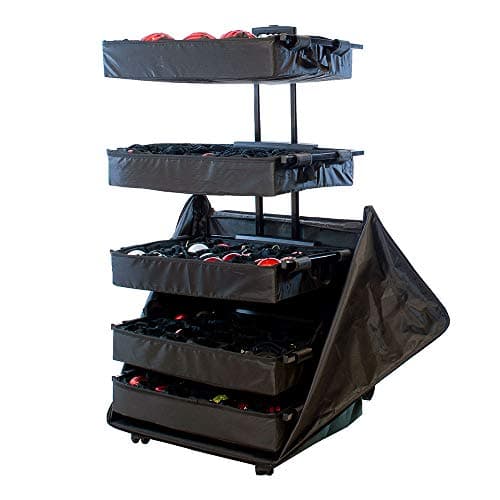
If the collection is large and mostly mid-sized — small houses, trees, carolers, accessories — the telescoping chest is the one that scales. It publishes a 4-inch tray height with movable separators across five removable trays of 24, and an acid-free velour lining hung from rods, which is the best-specified interior in this comparison.
The price is the obvious objection, and it is a real one: this is the most expensive storage on the site. It earns it for a collection of a hundred-plus pieces that would otherwise need five boxes, and it does not earn it for twenty. The four-inch ceiling also still rules out full-size houses and any nutcracker worth the name.
Best for 4-inch pieces: the 612 Vermont box
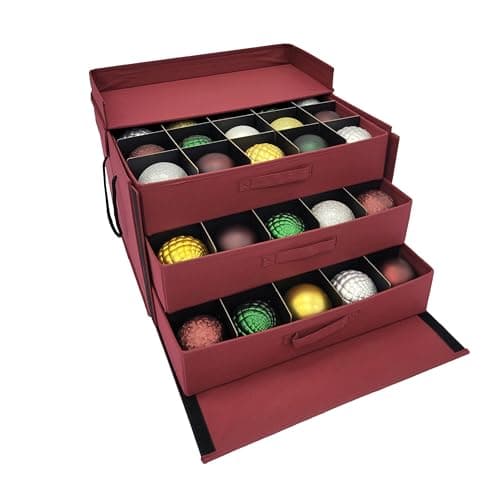
Sixty cells sized for 4-inch pieces across three trays, behind a front panel that opens so the bottom tray is reachable, in crush-resistant cardboard lined with non-woven fabric and stated 100% acid-free. For small village figures, carolers, trees and the mid-sized ceramics, it is the right size class and the right lining at a fraction of the chest.
Its honest weakness is the shell. Cardboard, however crush-resistant, is the wrong material for a damp garage or a basement floor, and the listing is straightforward about what it is rather than calling itself hard plastic. Keep it in conditioned space, or put it inside a rigid tote — the same arrangement recommended for glass on storing glass ornaments.
Best for the accessories: the BROSYDA 128
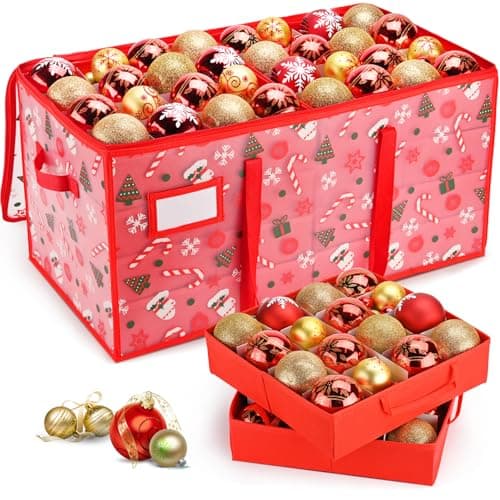
Every village has a second population: trees, fences, figures under three inches, signage, bags of snow. Those genuinely are ornament-sized, and for them the cheapest sensible box wins. This one publishes 25.5 by 13 by 13 inches, 128 cells across eight trays with a fabric pull-tab on each, dual zippers and a transparent label pocket, in PP plastic.
Eight trays is the useful part: a village is unpacked in a particular order, and pulling one tray beats excavating a box. The label pocket helps for the same reason. What it does not do is height — it is a 3-inch grid, the waterproof claim has no rating behind it, and the closure is a zipper rather than a latch.
Skip: the village scene box
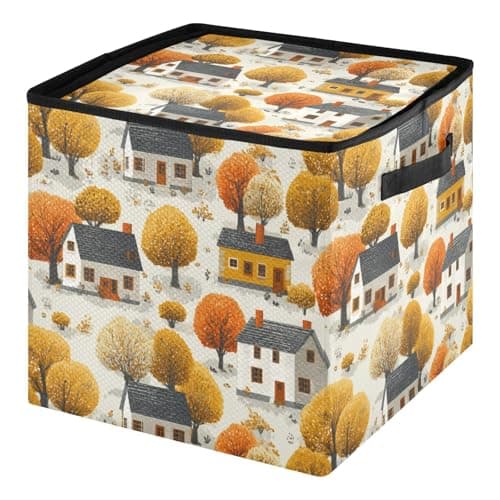
It is a competent 64-ornament box: four layers of sixteen, a hollow support board, a water-resistant polyester surface, folds flat. If that is what you want, fine.
It is on this page because it ranks for village storage while storing no village piece taller than three inches. The village is the picture printed on the outside. Its dividers are corrugated paper, which is the first thing to soften in an unconditioned attic, and it costs about what boxes holding twice as many ornaments cost. Buying it to protect a ceramic village means discovering in January that the houses do not go in.
Measure these three things first
- 1
Measure the tallest piece, chimney included
Stand it on a table against a ruler. Include the chimney, the finial, the hat -- whatever sticks up is what has to clear the lid. This one number rules out most of the category.
- 2
Measure the widest piece at its base
Bases are wider than they look, especially on lit houses with a battery box underneath. Width decides how many cells you merge; height decides whether the box works at all.
- 3
Count the pieces in two groups
Over three inches and under. The tall group needs a figure box or its original cartons; the small group goes in a cheap divided box. Most people buy one container for both and it fits neither.
- 4
Check what the cords add
A lit village stores its cords separately or they press into the ceramic all year. The method for that is on the village guide, and it changes how much container you need.
Limits of this page
These are published-specification comparisons, not hands-on tests. Nobody here packed a nutcracker into each box to see which held it. Where a listing does not publish a height — and most do not — the table says so rather than inferring one from a photo.
The honest summary of this category is that it barely exists. Ornament storage is a mature product class with dozens of options; figurine storage is one specification-complete product, a couple of 4-inch boxes borrowed from ornament storage, and a lot of boxes with villages printed on them. For many collections the best answer remains the one that costs nothing: the original cartons, inside a rigid tote, which is where the village guide starts and why it starts there.