Skip to content
Tinsel Tote

Christmas Village Storage

Dozens of fragile ceramic pieces of wildly different sizes, each with a cord. This is not a bin problem.

By Scooter M.Published Last verified

Disclosure: buy links on this page go to Amazon and earn us a commission at no cost to you. It does not change what we rank or what we say about it — the full disclosure is here.

The short answer

Original boxes if you have them, inside a rigid bin. If you do not, use an adjustable divider box with bays merged to each building's size. Bulbs out and in their own divided box, cords coiled and bagged per piece. Never loose in a tote.

Why a tote is the wrong instinct

A village looks like a bin problem because the pieces are large. It is not. Ceramic buildings are fragile, irregularly shaped, and vary from a two-inch tree to an eight-inch church, which is precisely the profile that a divided container handles and a tote does not.

Put six buildings loose in a 27-gallon tote with tissue between them and they will move against each other every time the bin is carried. Chimneys, spires and porch posts are the parts that break, and they break by contact rather than by impact — the same failure mode as glass ornaments.

The original-box rule

Village manufacturers ship their pieces in fitted foam or molded card, shaped to that exact building. Nothing you can buy afterwards matches that, because it was designed around the object.

So: keep them. Every year, put each piece back in its own box. Then put those boxes inside a rigid latching bin rather than stacking them loose, because a cardboard box on the bottom of a stack collapses and the fitted insert stops being fitted.

A 27-gallon Stacker publishing 20 1/8 by 14 1/8 by 18 7/8 inches inside takes a surprising number of village boxes standing upright, and the published interior height is what lets you check before buying. Figures on bins by capacity.

If the boxes are long gone

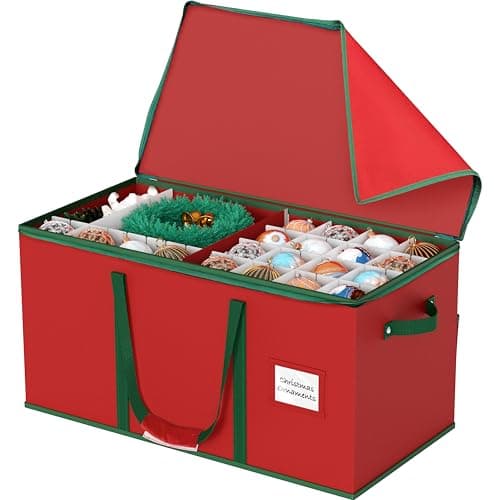
An adjustable-divider ornament box is the best general-purpose answer. The Simple Houseware publishes 48 interlocking dividers with seven slots each, which lets you build a bay to each building's footprint rather than forcing a house into a 3-inch square.

Build the layout empty, measure each building, and merge bays to suit. A typical village house at 5 by 4 inches takes four merged 3-inch bays. A church at 8 inches takes nine. The arithmetic is the same as for oversized ornaments.

The cords and bulbs

  1. 1

    Take the bulb out of every piece

    A bulb left in a socket is the most breakable part of the whole assembly, and a broken bulb inside a ceramic building is difficult to get out.

  2. 2

    Put the bulbs in a divided rigid box

    A small parts box with compartments, or a pill organizer. Not a bag, where they roll against each other.

  3. 3

    Coil each cord and tape it to its piece

    A loose coil taped to the base of the building it belongs to. Then you never have to work out which cord goes where.

  4. 4

    Bag any adapters or power strips separately

    Label the bag. Adapters are the item most often missing next December.

  5. 5

    Photograph the display before you dismantle it

    Village layouts are elaborate and easy to forget. One photo saves a lot of guessing.

Trees, figures and snow

The small accessories are where a village collection becomes unmanageable: dozens of two-inch figures, bottle-brush trees, fences, and a bag of artificial snow.

Those belong in a standard 3-inch divided grid, which is exactly what an ornament box is, so a single 128-slot box handles the entire accessory collection with capacity to spare. Keep the snow separate and sealed — it gets everywhere and it is the one component that will coat everything else in the bin.

Where it should be stored

The conditioned part of the house if you can, because a village is mostly painted detail and glued joints, both of which dislike repeated temperature cycling more than the ceramic itself does.

If it has to go in a garage or attic, a rigid latching bin off the floor is the minimum. The full comparison of the three usual locations is on attic versus garage versus basement.
What to buy for this

The products that answer the question above, with the manufacturer's published numbers and what each one costs you.

Simple Houseware Heavy-Duty Ornament Storage Box (128)

48 interlocking dividers with seven slots each. That is the only design here that lets you build a 6-inch bay for the finial without wasting the other 127 slots.

Published specifications

Box dimensions
25.5" L x 13" W x 13" HSimple Houseware listing, Amazon
Dividers
48 interlocking heavy-duty cardboard dividers, each with 7 slots, so compartments are adjustableSimple Houseware listing, Amazon
Default compartment
3" x 3" x 3"Simple Houseware listing, Amazon
Lid and handles
Dual-zippered fabric lid, reinforced handles with hook-and-loop wrapSimple Houseware listing, Amazon
Extra storage
2 rear pocketsSimple Houseware listing, Amazon

What it gets right

  • Adjustable slots are the whole game: pull two dividers and a 3-inch bay becomes a 9-inch bay for the tree topper
  • Published divider count and slot count, so you can work out your own layout before it arrives
  • Rear pockets take the hooks, which otherwise end up loose in the bottom scratching everything

What it costs you

  • Cardboard dividers, not plastic. They survive being lifted out, not being soaked
  • 13" of height means one layer of tall ornaments, not two stacked trays

Do not buy it if: Every ornament you own is a uniform 3-inch ball. The adjustability is the reason to buy this and you would not use it.

Sterilite 27 Gal. Stacker Tote

Sterilite publishes the inside dimensions as well as the outside: 20 1/8 by 14 1/8 by 18 7/8 inches. Interior height is the only figure that tells you whether a wreath box stands up in it.

Published specifications

Capacity
27 gallons (108 quarts)Sterilite product page
Outside dimensions
25 3/4" L x 18 3/8" W x 19 3/8" HSterilite product page
Inside dimensions
20 1/8" L x 14 1/8" W x 18 7/8" H at the bottomSterilite product page
Stacking
Deep recessed lid for secure stacking; the 10, 19 and 27 Gal bins share a lid size and stack in the same footprintSterilite product page

What it gets right

  • Published inside dimensions, which almost no bin maker gives you and which is the only number that answers 'will my ornament box fit'
  • Shared lid size across three capacities means a mixed stack keeps one footprint
  • 18 7/8 inches of interior height stands a 13-inch ornament box upright with room over it

What it costs you

  • The 5.5-inch gap between outside and inside length is real: 25 3/4 inches of shelf buys you 20 1/8 inches of usable space
  • 27 gallons of holiday decorations is heavier than most people should carry down a ladder

Do not buy it if: You are storing one category per bin and want to lift it alone. A 66 qt box is about two thirds the volume and a great deal easier to handle.

Questions people ask

How do you store a lit Christmas village?
Piece by piece in individual compartments, with the bulbs and cords removed and bagged separately, inside a rigid outer bin. A village is a collection of fragile, irregularly sized ceramic objects, which makes it an ornament storage problem rather than a bin problem, even though the pieces are larger than ornaments.
Should I keep the original boxes for village pieces?
Yes, if you have them, and this is the one category where it is close to essential. Village manufacturers supply molded foam or fitted card inserts shaped to the specific building, which is far better protection than any general compartment. Store those boxes inside a rigid bin rather than stacking them loose.
What do I do with the cords and bulbs?
Take the bulb out of every piece and put the bulbs in a small rigid divided box. Coil each cord loosely and bag it, or tape it to the base of the piece it belongs to. A loose cord in a bin wraps around a chimney and pulls it off when you unpack.
Can a Christmas village be stored in an attic?
Ceramic pieces tolerate temperature swing better than glass ornaments do, but painted detail and glued components do not, and a village is mostly painted detail. If you have conditioned space, a village is one of the better candidates for it.

Sources