The short answer
A 12 ft tree needs roughly 67 by 26 by 26 inches, because it breaks into sections of 52 to 64 inches and the bag has to take the longest one plus the branches folded against it. Measured against that, the Elf Stor rolling duffle is the only bag here that clears it on every axis at 67 by 28 by 28. The HikooLSS flat bag is the value pick at 65 by 23 by 27, three inches narrow but long enough. If the tree stays assembled, the upright bag states 9 to 12 ft.
What we looked for
Every bag on this page advertises a tree height. None of them is bought on a tree height — it is bought on whether the longest section fits. So the ranking runs on dimensions first.
- Published length against the section range. A 12 ft tree usually divides into three or four sections of 52 to 64 inches. Length is the one measurement you cannot negotiate with.
- Published width and height against the girth. Branches fold inward, not away. This is where most bags sold for tall trees come up short, and it is why the zipper is the part people complain about.
- How it moves. A 10 to 12 ft tree is the heaviest thing in the holiday cupboard. Handles, wheels, or a frame — and whether any load rating is published at all.
- Fabric stated as a weight. 600D means something. “Heavy duty” on its own does not, which is the argument made in full on heavy-duty tree bags.
- Whether the listing agrees with itself. One bag here publishes two different lengths, and the gap between them is eight inches.
What each bag publishes
Bags sold for 10 to 12 ft trees, against the 67 x 26 x 26 in target| Bag | Published size | Meets the target? | Material | Moves how |
|---|
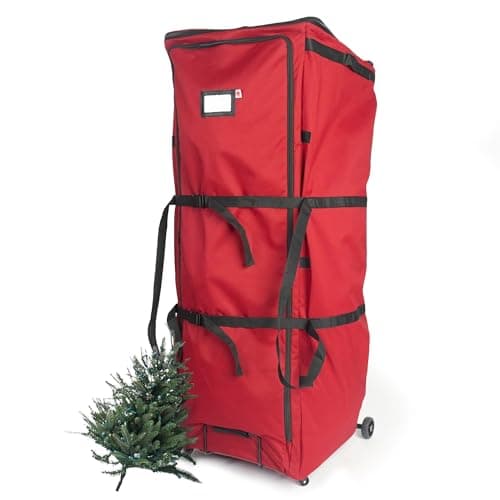
| Elf Stor rolling duffle | 67 x 28 x 28" | Yes, on all three | 600D Oxford canvas | Rollerblade wheels, handles |
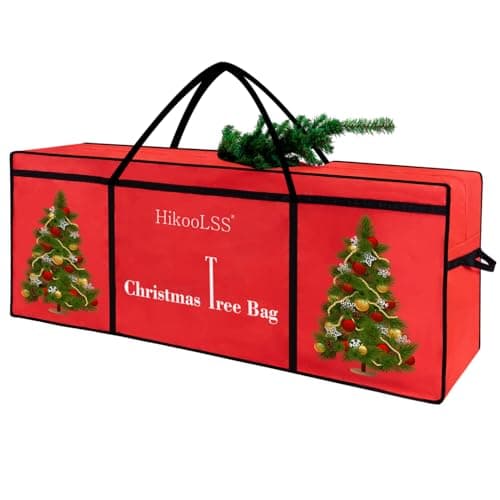
| HikooLSS flat bag | 65 x 23 x 27" | Short 2 in of length, 3 of width | 600D Oxford | 4 handles |
| Santa's Bags dolly | 60-72 x 22 x 22" | Length yes, girth no | 300D over a steel frame | 4 wheels, steel frame |
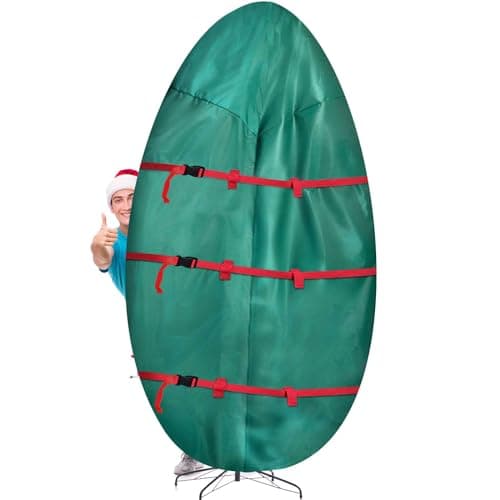
| Wesnoy upright | About 75 x 118" | Different format: tree stays whole | 420D Oxford, PU coated | 3 handles |
| PLTCAT flat bag | 60 or 68 x 20 x 30" | Disputed length, width no | 600D Oxford | Reinforced handles |
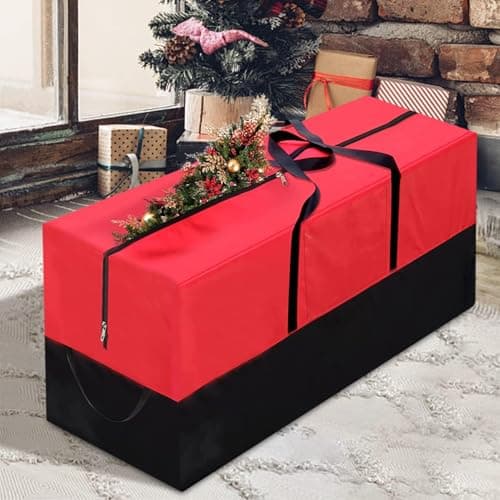
| DNIEBW cushion bag (skip) | 68 x 30 x 20" | Length and width yes, height no | Canvas or Oxford, unclear | 4 handles |
The target in that third column is ours, not a manufacturer's: it comes from the height-to-bag-size table on what size storage bag for your tree, which sets 67 by 26 by 26 inches as the minimum for a 12 ft tree. Read the column and the shape of this category is clear — the bags reach the length and then run out of width.
Why width is where these bags fail
A tall tree is not just a longer version of a 7.5 ft tree. The bottom section of a 12 ft tree carries branches that are themselves four feet long, and when you fold them upward against the pole they stack into a much thicker bundle than a small tree ever makes. That bundle is what the bag's width and height have to swallow.
Compression straps help, and three of the bags here have them, but compression has a limit: past a point you are bending branch wire rather than tightening fabric, and a branch bent at the hinge does not spring back. A bag three inches narrow is not a disaster — a bag three inches narrow on a full-profile tree that also has to be zipped shut from the outside is how zippers fail.
Best overall: the Elf Stor rolling duffle
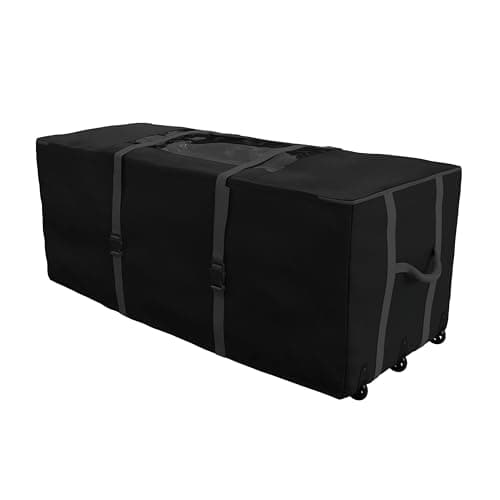
Sixty-seven inches long and twenty-eight inches square, in 600D Oxford canvas, on rollerblade-style wheels with reinforced handles. It is the only bag in this comparison that meets the minimum on all three axes rather than two, and the wheels answer the problem that actually defeats people with a tall tree, which is weight rather than size.
The honest costs are the ones every wheeled bag carries. Wheels and a base add outside dimensions, so this does not slide onto a high shelf the way a flat bag does, and it wants floor space in a garage or basement. No load rating is published, which is a gap it shares with everything else here. The broader wheels-versus-no-wheels argument, including what the wheels cost you in stacking, is on rolling and wheeled tree bags.
Best value flat bag: the HikooLSS
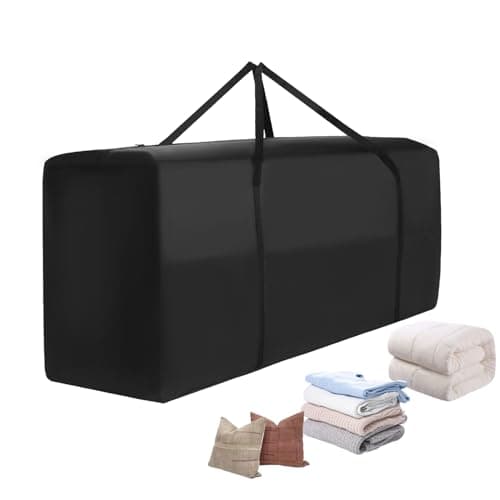
Sixty-five by twenty-three by twenty-seven inches of 600D Oxford, with a dual zipper, four reinforced nylon straps inside, two internal ornament pockets and handles at both ends plus two in the middle. For a bag this size at this price, that is a lot of published detail.
Sixty-five inches of length clears the top of the usual section range for most 12 ft trees, and the four handles are the right answer for a bag that two people should be carrying. What it does not have is width: twenty-three inches is three under the target, so a full-profile 12 ft tree compresses hard and a slim or pencil profile goes in comfortably. Note also that the same published dimensions appear under more than one brand name at a similar price — the factory is the constant in this part of the market, not the brand.
Best on wheels: the Santa's Bags dolly
The one product here whose durability rests on something other than cloth: a full-length steel frame under 300D fabric, four wheels including two oversized rear ones, a U-shaped zipper, inner compression straps that attach to the frame, and a top that expands from 60 to 72 inches. It also publishes a one-year warranty, which almost nothing in tree storage does.
Twenty-two inches square is narrower than our target, so this is a compression-led fit: the straps pull the sections into the frame rather than the bag closing loosely around them. That suits a slim or medium-profile tall tree and fights a wide one. It is also by far the most expensive option here, and the expandable top is the feature that makes it work at 12 ft — buy it for the frame and the wheels, not for volume.
Best if it stays assembled: the upright bag
A different proposition entirely. An upright bag goes over a tree that never comes apart, which saves the assembly hour at both ends of the season and costs you a permanent piece of floor. This one states 9 to 12 ft trees in a bag of roughly 75 by 118 inches, in 420D Oxford with a PU coating, three buckle straps and three nylon handles.
Two things to check before buying into this format at 12 ft. The ceiling where the tree is stored has to clear the tree, and a 12 ft tree in a bag is taller than a 12 ft tree. And the tree has to be moved standing up, which past about 9 ft is genuinely awkward without a rolling stand under it. The format comparison, and the widths each upright bag commits to, are on best upright tree storage bags.
Best budget pick, with a caveat: the PLTCAT
600D Oxford, double zippers, reinforced handles and a clear label pocket on the front, at the bottom of the price range for a bag this size. Thirty inches of height is the most generous figure in the table, and the label pocket is the cheapest feature that stops you opening three bags to find the tree.
The caveat is its length. The bullets say 68 inches; the listing's own dimension field says 60. Those two numbers sit on opposite sides of what a 12 ft tree's longest section needs, so the single most important figure on the listing is one you cannot rely on. At 20 inches it is also the narrowest bag here. If your tree is slim and its longest section measures well under 60 inches, it is a reasonable buy; otherwise the disagreement is disqualifying.
Skip: the patio cushion bag
Sixty-eight by thirty by twenty inches, four reinforced handles, two-way zippers, external straps, and a title that lists patio cushions, furniture, a 12 ft tree and a 12 ft skeleton. The dimensions are real and generous in two directions.
It is a skip for a tree because of what it leaves out and what it cannot say. No compression straps inside, no ornament pockets, no tree profile stated — and a material sentence that describes the bag as made of canvas and made of Oxford cloth in the same breath. Twenty inches of height is also where a tall tree's folded sections stop cooperating. As a cushion bag it is fine. As the thing protecting the most expensive decoration you own, it is not specified well enough to trust.
Measure before you buy
- 1
Take the tree apart and measure the longest section
Pole and all, end to end. This is the only number that matters for length, and on a 12 ft tree it usually lands between 52 and 64 inches.
- 2
Fold the branches up and measure across the bundle
Do it on the bottom section, which is the fattest. Compare that figure against the bag's published width -- not against the tree height on the front of the listing.
- 3
Weigh it if you can, or at least lift it
If one person cannot carry a section comfortably, no bag fixes that. Buy wheels or plan on two people, because no listing here publishes a load rating.
- 4
Measure the storage spot, including the doorway
A 67-inch duffle on wheels has to get through the door of wherever it lives. Tall-tree storage fails on access more often than on capacity.
Limits of this page
These are published-specification comparisons, not hands-on tests. Nobody here loaded a 12 ft tree into each bag and zipped it. The 67 by 26 by 26 inch target is our own working figure from measured section lengths, not a manufacturer standard, and a slim or pencil 12 ft tree will fit things this table says it should not.
The other honest note is about the market. Above 9 ft the choice narrows sharply, half the bags come from sellers with no history, and identical dimensions appear under several brand names. Buy on the published numbers, check the length twice, and treat a listing that disagrees with itself as the warning it is.