The short answer
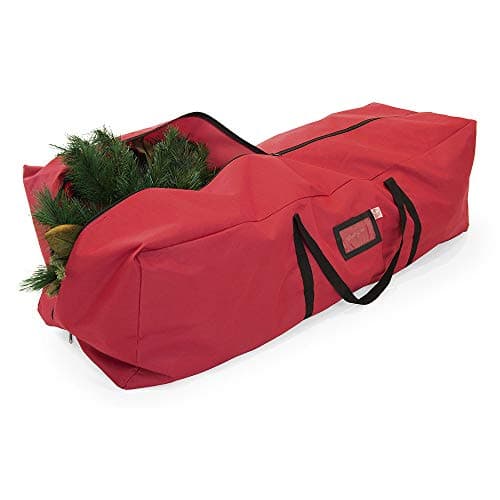
Buy rigid bins for anything fragile, anything with a cord, and anything that will have something stacked on top of it. Buy a fabric bag for the long soft things — garland, stockings, tree skirts, artificial foliage — because a rectangular tote wastes most of its volume on them. Almost every household ends up with four to six bins and one or two bags, and the mistake is buying a seventh bin for one nine-foot garland.
The comparison, on published numbers
Both formats publish enough to compare properly, which is unusual in this category. The figures below are the makers' own, from the pages linked in the sources.
A 48-inch fabric decoration bag against a 27-gallon rigid tote, on published figures| Attribute | Fabric decoration bag | Rigid tote |
|---|
| Published interior | 48" x 14" x 14" | 20 1/8" x 14 1/8" x 18 7/8" |
| Longest item it takes | 48 in | 20 in |
| Crush resistance | None | High |
| Stacks | No | By design, with a recessed lid |
| Seals against damp and pests | No | Latching lid on some models |
| Compresses into an odd space | Yes | No |
| Contents visible without opening | No | On the clear models |
| Published fabric weight or load rating | Neither | Not published either |
| Warranty published | 1 year | None published |
| Built-in label holder | Clear-view ID tag | No |
Two rows in that table do the real work. The bag takes a 48-inch item and the tote takes a 20-inch item, which is the entire argument for owning one bag. And the bag has no crush resistance whatsoever, which is the entire argument against owning only bags.
What a bag is for: shape, not volume
A holiday bin is a rectangle roughly 20 inches long inside. Almost nothing awkward about Christmas is 20 inches long. A nine-foot garland coiled properly is a disc of roughly 14 to 18 inches across and a few inches deep — the figure we use on how to store garland after Christmas — and a stack of those discs is a short cylinder, not a cube. A tree skirt is a circle. Stockings are long and floppy. Artificial swags are long and springy.
Put any of that in a 27-gallon tote and you fill the middle and waste the corners, then buy a second tote for the overflow. Put it in a 48-inch bag with a 14-inch square section and the shape matches the load. That is not a durability argument or a price argument, it is a geometry argument, and geometry is why both formats exist.
The same logic runs in the other direction. A bag is a terrible container for twenty small boxes, because nothing inside it holds position: the first time it is moved, everything settles to the bottom corner. A tote keeps its contents where you put them, which is worth more than it sounds when the contents are ceramic.
What a bin is for: a load path
A rigid tote carries weight through its walls, which is why it stacks and why a bag never will. The Sterilite Stacker publishes a deep recessed lid designed for stacking and shares a lid footprint across its 10, 19 and 27 gallon sizes, so a mixed stack keeps one footprint. That is a structural specification. “Reinforced handles” on a bag is not.
The second thing a bin does is close. A latching lid on the ClearView box is a physical catch, not a zip that a shifting load works open over ten months, and it is the difference between a container that keeps dust out and one that keeps damp and insects out for the most part. No fabric bag on this page seals, and none of their makers claims one does.
The third thing is that good bins publish their inside dimensions. Gallons cannot tell you whether a divided ornament box stands up inside; 18 7/8 inches of interior height can. The full set of published interiors is on holiday storage containers by capacity, and it is the table to check before buying anything at all.
The decoration-by-decoration answer
Which format each category of decoration actually wants| What you are storing | Format | Why |
|---|
| Garland and artificial swags | Bag | Coils to a 14-18 in disc; a long bag matches the shape |
| Stockings, tree skirts, table linen | Bag | Soft, long, and nothing is damaged by compression |
| Glass and painted ornaments | Divided box, then a bin | Cells stop contact; the bin stops crushing |
| Light strands on reels | Bin | Reels are rigid and stack; a bag lets them shift and tangle |
| Wreaths | Wreath container | Diameter-specific; neither a tote nor a long bag fits a 30 in wreath |
| Ceramic village pieces | Divided box, then a bin | Fragile, irregular, and cord-carrying |
| Inflatables and yard decor | Bin | Must be bone dry; a sealed rigid box is easier to check |
| The tree itself | Tree bag | Sections are 34-50 in long; no household tote takes them |
Three of those rows have their own pages, because the answer is more than one line: ornament storage for the divided-box question, wreath and garland containers for the diameter problem, and bag versus box for the tree, which is the same argument as this page run over a single very awkward object.
Where bags lose, honestly
Neither bag on this page publishes a denier or a load rating. The material is described as “durable, wipe-clean polyester”, which is an adjective where the tree bags in the same brand family at least state a number. We rank on published figures, so an unpublished fabric weight costs a product points here rather than earning it the benefit of the doubt.
Neither closes against anything but dust. In an unheated garage with a mouse problem, a fabric bag full of soft foliage is closer to bedding than to storage, and no amount of zip quality changes that. If your space is damp or shared with wildlife, the honest recommendation is a latching rigid box and a smaller bag count, not a better bag.
And a bag has no bottom of its own. Loaded with something dense it sags into a shape that will not sit flat on a shelf, and the reinforced handles are then carrying the whole load through two stitched anchor points. Keep bags for light, bulky, soft things and the format works. Load one with hardware and it becomes the worst container you own.
Where bins lose, honestly
A 27-gallon tote is 25 3/4 inches of shelf for 20 1/8 inches of usable length, so more than five inches of every bin is wall, lip and lid. Buy six and you have given up two and a half feet of shelf to plastic. That is a fair trade for crush resistance and a bad trade for a garland.
Weight is the other real cost. Twenty-seven gallons of decorations is heavier than most people should be carrying down a loft ladder, and the honest answer for an attic is more, smaller boxes rather than fewer large ones — the reasoning is in attic versus garage versus basement.
Bins are also sold in gallons, which is a volume figure that tells you nothing about whether a specific object fits. Two 27-gallon totes can differ by four inches of interior height for the same stated capacity. Always buy on the interior dimension, never on the number on the label.
How many of each, for a normal house
Four to six rigid bins, one or two long bags, and the tree in its own bag. Sort the bins by category rather than by room — ornaments, lights, wreaths and garland hardware, table and mantel, outdoor — because December unpacking happens by category, not by where things ended up in the loft.
The bags absorb the items that would otherwise force a bin purchase for one object: the garland run, the stockings, the tree skirt, the roll of artificial greenery. Buying one 48-inch bag instead of a seventh tote is usually both cheaper and a better fit, which is the rare case where the frugal answer and the correct answer are the same.
Whatever the split, label both formats. The bags here carry a clear-view ID tag built in; the bins need a label you add. The system that survives a real attic is on labeling so you find it next year.
Sort in this order
- 1
Separate fragile from not fragile
Everything glass, ceramic, painted or corded goes on one side of the floor. That side is going into divided boxes inside rigid bins, and nothing on it will ever go in a bag.
- 2
Pull out the long soft items
Garland, swags, stockings, tree skirt, table runners. Measure the longest one coiled or folded as it will be stored, not laid out flat.
- 3
Match the bag length to that measurement
A 36-inch bag fits a standard closet shelf; a 48-inch bag needs four feet of clear run but holds several garland coils. Buy for the shelf you actually have.
- 4
Buy bins on interior dimensions for the rest
Check the interior height against the tallest thing going in, usually a divided ornament box. Gallons will not answer that question and interior dimensions will.
What we cannot tell you
We have not handled either format. Every figure above is published by the maker and linked in the sources, and where a maker publishes nothing — the fabric weight on both bags, the load rating on all five products — the tables say so rather than carrying a guess. What we can compare honestly is what each company was willing to print, and on that measure the rigid bins publish their interiors and the bags publish their exteriors and a warranty.
There is one space where this stops being a trade and becomes a single answer. In a garage with a rodent problem, a zipper is an open seam and a bag full of soft foliage is a nest — the containers that remove the easy routes in are on rodent-proof holiday storage bins.
The full method, including what would get a product pulled from a ranking, is at how we pick.