The short answer
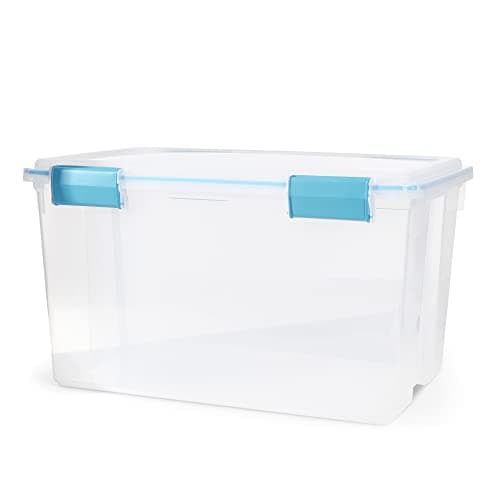
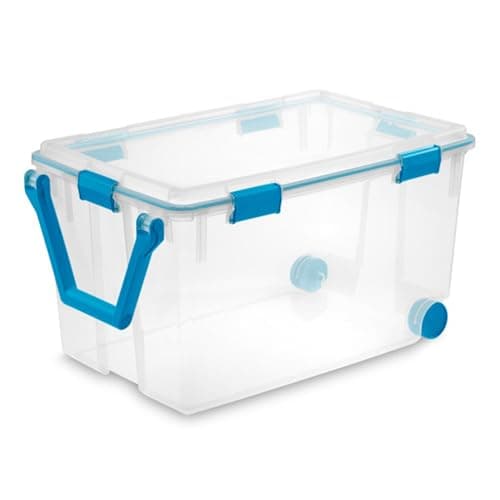
There is no rodent-proof storage bin. Nothing in this category publishes a rodent claim, and the University of Nebraska-Lincoln Extension rodent-proofing guide lists plastic among the materials mice gnaw through. What genuinely lowers the risk is a rigid box whose lid closes on a gasket and latches rather than on a seam — the Sterilite 120 Qt. Wheeled Gasket Box for a garage floor, the 54-quart version if you have to carry it. And the step that does more than either costs nothing: take the pine cones, berries and popcorn garland out before the lid goes on.
Why there is no such product
We went looking for a published rodent claim across every bin, tote and bag on this site and did not find one. Makers publish capacity, interior dimensions, lid type, stacking geometry and, in one case, an IP68 dust and water rating. None of them says anything about pests, which is the correct decision on their part: it is not a claim they could stand behind.
The guidance that does exist is about buildings rather than boxes. Rodent-Proof Construction — Structural (NebGuide G1530) from University of Nebraska-Lincoln Extension states that rats and mice gnaw through a wide variety of materials “including aluminum sheeting, wood, rubber, vinyl, plastic, and concrete block”, and that gnawing can quickly enlarge smaller crevices. The materials it recommends for exclusion are metal mesh: 24-gauge hardware cloth at quarter-inch mesh for mice, 19-gauge at half-inch for rats.
So the honest version of this page is not a ranking of rodent-proof bins. It is a ranking of the containers that remove the easy routes in, next to a plain statement of what they do not do.
The three things that change the odds
Two of them are published figures you can check before buying. The third is free and matters most.
- Whether the closed lid leaves a gap. Nebraska Extension puts the threshold at slightly more than a quarter inch for a mouse. An ordinary friction-fit lid rests on a seam that runs the whole perimeter of the box; a gasket with latches compresses that seam shut. This is the only one of the three where paying more buys something measurable.
- Whether the wall is rigid or fabric. Rigid polypropylene is on the extension guide's gnaw list, so it is not a barrier — but it is a flat hard surface with no edge to start on, and a loaded tote does not deform to give one. A polyester bag with a zipper gives both the edge and the opening.
- Whether there is a reason to try. Rodents are indifferent to polyester foliage, glass and plastic, and extremely interested in pine cones, dried berries, citrus slices, cinnamon, raffia and paper. The container decision is second; the first decision is whether the box contains food.
The closure ladder, on published figures
What each format publishes about how it closes| Format | Published closure | Wall | What we would store in it |
|---|
| Wheeled gasket box | Gasket seal with tight-fitting latches | Rigid, 15 1/8 in interior height | Anything organic, paper or fabric, on a garage floor |
| Gasket box, 54 qt | Silicone gasket, wide latches, IP68 stated | Rigid, 18 7/8 in interior length | The fragile and paper categories, carried up to a shelf |
| Latching box | Latching lid, no gasket | Rigid, clear, 12 7/8 in interior height | One category per bin on dry indoor shelves |
| Friction-lid tote | Lid only, no latch published | Rigid, opaque, thick-walled | Plastic foliage, tinsel, hardware |
| Fabric bag | Zipper | Polyester, no denier published on most | Nothing, in a space with a mouse problem |
| Cardboard box | Flaps | Paper | Nothing. It is both the door and the nest material |
The step that costs nothing
Strip the organic material first. On most store-bought wreaths and garlands the pine cones, berries and citrus slices are wired on and come off in a couple of minutes. Popcorn and cranberry garlands, dried orange rings, cinnamon sticks and gingerbread ornaments do not belong in a stored box at all. Paper is nesting material rather than food, which is a reason to keep wrapping paper, cards and tissue inside the house rather than in the garage.
Then raise everything off the floor. A shelf, a pallet or two lengths of timber removes the coldest, dampest surface in the room and makes every box a climb rather than a walk. The same move solves the condensation problem, which is why it appears on attic versus garage versus basement as well.
Which box for which category
The wheeled gasket box is the one we would put on a garage floor. It is the only sealed container we have measured that also rolls, and at 15 1/8 in of published interior height it stands a 128-ornament box upright inside a sealed bin. Its seal is described in words — a gasket and tight-fitting latches — with no rating published, which is less than its smaller sibling states.
The 54-quart gasket box publishes the stronger claim: a silicone gasket with wide latches, stated by the maker as waterproof, dustproof, IP68-rated and fully submersible. It is also the one a single person lifts loaded. Its interior is narrow at 12 5/8 in, so a standard 64-ornament box does not lie flat in it — check that before buying.
The latching ClearView and the Roughneck tote are the dry-shelf containers. Neither publishes a gasket, so neither closes the perimeter seam, and both are a sensible buy for the categories nothing wants to eat: plastic foliage, tinsel, light strands once dry, stands and hardware. The full seal ladder from lid to gasket, and what waterproofing does and does not protect, is on waterproof holiday storage bins.
What is not a barrier
Fabric bags. Every tree bag, wreath bag and multi-use bag on this site is a dry-shelf product, and in a space with a rodent problem that is the only place for them: a zipper is an open seam, and a bag full of soft polyester foliage is a finished nest once something is inside. That is not a criticism of the bags — it is the published reality of what they are, and the trade is laid out on Christmas storage bags versus bins.
Cardboard is worse, because it is simultaneously the door and the nesting material. That includes the boxes ornaments came in, which is the one case where we would say keep the box and put the box inside something rigid — the reasoning is on storing keepsake ornaments in their original boxes.
And a sealed box is only as good as what you close it on. A gasket holds in moisture as reliably as it holds out dust, so anything damp — a wreath off a front door, a light strand off a wet gutter, a tree skirt from under a watered tree — must be bone dry before the latches go down. Sealing a damp wreath into a gasket box in January is how you trade a mouse problem for a mold problem.