The short answer
Buy on published diameter, not on fabric weight. A flocked tree loses its coating to compression and rubbing, so the bag you want is one whose stated fit is wider than your tree — the Santa's Bags Pro Upright publishes 72 in of diameter against the 40 in the standard upright states, and it zips fully shut with no drawstring to cinch. Store it cool and dry rather than in an attic, shake the loose flocking off first, and never pull the compression straps tight.
What actually takes the flocking off
Flocking is a coating applied to the outside of the needles, which is why it behaves nothing like the rest of an artificial tree. Polyester foliage does not care what you do to it in storage; a flocked surface is damaged by two specific things, and both of them happen during a pack-down rather than during the season.
Compression. King of Christmas's storage guide states that overly compressed tree branches can result in damaged flocking, and tells you to make the wrap snug but not so tight that it compresses the branches. Balsam Hill's own storage instructions use almost the same words from the other end of the market: wrap sections snugly, but not so tight that the branches are crushed and the flocking is damaged.
Abrasion. The other mechanism is rubbing, which is what a bag dragged across a concrete floor does to the branches pressed against its inside face. King of Christmas tells you to handle the tree gently to prevent the flocking flaking off, and to keep sections away from heavy objects that could crush the branches.
Notice what is missing from both of those. Neither maker publishes a figure for “gently”, and neither could. That is the gap this page is about.
So buy the figure that removes the judgment call
If compression is the risk and nobody will tell you how much is too much, the answer is to buy a container large enough that you never have to compress at all. That turns a judgment call into a measurement, and it reorders the whole tree-bag ranking.
- Published diameter or width fit, first. Measure your tree across the bottom branches with the tree standing. You want a bag whose stated fit exceeds that, not one that merely mentions your tree's height.
- How the bag closes, second. A zipper that closes on a roomy bag is doing nothing to the branches. A drawstring or a set of buckle straps closes by pulling the branches in, which is the mechanism you are trying to avoid.
- Whether it rolls, third. Dragging is abrasion. A bag that comes with a rolling stand moves the tree on its base rather than on its branches.
- Fabric weight last. This is the reverse of our usual order, and it is deliberate: 600D against 300D matters when a bag is being hauled up a ladder loaded, and matters very little to a coating that is damaged by the bag being too small.
What each bag states about width, and how it closes| Bag | Published fit | How it closes | Flocked verdict |
|---|
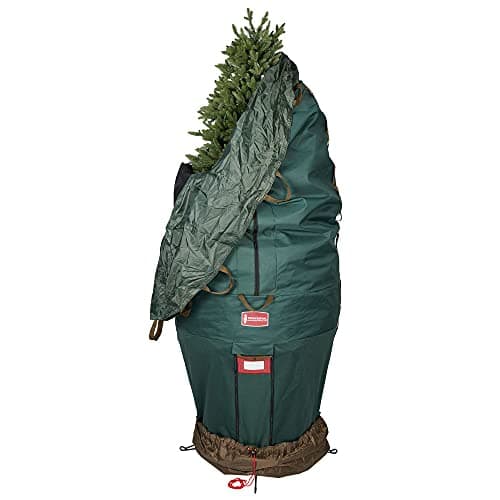
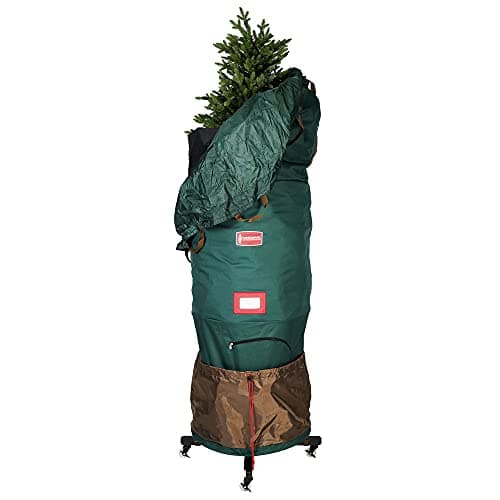
| Santa's Bags Pro Upright | 9 ft tall, 72" diameter | Zipper, fully shut, no drawstring | Best: the most room, nothing cinches |
| TreeKeeper Large Upright | 9 ft tall, over 6 ft wide | Zipper; top section comes off over 7 1/2 ft | Good: wide, but the tree splits |
| TreeKeeper Upright + stand | 9 ft tall, under 6 ft wide | Zipper, on its own rolling base | Good if it must be moved |
| Santa's Bags Upright | 9 ft tall, 40" diameter | Zipper, drawstring and compression straps | Avoid: the straps are the risk |
| Wesnoy Jumbo Upright | 9 to 12 ft tall, width not published | Zipper plus 3 buckle straps | Avoid: straps, and no width figure |
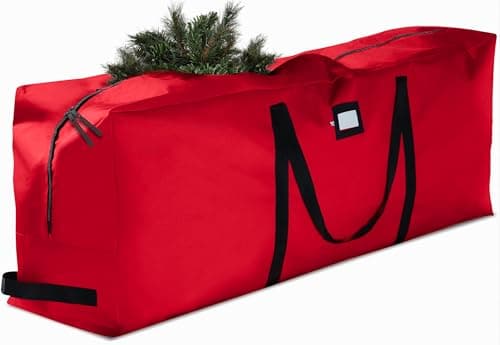
| Zober 600D flat bag | 65 x 15 x 30 in, tree disassembled | Zipper | Fine, if the tree comes apart |
The pattern is clear enough to act on. Every bag that advertises compression hardware is advertising the one feature a flocked tree does not want, and the two bags that publish the most generous width figures close on a plain zipper. That is why the ranking on this page is not the ranking on the best upright bags, where compression straps are a genuine advantage for an ordinary pre-lit tree.
The pack-down, in order
- 1
Shake it before you touch anything else
Standing, over a floor you can sweep. The guidance we read says to gently shake the tree to dislodge loose flocking and dust. Shedding at this stage is normal and is far better on the floor than inside the bag.
- 2
Dust with a soft brush, never anything damp
A soft brush or a feather duster. Water and cleaning products are named specifically as things to avoid, because moisture damages flocking.
- 3
Measure the tree across the bottom branches
With the tree still standing. This figure, not the tree's height, is the one to check against the bag's published diameter or width fit.
- 4
Lift the tree into the bag rather than pushing the bag over it
Branches dragged down the inside of a bag is abrasion along their whole length. Two people and a lift is gentler than one person and a shove.
- 5
Close the zipper and leave the straps loose
If the bag has compression straps, fasten them without tension, just enough that they are not flapping. If the zipper will not close without pulling them tight, the bag is too small for this tree.
- 6
Store it standing, cool and dry, with nothing on it
A conditioned closet or a dry basement rather than an unconditioned attic. In a humid climate, silica gel packets in the bag are suggested by both makers' guidance.
Where it goes, and why the attic is the wrong answer
This is the one category where we would override the usual advice that bulky items go wherever there is room. King of Christmas names a cool, dry basement, attic or closet as potentially suitable and then rules out extreme temperatures and high humidity because both damage flocking — and an unconditioned attic is precisely where temperature swings hardest.
Balsam Hill is blunter about the consequence on its own trees: damage caused by improper storage conditions, such as excessive heat or humidity, is not covered by the tree's warranty. If you spent flocked-tree money, the storage location is part of what you bought.
So: a conditioned closet first, a dry basement second, a garage third, an attic last. That ordering is the reverse of what the tree's size suggests, and it is the same reasoning applied to glass ornaments on attic versus garage versus basement.
Taking it apart, or not
Leaving a flocked tree assembled is gentler on the coating, because every disassembly is another round of handling and every section stacked on another section is pressure. If you have the headroom and the floor space, an upright bag with room to spare is the least damaging arrangement available.
The honest caveat is headroom: a bag published at 108 inches is nine feet tall and does not stand up under an eight-foot ceiling, and the TreeKeeper listings state that trees over 7 1/2 feet need the top section removed and stored at the base of the bag. If none of that fits your space, take the tree apart and use the roomiest flat bag you can — the Zober publishes 65 in of length, the most generous flat-bag figure we found, which means the sections lie in it rather than being forced. The full case for each format is on upright versus flat tree storage bags, and keeping a tree assembled is covered on storing a tree without taking it apart.
One thing we will not tell you is that any bag stops flocking shedding. All of them let some go, every maker whose guidance we read says to expect it, and a tree that sheds a little each January is behaving normally rather than failing. What the published diameter figure buys you is the difference between shedding and bald patches.