The short answer
Test it, wind it from the plug end onto its own reel under light even tension, label the reel, and store the reels in their slots. A strand alone on a reel cannot tangle, because tangling requires a second strand.
What a tangle actually is
A tangle is two or more flexible strands crossing each other repeatedly. One strand, on its own, coils. It might knot loosely if it is thrown into a box, but a single-strand knot pulls out in seconds.
The January morning with a ball of wire on the floor requires several strands in one container, moving against each other over ten months. Once you see it that way, the entire product category makes sense: everything in it is a mechanism for keeping strands apart.
The method
- 1
Test every strand while it is still up
Plug each one in and look. A failed strand discovered now is a note on a reel; discovered in December it is an evening and a shop trip.
- 2
Take down one strand at a time, completely
Off the tree, wound, on the reel, before you touch the next one. Pulling three strands off and leaving them on the sofa is how the tangle starts, and it is the step everyone skips because it feels slower.
- 3
Start at the plug end
Tape the plug down or tuck it into the reel's notch, then wind toward the tail. Next December you unwind from the tail and the plug arrives last, nearest the socket where you need it.
- 4
Wind under even, light tension
The feel of coiling a garden hose. Too loose and the strand slips off the flange in the box. Too tight and every bulb socket is under stress for ten months, which is where these strands fail.
- 5
One strand per reel
The rule the whole method serves. If you are short of reels, buy another reel rather than doubling up.
- 6
Label the reel
Masking tape and a marker. Where it goes, roughly how long it is, and whether it passed. Thirty seconds now saves fifteen minutes of trial and error next year.
- 7
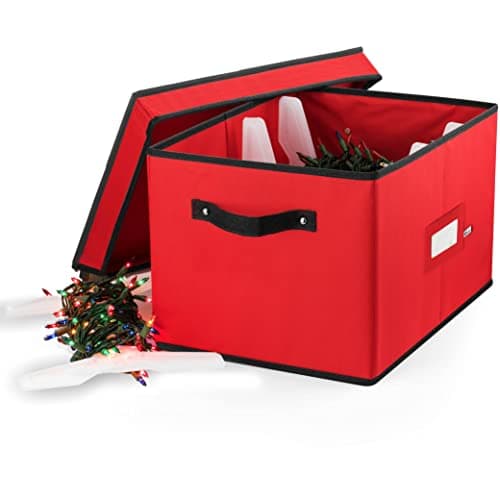
Store the reels in their slots
Not loose in a bin. A reel rolling around unwinds itself, and an unwound reel in a bin of reels is exactly the situation you started with.
Why testing first is worth more than any container
Half the misery of putting lights up is discovering that one strand is dead after you have already run it along a roofline. Testing at take-down moves that discovery to a moment when you can do something about it calmly, and it costs about thirty seconds per strand.
Write the result on the reel label. “Tested Jan, OK” is enough. A strand that failed either gets a note to replace it or goes in the bin then and there rather than being stored for a year and thrown out anyway.
Tension, specifically
This is the detail that separates a reel that works from one that annoys you. Wound too loose, the coil is wider than the flange and slips off the side in the container; you then have a half-unwound strand mixed with the others, which is the tangle again.
Wound too tight, every bulb socket carries a constant bending load for ten months. Sockets are where strands fail, and repeated tight winding is a plausible reason a strand that worked in January does not in December.
If you have more strands than reels
Three honest options. Buy another reel set — they are inexpensive and the published capacities are on the strand count page. Make cord wraps from cardboard for the short indoor runs, which genuinely works and is covered on DIY versus bought. Or deliberately wind two short strands together as one unit and label them as a pair, accepting that they come out together.
What does not work is putting the extras loose in the same container. One loose strand among reels finds them all.
Outdoor strands need one extra step
Let them dry indoors overnight before winding. A strand that comes down wet and goes onto a reel in a sealed container spends ten months with moisture in the sockets. Full detail on outdoor and exterior light storage, and the same drying rule applied to the cords, timers and clips that came down with them on storing light cords, clips and hardware.
Every step above assumes the set is a strand. Two common ones are not: an icicle set is a common wire with drops hanging off it, and a net is a mesh, and neither goes on a reel without becoming the thing you were trying to avoid. Both are handled on storing icicle and net lights.