The short answer
Secure the loose end of every roll before anything else — a cut section of an old cardboard tube slipped over the outside works perfectly and costs nothing. Then load the rolls flat and parallel, tape and scissors in the pockets, bags flat underneath, and store it somewhere dark and dry.
The loose end is the whole problem
Most wrapping paper damage is not a crease from being lain flat. It is the outer layer unwinding inside the container, catching on something, and tearing or creasing along the length. That happens to every roll that is not secured, and securing takes four seconds.
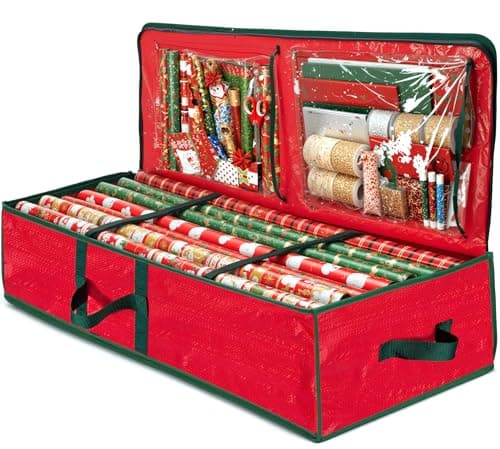
The best free method: keep one finished cardboard tube, cut it into three-inch rings with a knife, and slide a ring over the middle of each roll. It holds the outer layer down without pressing a line into it, which is more than a rubber band manages. For two or three rolls that ring and a closet corner are the whole system; where the free version stops and a bought organizer starts earning its money is on cheap wrapping paper storage.
The method
- 1
Secure every loose end
Tube ring, hook-and-loop strap, or a loose rubber band. A rubber band left tight for months will emboss the paper, so keep it loose.
- 2
Sort seasonal from everyday
Christmas paper at the bottom, birthday paper on top. You will open this container in March and you do not want to unpack it to reach one roll.
- 3
Measure your longest roll
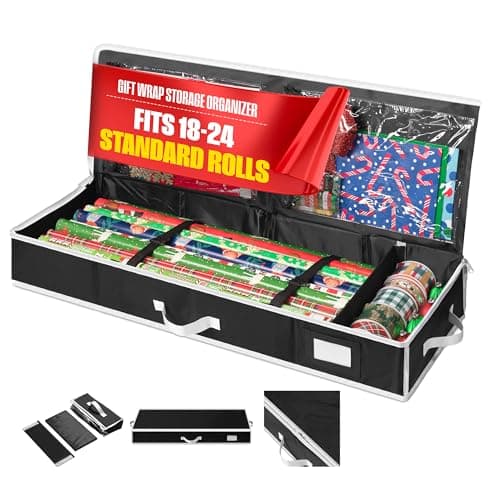
Then check it against the container's published interior length. Forty-inch rolls need one of the fabric formats.
- 4
Load flat and parallel
Every tube pointing the same way, nested. A roll lying across the others takes all the weight at two points and creases in both.
- 5
Small items in the pockets
Tape, scissors, tags, ribbon. Not loose on top of the rolls, where a pair of scissors presses a line into three of them.
- 6
Gift bags flat, underneath
Flattened, at the bottom. A gift bag on top gets crushed by the lid, and a crushed bag does not recover.
- 7
Store dark and dry
Under a bed, in a closet, on top of a wardrobe. Light fades it and humidity curls it.
Where paper actually survives
Two things end a roll of wrapping paper, and neither is mechanical.
Light. Printed paper fades, and reds and metallics go first. This is the one case where a clear container is the wrong choice: clear plastic is helpful for finding things and unhelpful for anything printed. Store wrap in an opaque container, or in a clear one somewhere genuinely dark.
Humidity. Paper takes up moisture from the air, and a roll that has been in a damp garage develops soft, wavy edges that never quite flatten. A conditioned interior closet or under a bed is dramatically better than a garage for this, and it costs nothing to choose. See attic versus garage versus basement for what each location does across the whole decoration set.
The five-second habit
When you put the container away, give the rolls a quarter turn. The contact line where a roll rests moves to a different part of the sheet, so no single line bears the weight two years running.
It is a small thing and it is the entire practical difference between flat storage and upright storage, which is the trade we work through on cart versus bag.