Skip to content
Tinsel Tote

Wrap Cart vs Under-Bed Bag

One holds twice as much and vanishes. The other keeps the paper flat and stays in the room all year.

By Scooter M.Published Last verified

Disclosure: buy links on this page go to Amazon and earn us a commission at no cost to you. It does not change what we rank or what we say about it — the full disclosure is here.

The short answer

The bag, for almost everyone. It holds roughly twice as many rolls and occupies space nobody was using. The cart wins in one specific case: you wrap all year and want the rolls standing, visible and reachable without getting on the floor.

Side by side

Published figures for each format
Under-bed bagRolling cart
Published capacity18 to 24 standard rolls3 to 12 rolls
Published dimensions40.5 x 14 x 6 inNot published as one figure
Space usedUnder a bedFloor, all year
Paper orientationFlatUpright
Crease riskReal but minorNone
AccessPull the bag outWheel it over
Ribbon and tapeInterior pocketsRods and drawers

The crease, honestly

A roll stored on its side rests along a single line for ten months and paper takes a set. It is real. It is also usually a faint line rather than a ruined roll, and it lands on the outermost layer, which is the part you unroll and discard first anyway.

There is a free mitigation almost nobody does: give the rolls a quarter-turn when you put the bag away, so the contact line falls somewhere different each year. That takes five seconds and removes most of the argument for a cart.

The capacity gap is the real story

Eighteen to twenty-four rolls versus three to twelve. That is not a close comparison, and it is a consequence of geometry rather than design quality: rolls standing upright need floor area per roll, while rolls lying flat nest against each other.

If you own six rolls, this does not matter and the cart is a perfectly reasonable buy. If you own twenty, the cart is not an option and you were never really choosing.

Who should buy a cart

Someone who wraps continuously. Birthdays, small business orders, craft work. In that use the cart's advantage is not storage at all — it is that the whole operation wheels to a table and back, with the tape and scissors traveling with it. That is worth a square foot of floor.

Someone who wraps in the third week of December is buying a permanent object for a temporary job. That is the case where we would say no.

The 40-inch caveat applies to both

Whichever you choose, measure your longest roll. Christmas rolls are commonly 40 inches and everyday rolls commonly 30, and a cart sized for 30-inch rolls will not hold a 40-inch one upright any more than a 37-inch box will hold one flat.

The bag we recommend publishes 40.5 inches of interior length for exactly this reason. The carts we looked at do not publish a maximum roll length at all, which is a gap worth knowing about. Full detail on storage for long rolls.
What to buy for this

The products that answer the question above, with the manufacturer's published numbers and what each one costs you.

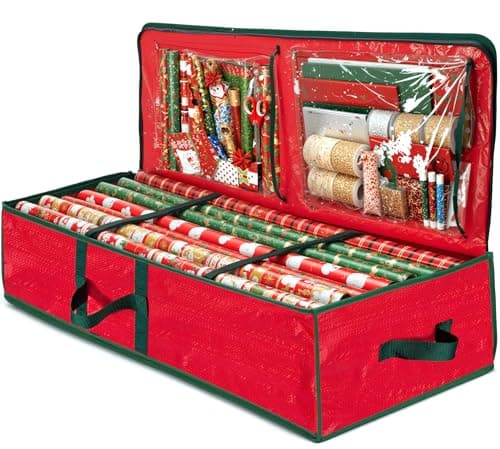
Zober Underbed Gift Wrap Organizer (40 in)

40.5 inches of published interior length and 6 inches of height. Those two numbers together are why a 40-inch roll goes in flat and the bag still slides under a bed.

Published specifications

Organizer dimensions
40.5" L x 14" W x 6" HZober listing, Amazon
Capacity
Fits 18 to 24 standard rollsZober listing, Amazon
Material
Water-resistant polyester, stated tear-proofZober listing, Amazon
Extras
Interior pockets, zipper closure, collapsibleZober listing, Amazon

What it gets right

  • 40.5 inches is genuinely long enough for a 40-inch roll, with half an inch to spare and no bending
  • 6 inches tall clears most bed frames, so the storage location is free
  • Interior pockets take the tape and scissors, which is where they get lost otherwise

What it costs you

  • Lying flat means rolls can slump into each other, and there is no rigid divider
  • Half an inch of clearance on a 40-inch roll is not much if the roll is bowed

Do not buy it if: Your rolls are all the 30-inch standard. You are buying ten inches of bag you will never fill.

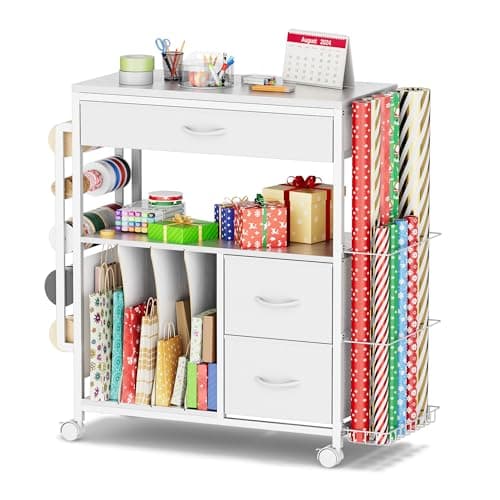
PUNLUXU Rolling Wrapping Paper Storage Cart

Vertical and on wheels, holding 3 to 12 rolls. Storing rolls upright is the one arrangement that never leaves a crease down the sheet.

Published specifications

Capacity
3 to 12 rolls of varying sizesPUNLUXU listing, Amazon
Format
Vertical rolling cartPUNLUXU listing, Amazon
Cart dimensions
Not published as a single figure on the listing we readPUNLUXU listing, Amazon

What it gets right

  • Vertical storage is the only arrangement that keeps a partly used roll from creasing where it rests
  • Wheels mean it lives in a closet and comes out to the table, which is the actual workflow

What it costs you

  • 12 rolls is a fraction of what a 40-inch under-bed bag takes
  • A cart occupies floor space all year for a job that is seasonal for most people

Do not buy it if: You wrap twice a year. A cart is for people who wrap constantly; everyone else is better served by a flat bag that disappears under a bed.

Questions people ask

Is a wrapping paper cart worth buying?
Only if you wrap year-round. A cart holds 3 to 12 rolls against 18 to 24 in an under-bed bag, and it occupies floor space for the ten months you are not using it. If you wrap birthdays constantly, or run a small shop, the accessibility is genuinely worth it. If Christmas is the whole use case, the bag is the better buy by a distance.
Does storing wrapping paper flat ruin it?
It creases it. A roll lying on its side rests along one line of contact for months and the paper takes a set there. It is usually a faint crease rather than a ruined sheet, and rotating the rolls a quarter turn when you put them away largely prevents it. Upright storage avoids it entirely, which is the cart's real advantage.
How much floor space does a wrap cart take?
The carts we found publish footprints around 16 by 11 inches, or a little over one square foot, and stand roughly 32 inches tall. That is small, but it is floor space in a room rather than dead space under a bed, and it is occupied all year.

Sources