The short answer
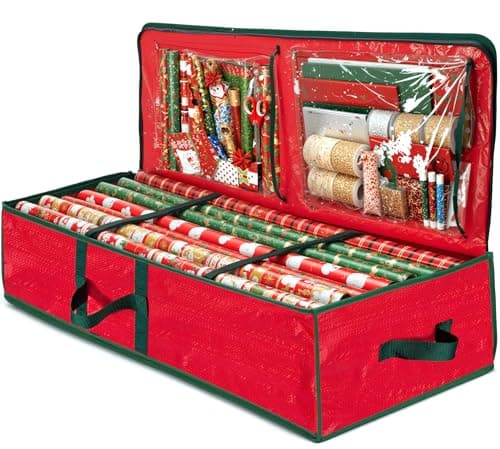
Packing order is the whole method: flattened gift bags and tissue at the bottom, rolls next, tape and scissors in a pocket, bows last and on top with nothing pressing on them. Ribbon stays on its spool with the tail secured.
The packing order, and why it is that order
- 1
Secure every ribbon tail
A binder clip, or a pin pushed through the ribbon into the spool. Ribbon that comes off its spool wraps around every other item in the container and is functionally lost.
- 2
Flatten the gift bags and sort by size
Flat bags take almost no space and are not damaged by weight above them. Keep the tissue paper flat with them.
- 3
Bags and tissue in first
Bottom layer. This is the counterintuitive bit: the flimsiest items go underneath, because flat and pressed is their natural state.
- 4
Rolls next, flat and parallel
Tubes all pointing the same way. A roll lying across the others bears weight at two points and creases at both.
- 5
Tape, scissors and tags into a pocket
An interior pocket if the container publishes one. Loose scissors resting on a roll emboss a line into several layers of paper.
- 6
Bows last, on top, uncompressed
Do not pack above the lid line. A bow is the one item here that does not recover from being crushed.
Ribbon
Ribbon is durable. Creased ribbon can be pulled through a warm hand or lightly steamed and it comes back. The failure mode is not damage, it is tangle: a loose end finds another spool, and by next December you have a knot with four colors in it.
So the whole job is securing tails. Binder clips are the neatest because they come off in one motion. A pin through the ribbon into the cardboard core works and leaves a tiny hole you will never see. A rubber band around the spool works and is the version everybody already owns.
Bows
Bows are the opposite: they take almost no abuse and never recover. A pre-made bow is held in shape by the set in the ribbon loops, and once those loops are flattened under weight the bow is finished.
If you own a handful, they go on top of the wrap container and you keep the lid from pressing. If you own dozens — and people who make their own do — give them a shallow rigid box of their own with nothing stacked on it. A 66 qt ClearView publishing 12 7/8 inches of interior height holds a lot of bows and is rigid enough that the lid takes any weight, not the contents.
Gift bags
Flatten them. Every one. A flattened bag is a sheet of card and behaves like one; an unflattened bag is a box full of air that gets crushed into a diagonal fold across the printed face.
Sort by size while you are at it, because the reason people keep gift bags is to have the right size available, and a stack of forty unsorted bags does not achieve that. Three rough groups — small, wine-bottle, large — is enough.
The tape problem
Tape is the item most reliably missing in December, and it is missing because it is small, useful and gets borrowed. The fix is not a storage product, it is a rule: the wrapping tape lives in the wrap container and nowhere else, and there is a separate roll for household use.
Interior pockets exist for exactly this. Both fabric organizers we recommend publish them. If yours does not, a zip bag clipped to the inside works. The general principle — that the container holds the whole task, not just the bulky part of it — is what makes a pack-down actually save time next year. It runs through the pack-down checklist as well.
If the tape going missing is a symptom of having no fixed place to wrap, the fix is a station rather than a container, and the four formats are compared on how to set up a gift wrapping station. The other paper keepsake that comes out of the same pack-down, the cards, is on storing the Christmas cards you keep.