The short answer
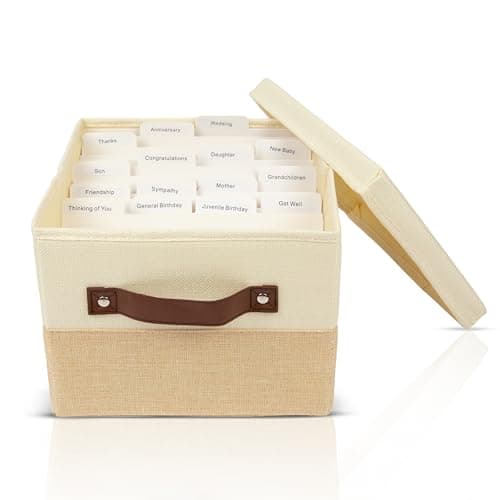
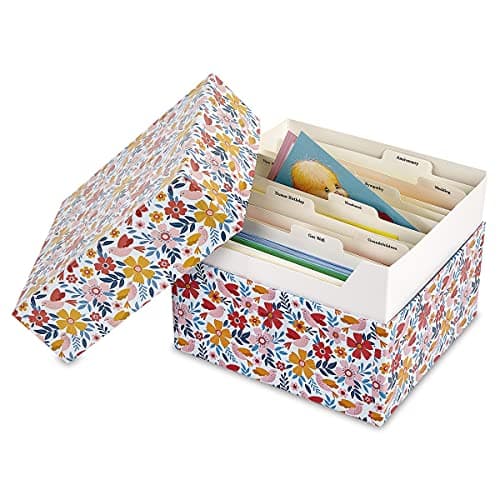
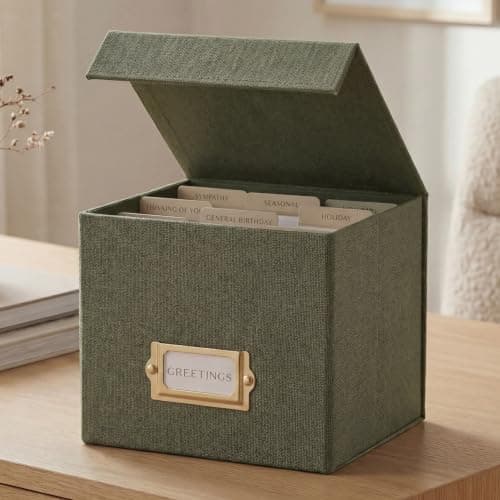
Keep them inside the house, sorted upright in a divided box that states an acid-free lining — of the three card organizers we read, only the Kalolo Malosi publishes that claim, alongside 15 dividers, 150+ cards and a published 9.5 x 9 x 7.5 in. Cards are paper, so the location question answers itself: not the garage, not the attic. And ignore the biggest capacity number on the shelf; it does not survive being divided by the box.
The location decision is already made
Most of this site is about finding somewhere for things that are too big to keep indoors. Cards are the opposite problem: a decade of kept cards is a shoebox, and there is no reason at all for it to leave the conditioned part of the house.
Paper is the single worst material for the three usual storage locations. It absorbs humidity, which rules out a damp basement; it is nesting material, which rules out anywhere with rodent access; and it discolors with heat cycling, which rules out an unconditioned attic. The full comparison of what each location does over ten months is on attic versus garage versus basement, and paper falls on the wrong side of all three columns.
So the card box lives on a closet shelf, in a drawer, or with the wrapping paper. That decision is free and it matters more than which box you buy.
What we judged the boxes on
We have not bought or handled any of these. The ranking is the published claims, in this order.
- An acid-free or archival claim. This is the only specification in the category that does anything the box's shape does not. Acidic board in long contact with paper discolors it along the contact line, which on a card is the bottom edge and the face touching the divider. One of three boxes makes the claim.
- A published divider count. The dividers are the product; a box without them is a shoebox. A count is checkable, a photograph of dividers is not.
- Published box dimensions. So it can be checked against a shelf, a drawer or the bin it will sit inside.
- A capacity claim that survives arithmetic. Divide the claim by the published volume. Where the result is wildly out of line with its competitors for the same object, the claim is the thing that is wrong.
The three boxes, and the arithmetic
Published claims, with cubic inches per claimed card | Kalolo Malosi | Current | ZICOTO |
|---|
| Published capacity | 150+ cards | 140+ cards | Up to 300 cards |
| Published box size | 9.5 x 9 x 7.5 in | 9 x 9.5 x 7 in | 7.7 x 7.8 x 7.6 in |
| Volume, cubic inches | 641 | 599 | 457 |
| Cubic inches per claimed card | 4.3 | 4.3 | 1.5 |
| Dividers published | 15 | 12 | Not published |
| Labels included | Printed and blank stickers | 24 self-stick | A selection of stickers |
| Acid-free claim | Yes, stated archival | No | No |
| Folds flat | Yes | Not stated | Yes |
The fourth row is the one to read. Two of these boxes independently arrive at about 4.3 cubic inches per card they claim to hold, which is a believable figure for a greeting card standing upright with a divider every ten or so. The third claims the same object at 1.5. Nothing in its description explains the difference, and none of the three states what thickness of card it counted — so the honest reading is that 300 is an optimistic count of thin single-fold cards and the usable figure is closer to the other two.
That is not a reason to avoid it. It is a reason to buy it for its footprint, which is genuinely the smallest here, rather than for its capacity.
Why acid-free is the specification that matters
Everything else about a card box is geometry you could reproduce with a shoebox and some cut card. The one thing you cannot reproduce is the board the cards sit against for ten months a year for decades.
This site already makes the same argument about ornaments: the acid-free lining in a keepsake ornament box is the reason to pay for one, and the reason an ordinary cardboard box is a poor long-term home for anything papery or painted. The full version is on cardboard and acid-free ornament storage. Cards are a purer case, because a card is nothing but paper and ink.
The honest limit of the claim: the Kalolo listing states acid-free and describes the design as archival, and it never names the material. So what you are buying is a stated property rather than an identifiable board, and we report it as the listing's claim. It is still the only one of the three making it.
The pack-down, for cards
- 1
Decide what you are keeping before you buy a box
Most households keep a fraction of what arrives. Cards from people you still know, cards with a handwritten note rather than a signature, the children's homemade ones. That pile tells you which capacity claim you need.
- 2
Drop the envelopes unless the handwriting is the point
Envelopes roughly double the volume for information you will not look at. If the handwriting or the postmark matters, keep the envelope behind its card in the same slot.
- 3
Sort by year, not by sender
The question you ask a kept card in a decade is when it arrived and from whom. A year slot answers both; a sender slot answers only one, and it breaks the first time somebody moves.
- 4
Stand them upright, spine down, loosely
Upright keeps every card on the same two edges, which is where the divider contact happens. A box packed tight bends the cards at the top; leave a finger of slack per slot.
- 5
Write on the dividers and keep the spare labels
In the box, not on a list somewhere else. Twenty-four labels against twelve dividers is the one genuine advantage of the Current box: your categories will change.
- 6
Put the box inside the house, with the wrapping paper
A closet shelf, a drawer, or the same container as the wrap and the tissue. Not the garage and not the attic, for the reasons above.
If the collection is decades deep
None of these boxes is an archive. A hundred and fifty cards is one generous year for a large family, so a household with thirty years of kept cards is looking at a shelf of boxes rather than a box.
Two things change at that scale. First, the collapsible boxes stop being appropriate as the bottom of a stack, because a folding box folds — keep them side by side on a shelf rather than piled. Second, the enclosing container starts to matter more than the card box: a rigid latching bin holding four card boxes gives the whole collection one dust-tight, light-proof home and one label, which is the same logic the rest of this site applies to ornament boxes inside a tote. The published interiors for that job are on holiday storage containers by capacity.
What we would not do is move the collection outdoors to make space. Cards are the cheapest thing in the whole pack-down to store correctly, and the only mistake that actually destroys them is a location decision.