The short answer
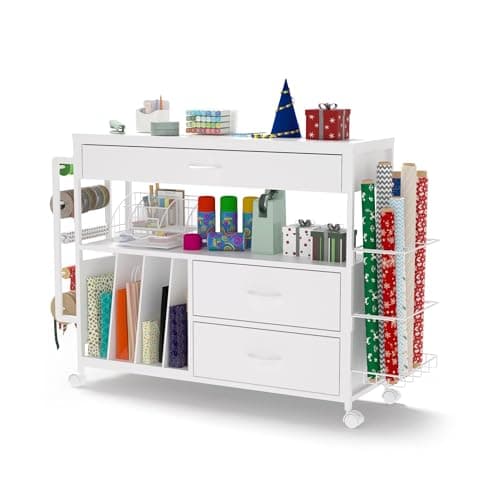
Get the HIDODO rolling cart if the station may own floor space: it is the only one we have read that publishes a work surface, a roll compartment count and a ribbon holder, and whose bullet figures match its own dimension field — 20+ rolls, a 25.6 x 11.8 in top, a frame 31.1 in tall. If floor space is the constraint, the station is a Zober 40.5-inch under-bed organizer plus the table you already own, for a fraction of the money. And if your rolls are the 40-inch Christmas kind, no cart here contains them — the over-door bag is the only format that publishes that length.
A station is four things
The word “station” sells carts, and a cart is only one of the four parts. If any of the four is missing the station stops getting used, and the missing one is almost always the fourth.
- A surface. Something you can lay a sheet on and cut without moving anything first. It does not have to be part of the product — a desk, a dining table or a bed all work — but a product that claims to be the surface should publish how big that surface is.
- Roll storage sized to your longest roll. Not to an average roll. Everyday paper is commonly 30 inches and Christmas paper commonly 40, and the gap between those two numbers decides which formats are candidates at all.
- One closed home for ribbon, bows and bags. These are the items storage ruins rather than merely squashes, and they need a lid rather than a rack.
- A tool pocket nothing borrows from. Tape, scissors, tags. This is the part everybody skips, and it is why a station that looked good in October is a pile of paper by December.
How we judged the formats
Four published figures, in this order. We have not assembled or used any of these; the ranking is what each maker commits to in writing, and the gaps are reported as gaps.
- A published work surface. Dimensions for the top, not a photograph of somebody wrapping on it.
- A published roll capacity, and ideally a roll length. Capacity claims in this category run from 3 to more than 20 for carts of similar size, and none of the carts publishes a maximum roll length.
- Somewhere closed for the accessories. Drawers, a lidded box or interior pockets — anything that is not an open sling.
- Footprint, judged over twelve months. A cart is floor space in a room for the whole year, which is a different purchase from a bag that disappears.
Published figures for each station format | Rolling cart | Console cart | Under-bed bag + your table | Over-door bag + your table |
|---|
| Published work surface | 25.6 x 11.8 in | 31.5 x 11.4 in | None (you provide it) | None (you provide it) |
| Published roll capacity | 20+ rolls | 3 to 12 rolls | 18 to 24 rolls | 12 rolls at 40 in |
| Published max roll length | Not published | Not published | 40.5 in interior | 40 in stated |
| Accessory storage | 3-tier ribbon bars | 3 wooden drawers | Interior pockets | Removable tool box |
| Floor space used | 11.8 x 25.6 in, all year | 11.4 x 31.5 in, all year | None | None |
| Published frame height | 31.1 in | 30.5 in | 6 in tall, flat | 48 in tall, 5 in deep |
| Published load rating | Not published | 220 lb | Not applicable | Not published |
Two things fall out of that table. The carts are the only formats that bring their own surface, and they are the only formats that publish no roll length at all. The bags publish the roll length and bring no surface. No product here does both, which is why the honest recommendation for most people is one of the bags plus furniture they already own.
Build it in this order
- 1
Measure your longest roll before buying anything
Stand your longest roll against a tape measure. If it is over 31 inches, no cart on this page contains it and the choice is between the 40.5-inch under-bed organizer and the 48-inch over-door bag.
- 2
Decide whether the station may own floor space all year
A cart is roughly one to two square feet occupied in January, April and July as well as December. If the answer is no, the station is a bag plus a table, and you have just saved most of the money.
- 3
Pick the surface
Either the cart's published top, or the desk or table you will actually use. Check what you have against the 30.5 to 31.1 inches the carts publish, so you know whether you are gaining or losing working height.
- 4
Give ribbon, bows and bags a closed box of their own
Not the open racks on a cart. Bows are the one item here that never recovers from being crushed, and a lidded rigid box is what keeps the weight off them.
- 5
Fill a tool pocket and close it
Tape, scissors, tags, a pen, in interior pockets, a drawer or a zip bag clipped inside. A second roll of tape lives elsewhere in the house for household jobs.
- 6
Put the whole thing where you will stand
Next to the surface, in a dry room. Not a garage: the particle board and fabric in this category are for conditioned rooms, and a station you have to go outside to use is one you stop using.
Which format for which room
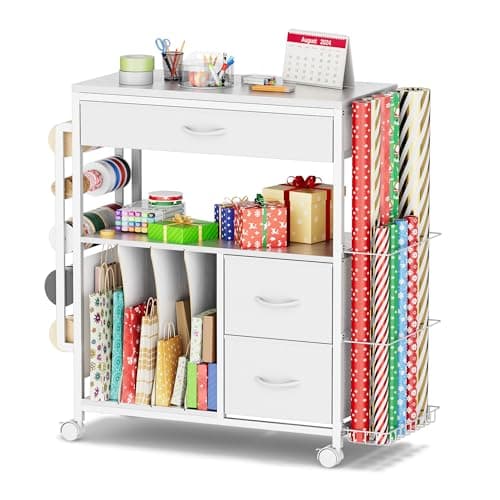
A spare room, office or craft room. This is where the carts earn their money, and choosing between the two is choosing between paper and furniture. The HIDODO publishes more than 20 rolls under a 25.6-inch top; the Anrigeail publishes 3 to 12 rolls under a 31.5-inch top and a 220-pound load rating. If the rolls are the problem, take the first. If you want to wrap on it with the tools in drawers underneath, take the second and accept that it holds a quarter of the paper. Both are ranked against the rest of the category on the best wrapping paper storage carts.
A bedroom with a bed in it. The station is the 40.5-inch Zober organizer under the bed and the nearest table. Six inches of published height clears most bed frames, the interior pockets take the tools, and the floor space cost is zero. This is what we would recommend to most people who asked, and it is the same decision laid out in full on wrap cart versus under-bed bag.
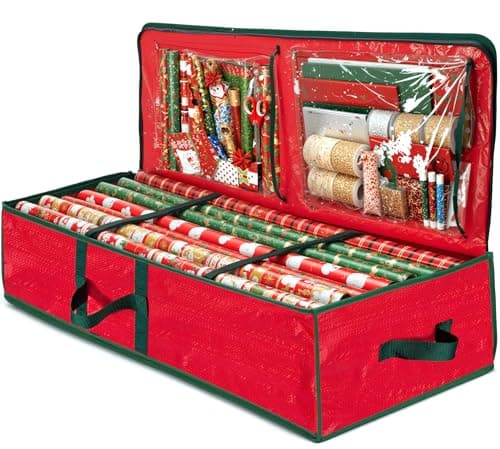
A home with no spare floor and no reachable bed. The over-door bag: 48 inches tall, 5 inches deep, published for 12 rolls of 40-inch paper, with a removable tool box. It is the only format here that publishes a 40-inch roll capacity and uses no horizontal space at all. The trade is that rolls stand on end, so the bottom of each one carries the weight of the roll above it. More over-door and upright options are compared on hanging and upright wrapping paper storage.
The half of the station that is not paper
Ribbon, bows, gift bags, tissue, tape and tags are the part of a station that fails, and they fail differently from paper. Ribbon tangles and recovers. Bows crush and never recover. Bags take a permanent diagonal fold if they are stored open. None of that is solved by a rack.
So the fifth pick here is a rigid lidded box rather than anything wrap-specific: a 66-quart ClearView publishing 19 7/8 x 13 3/8 x 12 7/8 in inside, latching, with walls you can see through. Bows go in last and on top with nothing pressing on them; bags go in first, flattened; ribbon stays on its spool with the tail clipped. The full packing order, and why it is that order, is on storing ribbon, bows and gift bags.
What we would not buy as a station
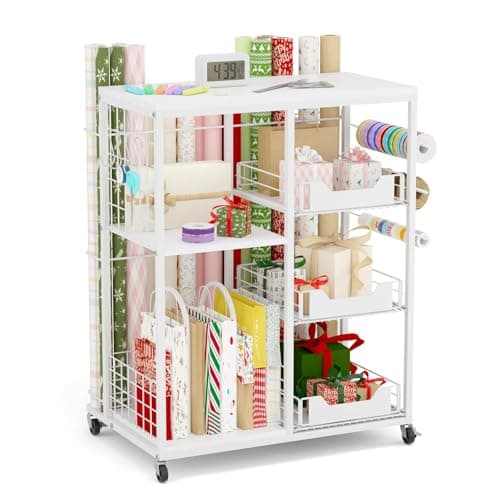
A cart that publishes no dimensions. The PUNLUXU rolling cart states a capacity of 3 to 12 rolls and, on the listing we read, no cart dimensions as a single figure — so there is no published top to wrap on and no published height to compare against your rolls. As roll storage it is a reasonable vertical rack, and vertical storage genuinely is the one arrangement that never creases a part-used sheet. As a station it is unverifiable, and a station is mostly a claim about a surface.
We would also not buy a cart on a roll-count claim alone. Capacity figures in this category run from 3 to more than 40 for carts of broadly similar size, and not one listing states the size of roll it counted. The number that matters is the one you measure yourself, which is why the first step above is a tape measure rather than a basket. Why 40 inches keeps deciding this category is set out on storage for 40-inch rolls.