The short answer
Buy the cart that publishes a number you can check. The HIDODO rolling cart states more than 20 rolls in three slotted compartments under a 25.6 by 11.8 inch top, on a frame 31.1 inches tall, and its bullet figures agree with its own dimension field — which is not true of everything here. For sheer roll count the Aquzee station is taller at 34.6 inches and claims 30 to 40. For a surface to wrap on, the Anrigeail publishes a 220 pound rating and a 31.5 inch top, and holds the fewest rolls of any of them.
What we looked for
A wrap cart is bought on a promise about rolls, and rolls are exactly what these listings are vaguest about. So the ranking runs on the figures a buyer can actually check before the box arrives, in this order.
- A published roll count, and what it counted. Every cart claims a capacity or avoids the subject. None of them says whether the roll in question is a 30-inch everyday roll or a 40-inch jumbo, which is the difference between a rack that holds your paper and one that does not.
- Frame height. The racks are open at the top, so height is not a hard limit; it is how much of a long roll is supported instead of leaning. The spread here is 30.5 to 34.6 inches, and it is the single figure every listing does publish.
- How the rolls are held. Fixed slotted compartments, adjustable rods, or a plain open bin. Rods move to suit the paper you own; slots do not.
- A work surface, or not. Some of these are console carts you can wrap on. Others are racks with a shelf, which is a different product sold under the same search term.
- Load rating and wheels. Published pounds, and how many of the four wheels lock. A cart that rolls while you are cutting paper is worse than no cart.
Everything below comes from the listing each product links to, read on the date this page was published. Where a listing does not publish something, the table says so rather than carrying a guess — the method is the same one on how we pick.
The carts compared
Wrap carts compared on the figures each listing publishes| Cart | Roll capacity stated | Frame height | Work surface | Load rating |
|---|
| HIDODO rolling cart | More than 20 rolls, 3 compartments | 31.1" | 25.6 x 11.8" | Not published |
| Aquzee gift wrap station | 30-40 rolls, 9 adjustable rods | 34.6" | Narrow side shelf | Not published |
| Anrigeail 3-drawer console | 3-12 rolls | 30.5" | 31.5" console top | 220 lb |
| Rsaayekkt compact cart | Not published | 32.68" | Top tray | 20 lb per layer |
| KITIVIALA side-pocket cart | Not published | 30.7" | Wood top | Not published |
| Aquzee adjustable rack (skip) | 30+ rolls, 6 or 9 rods | 32" | Drawer top only | Not published |
Read down the capacity column and the problem with this category is plain. Two listings publish no roll count at all; the ones that do range from 3 rolls to 40 for carts whose footprints are within a few inches of each other. A rack 15 inches wide claiming 30-plus rolls and a console 31.5 inches wide claiming 12 cannot both be measuring the same thing.
The number none of them publish
Not one listing on this page states the longest roll its rack will hold. That is the number the buyer needs, and its absence is the reason this page ranks on frame height instead.
Here is what height actually means on these carts. The roll racks are open at the top, so a roll taller than the frame is not excluded — it stands proud of it, held along the lower part of its length by the rods or slots and free above that. On a 31-inch frame, a 30-inch everyday roll is supported almost end to end. A 40-inch jumbo roll has most of a foot sticking out, leaning against whatever is next to it, which is how a roll develops the bow described on storage for 40-inch rolls. Carts are a 30-inch-roll product that tolerates a 40-inch roll badly.
One listing is worth quoting on this. The HIDODO cart sells its rack as organizing rolls “without the height restrictions of a paper storage bag or box”. An open rack genuinely has no ceiling, so the claim is not false; it is just not a measurement, and it should not be read as an assurance that a jumbo roll is looked after.
Best overall: the HIDODO rolling cart
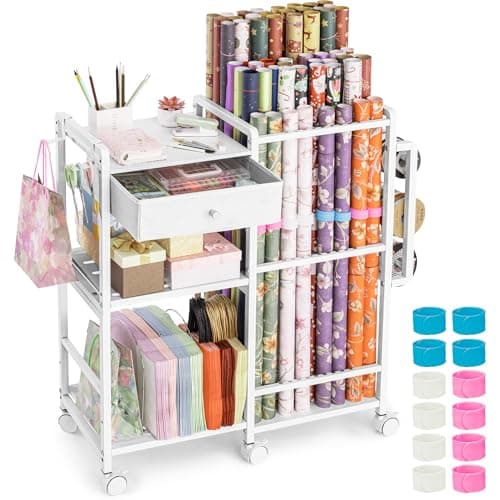
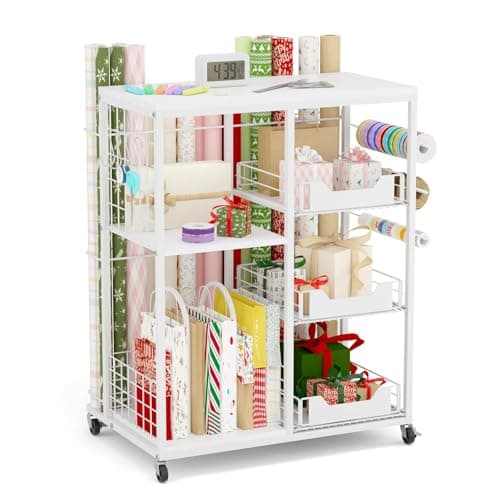
This is the cart whose listing behaves. It states more than 20 rolls in three slotted metal compartments, a tabletop of 25.6 by 11.8 inches, a frame of 11.8 by 25.6 by 31.1 inches, a three-tier ribbon holder on 11-inch bars that lift out, four storage hooks, and four wheels of which two have brakes. The dimensions in the bullets and the dimensions in the listing's own data field are the same numbers — a low bar that half this category fails.
Three compartments rather than one bin is the practical difference in use. Rolls sorted into thirds stay sorted; a single wide bin turns into a leaning stack the first time you pull one from the middle. The removable ribbon bars matter for the same reason, because the alternative is unthreading four spools to change the one at the back.
Two honest caveats. The first is the one every cart here shares: no maximum roll length. The second is that this exact spec sheet — 20 rolls, three drawers, an 11-inch three-tier ribbon holder, 25.6 by 11.8 inches, 31.1 inches tall — also appears on Amazon under a different brand name at a slightly higher price, and that listing's dimension field says 23.6 inches wide while its bullets say 25.6. The factory is the constant here, not the brand. Buy on price between them, and prefer the one whose numbers agree with themselves.
Best for the most rolls: the Aquzee station
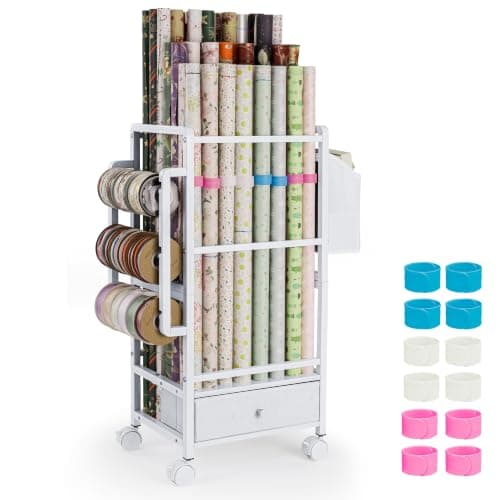
At 34.6 inches this is the tallest frame on the page, which by the logic above means more of a long roll is held rather than leaning. It holds rolls on nine adjustable rods with silicone sleeves, ships with twelve slap-band clips, carries a U-shaped gift bag holder on the bottom and a ribbon holder on the side, and states FSC-certified wood and metal with four lockable wheels.
Adjustable rods are genuinely better than fixed slots. Spacing that suits four fat rolls suits eleven thin ones badly, and a rod you can move is the only fix. The clips are a small thing that matters more than it sounds: a part-used roll in an open rack unwinds itself, and twelve bands in the box is twelve you do not buy separately.
The capacity claim is where the caution goes. Thirty to forty standard rolls is the largest number on this page, and the listing never says what standard means. No load rating appears anywhere. And in the listing photos the flat top is a narrow shelf beside the rack, holding a pen cup, rather than a surface to wrap a box on. Buy it as a rack and it is the best rack here; buy it as a station and the name oversells it.
Best work surface: the Anrigeail console
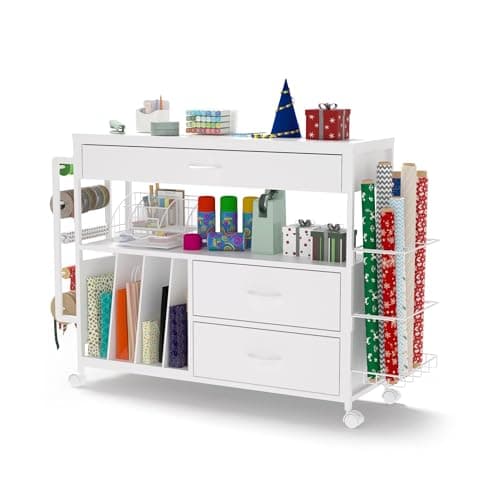
The console is the other shape this category comes in: 31.5 inches wide, 30.5 tall, with three wooden drawers, a gift bag compartment, a ribbon roller on the side and a roll rack on the end. It publishes a 220 pound load rating on a steel frame with particle board panels, and silent casters with brakes.
That top is the reason to buy it. At 31.5 inches across it is the widest work surface here, with the tools in drawers directly beneath it, and 220 pounds is more than twice what any rack on this page claims to carry. Be realistic about the depth, though: 11.4 inches is a bench for holding tape, scissors and a roll in progress, not a table you can spread a large box out on. Wooden drawers instead of fabric slings is the second reason — fabric drawers are the first thing to sag on a cart that lives loaded.
The cost is capacity. Three to twelve rolls is the lowest published figure on the page, and it is attached to the highest price. At 30.5 inches it is also among the shortest frames, so a long roll leans further out of the end rack than it would on the Aquzee. Particle board wants a dry room, not a garage — the same constraint that rules out most of the fabric and board products in small-space and under-bed wrap storage.
Best compact pick: the Rsaayekkt cart
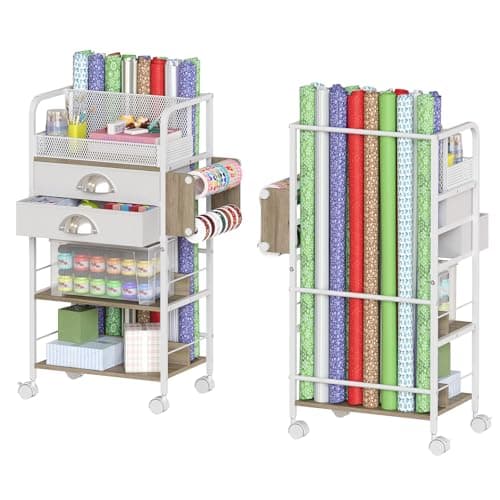
The cheapest cart here that still publishes its own footprint, and it publishes it in the bullets where people read rather than only in a data field: 16.54 by 11.4 by 32.68 inches. That is a little over 1.3 square feet of floor, matched only by the KITIVIALA below, with two fabric drawers, a top tray, a ribbon spindle on the side and four swivel wheels of which two lock.
It is also the clearest example of the category's blind spot. A cart sold to hold wrapping paper rolls says only that it holds “multiple rolls” and never counts them. The stated 20 pounds per layer is the lowest rating here, and the build is steel and particle board. If you own a dozen rolls and a narrow gap beside a desk, it is the sensible buy. If you own thirty, nothing on the listing suggests this is the cart for them.
Best for craft rolls: the KITIVIALA cart
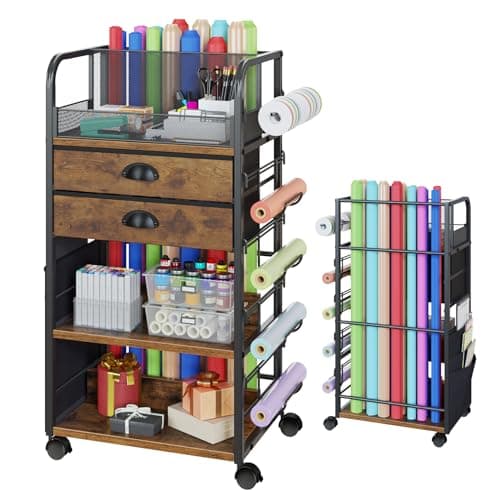
This one is honest about being a craft cart. A rear compartment takes long wrapping paper rolls, three vertical fabric pockets on the left hold scissors, tape and flat gift bags, and four two-inch hooks on the right are described specifically for vinyl rolls or short tubes. The top is wood on a carbon steel frame, and two of the four swivel wheels lock.
If a Cricut lives in the same room, that hook wall is worth more than another few roll slots. For wrapping paper alone it is the weakest of the five: 30.7 inches is the shortest frame here, so a long roll is supported least; the rear compartment is described but never measured; and like the Rsaayekkt it publishes no roll count. Half of what you are paying for is storage for things that are not wrapping paper.
Skip: the Aquzee adjustable rack
Same maker as the station ranked second, and a cheaper way into adjustable rods with the same twelve clips in the box. The problem is in a single bullet. Its heading reads “Upgraded 6 Adjustable Rods & Large Capacity”, and the sentence directly beneath it says “The 9 rods can be easily adjusted”. Rods are the entire capacity mechanism on a rack like this, so the listing cannot agree with itself about the one component that decides what you are buying.
On top of that it claims 30-plus standard rolls in a frame 15.1 inches wide, which is the least plausible number on a page that is already generous with them, and there is no work surface beyond the drawer top. The same maker's taller station publishes a consistent rod count for roughly twenty dollars more. Skipping this is not a judgment on the hardware; it is a refusal to buy from a description that has not been checked.
Measure these three things first
- 1
Measure your longest roll, end to end
Not the paper width printed on the label -- the tube itself. Everyday rolls run around 30 inches and jumbo rolls around 40, and there is no standard, so the roll in your closet is the only one that counts.
- 2
Count the rolls you actually keep from year to year
Most people keep far fewer than they think. If the honest number is under a dozen, the capacity claims on this page stop mattering and footprint becomes the deciding figure.
- 3
Measure the floor the cart will live on all year
A cart is furniture, not seasonal storage. Mark its footprint on the floor with tape and leave it there a week before buying -- the published footprints here run from about 1.3 to 2.5 square feet, plus room to open the drawers.
When a cart is the wrong answer
For most households it is. A cart holds a fraction of what a 40-inch under-bed bag takes, costs several times as much, and stands in a room for the ten months nobody is wrapping anything. It earns its place if you wrap birthdays all year, run a small shop, or share the cart with craft supplies; it does not if Christmas is the whole use case. That trade-off is worked through properly on wrap cart vs under-bed bag, and the wall-mounted and door-hung alternatives are on hanging and upright storage.
What a cart does genuinely fix is creasing. Paper stored on its side rests along one line of contact for months and takes a set there; upright storage avoids it entirely. If your rolls come out of storage with a crease down every sheet, that is the problem a cart solves, and the only one it solves outright.
Limits of this page
Two things to be straight about. First, this is a category almost entirely made up of unbranded sellers: the same cart appears under several names, listings change titles, and a model available today may be gone next season. Every cart here had a live listing with a new in-stock offer when the page was written, which is the only availability claim we will make.
Second, these are published-specification comparisons, not hands-on tests. Nobody here loaded 40 pounds of paper onto a 20 pound shelf to find out what happens. Where a figure is missing the page says it is missing, and where a listing contradicts itself the page quotes both versions and lets that decide the ranking.