The short answer
Yes — and the holiday-branded bin was usually the wrong buy. A tote is a published volume with a lid, and nothing about it is seasonal. Buy on published interior dimensions and a shared stacking footprint instead: the Sterilite 27 Gal. Stacker publishes 20 1/8 x 14 1/8 x 18 7/8 in inside and shares one lid size across three capacities, so every season you own stacks square. The one exception is divided containers, where the division is sized to an object rather than to a holiday.
What is actually holiday-specific, and what is not
We rank containers from six categories on this site, and the honest summary is that two thirds of them are general-purpose products that happen to be good at a holiday job. It is worth separating the two, because the distinction is what decides whether a second set of bins is a purchase or a waste.
Which properties are genuinely seasonal| Property | Seasonal? | Why |
|---|
| Published interior dimensions | No | A measurement. It answers any object, in any month |
| Latch or gasket closure | No | A closure is a closure |
| Stacking footprint | No | Geometry. Shared lid sizes matter more than themes |
| Clear or opaque walls | No | Identification and light exposure, not season |
| 3-inch divided cells | Yes, in effect | Sized to a bauble. Useful for anything of that size and shape |
| A published figure height | Yes, in effect | Sized to a standing figurine, which is a Christmas and a Halloween shape alike |
| A wreath-diameter container | Yes | A circular container is a genuinely single-purpose object |
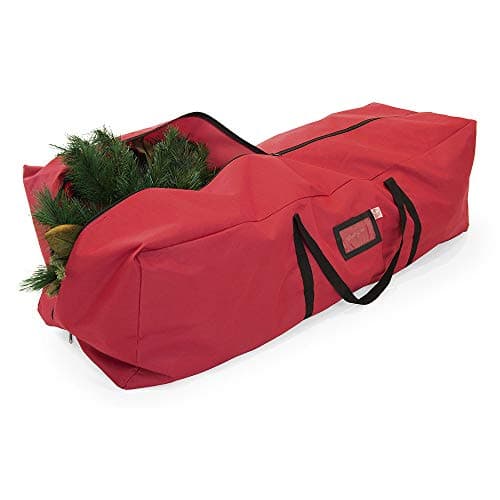
| A tree-shaped bag | Yes | Nothing else in a house is 65 inches long and 15 inches square |
Read down the “no” rows and you have the shopping list for a household that stores three or four seasons. Read the “yes” rows and you have the four products worth buying once, for the one holiday that needs them.
What to buy on, in order
- Published interior dimensions. This is the whole argument. An interior figure lets you check a 13-inch ornament box, a 16-inch nutcracker or a folded inflatable against the container before you buy it. Most bin makers publish only the outside, and the gap between the two is substantial: the Stacker's 25 3/4-inch outside length buys 20 1/8 inches of usable space.
- A shared stacking footprint. If Halloween, Easter and Christmas share a shelf, the bins should share a lid size so the stack is a column rather than a staircase. One maker's line doing this across three capacities is worth more than any individual bin's features.
- Identification without opening. Clear walls, or opaque walls and a system. The cost of getting this wrong is paid every retrieval, which over four seasons a year is the most frequent cost in the whole category.
- Shape, matched to the awkward objects. Long and soft wants a long bag. Standing and fragile wants a divided tray with a published height. Everything else wants a rectangular box.
The arrangement we would actually build
Volume in stackers. One 27-gallon Stacker per season for the bulk — plastic foliage, fabric, tinsel, non-fragile decor. The published interior height of 18 7/8 in stands a 13-inch divided box upright with room over it, and the shared lid means the seasons stack rather than teeter. Twenty-seven gallons loaded is heavy, which is the real argument against going bigger.
One category per latch box. Below the stackers, 66-quart ClearView boxes publishing 19 7/8 x 13 3/8 x 12 7/8 in inside, clear so a Halloween bin is identifiable from across a garage without a label and without opening it. The latch matters because these are the boxes that get carried by the ends. The clear versus opaque trade, including the UV-yellowing caveat, is on clear versus opaque storage bins.
Opaque where there is a window. The Roughneck publishes both inside and outside dimensions, and its opaque walls keep light off ribbon, fabric and printed card through ten months. Opaque means labeling stops being optional, which is a system rather than a purchase — the one we use is on labeling so you find it next year.
Long and soft in a multi-use bag. The 48-inch multi-use bag publishes 48 x 14 x 14 in, and its own listing states its contents as garlands, small wreaths, stockings and miscellaneous supplies. That is a shape, not a season: an Easter garland, a string of bunting and a Halloween skeleton are the same storage problem. No rigid bin in this category is built long and thin, which is the entire reason to own one. It is also a dry-shelf product in any month — the trade is on Christmas storage bags versus bins.
The exception: divided boxes sized to an object
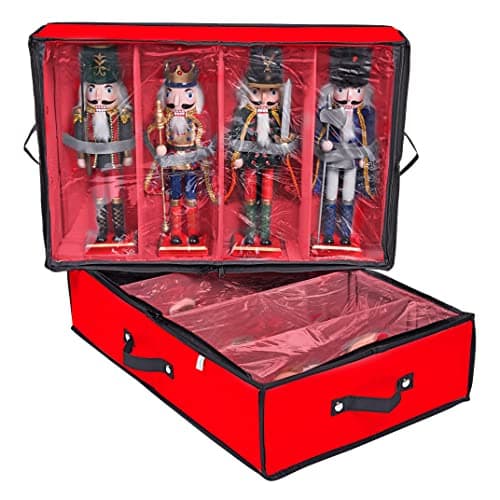
This is where a holiday-branded product genuinely earns its place, and it is worth being precise about why. The ProPik figures box is sold as Christmas storage, and the figure it publishes is four figurines up to 16 inches per box in 24 x 16 x 6 in, with adjustable dividers and a loop per section to stop a heavy piece sliding.
A published figure height is almost unheard of in this category, which specifies itself in ornament counts. And a standing resin figure 16 inches tall is not a Christmas object; it is a shape. Nutcrackers, Santas, Halloween figures, spring and harvest pieces are all the same storage problem, and nothing with a 3-inch cell grid takes any of them. Buy it once, use it in four seasons. Its own limits are honest ones: four figures per box is not a collection built over decades, six inches of internal height means a 16-inch figure lies down, and it was showing scarce stock when we checked. The wider field for tall and boxy pieces is on figurine and village storage boxes.
What we would not buy twice
An undivided tote because it is red and green. If the only seasonal thing about a container is the lid color or a printed snowflake, you are paying for the print, and the same maker's general-purpose line frequently publishes better figures. We have one bin on this site that we tell people to skip for exactly this kind of reason: the interior dimensions are not published, so there is nothing to check, which is disqualifying whatever season it is for.
And a second set of containers before you have counted the first. Most households overbuy volume and underbuy division: the bulk fits in fewer, larger boxes than expected, and the fragile and awkward items need more specific ones. Counting first is the whole method on holiday storage containers by capacity.